
Homework Answers
Ans) the correct option is a) the demand for Canadian dollars increases.
The yen is appreciated against the dollar, and the dollar has depreciated against the yen.
Add Answer to:
Suppose the dollar-yen foreign exchange rate changes from 140 yen per dollar to 130 yen per...
Consider the market for Canadian dollars. If the exchange rate rises from 2 Mexican pesos per...
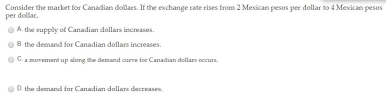 Consider the market for Canadian dollars. If the exchange rate rises from 2 Mexican pesos per dollar to 4 Mexican pesos per dollar, A. the supply of Canadian dollars increases. B. the demand for Canadian dollars increases. OC.a movement up along the demand curve for Canadian dollars occurs. OD. the demand for Canadian dollars decreases.
If the exchange rate between the Japanese Yen and the US Dollar changes from 100 to...
If the exchange rate between the Japanese Yen and the US Dollar changes from 100 to 110 yen per dollar, _____. A. the yen has appreciated against the dollar B. the dollar has depreciated against the yen C. the dollar has appreciated against the yen D. the cost of a yen has increased in terms of dollars
Exchange rate (U.S. cents per Canadian dollar) 120 Draw a demand for dollars curve. Label it...
 Exchange rate (U.S. cents per Canadian dollar) 120 Draw a demand for dollars curve. Label it D. Draw a supply of dollars curve. Label it S. Draw a point at the equilibrium quantity and equilibrium exchange rate. Draw an arrow between the D and S curves that indicates a price at which there is a surplus of dollars. Label it. O O O 1104 When there is a surplus of dollars in the foreign exchange market, _ 1007 O A....
If the cost of the yen per dollar changes from 100 to 110 yen per dollar,...
If the cost of the yen per dollar changes from 100 to 110 yen per dollar, a. The dollar has depreciated against the yen b. the cost of a yen has increased in terms of dollars c. The dollar has appreciated against the yen. d. The yen has appreciated against the dollar.
Suppose that the euro is trading at $1.25 per euro in the foreign exchange market. Next,...
 Suppose that the euro is trading at $1.25 per euro in the foreign exchange market. Next, suppose that the exchange rate falls to $0.88 per euro, due to falling interest rates in the eurozone. The following graph shows the supply and demand curves for dollars in the foreign exchange market. On the following graph, shift either the supply curve for dollars or the demand curve for dollars to reflect the influence of "carry trade" (in isolation from other factors that...
As the price of foreign exchange decreases relative to the U.S. dollar, the: a. U.S. demand...
As the price of foreign exchange decreases relative to the U.S. dollar, the: a. U.S. demand curve for foreign exchange shifts to the right. b. amount of foreign currency required to purchase a unit of U.S. dollar increases. c. goods made in foreign countries become cheaper for Americans. d. products made in the U.S. become cheaper for foreigners. e. supply curve of foreign exchange to U.S. markets decreases.
1a. In the foreign exchange market, a decrease in the world demand for Japanese exports a....
1a. In the foreign exchange market, a decrease in the world demand for Japanese exports a. shifts the demand curve for yen leftward, which causes the yen to appreciate. b. shifts the demand curve for yen rightward, which causes the yen to appreciate. c. shifts the demand curve for yen rightward, which causes the yen to depreciate. d. shifts the demand curve for yen leftward, which causes the yen to depreciate. 1b. A relatively high rate of inflation in the...
Suppose the exchange rate between the Canadian dollar (CS) and the American dollar (USS) changes from C$1.340/US$ to C$1.325/USS, but the Canadian government wants to maintain a fixed exchange rate o...
 Suppose the exchange rate between the Canadian dollar (CS) and the American dollar (USS) changes from C$1.340/US$ to C$1.325/USS, but the Canadian government wants to maintain a fixed exchange rate of C$1.340/US$. What should the Bank of Canada do? a. Stop trading with the U.S. so that fewer U.S. dollars will flow into Canada. b. Sell U.S. dollars (buy Canadian dollars). c. Sell Canadian dollars (buy U.S. dollars). d. Purchase British pounds and sell French francs.
Suppose the exchange rate...
Suppose the exchange rate between the Canadian dollar (CS) and the American dollar (USS) changes from C$1.340/US$ to C$1.325/USS, but the Canadian government wants to maintain a fixed exchange rate of C$1.340/US$. What should the Bank of Canada do? a. Stop trading with the U.S. so that fewer U.S. dollars will flow into Canada. b. Sell U.S. dollars (buy Canadian dollars). c. Sell Canadian dollars (buy U.S. dollars). d. Purchase British pounds and sell French francs.
Suppose the exchange rate...
Suppose that the euro/US dollar exchange rate changes from 1,3 dollar per euro to 1,1 dollar...
Suppose that the euro/US dollar exchange rate changes from 1,3 dollar per euro to 1,1 dollar per euro. Then: a) The euro has depreciated against the dollar. b) This will decrease the demand for Eurozone goods by the United States. c) This will lead to a rise in exports by the United States to the Eurozone. d) The euro has appreciated against the dollar.
15) When the nominal exchange rate in terms of dollars per yen rises, A) the dollar...
 15) When the nominal exchange rate in terms of dollars per yen rises, A) the dollar buys more yen and the dollar has depreciated. B) the dollar buys fewer yen and the dollar has depreciated. C) the dollar buys more yen and the dollar has appreciated. D) the dollar buys fewer yen and the dollar has appreciated.
 Consider the market for Canadian dollars. If the exchange rate rises from 2 Mexican pesos per dollar to 4 Mexican pesos per dollar, A. the supply of Canadian dollars increases. B. the demand for Canadian dollars increases. OC.a movement up along the demand curve for Canadian dollars occurs. OD. the demand for Canadian dollars decreases.
 Exchange rate (U.S. cents per Canadian dollar) 120 Draw a demand for dollars curve. Label it D. Draw a supply of dollars curve. Label it S. Draw a point at the equilibrium quantity and equilibrium exchange rate. Draw an arrow between the D and S curves that indicates a price at which there is a surplus of dollars. Label it. O O O 1104 When there is a surplus of dollars in the foreign exchange market, _ 1007 O A....
 Suppose that the euro is trading at $1.25 per euro in the foreign exchange market. Next, suppose that the exchange rate falls to $0.88 per euro, due to falling interest rates in the eurozone. The following graph shows the supply and demand curves for dollars in the foreign exchange market. On the following graph, shift either the supply curve for dollars or the demand curve for dollars to reflect the influence of "carry trade" (in isolation from other factors that...
 Suppose the exchange rate between the Canadian dollar (CS) and the American dollar (USS) changes from C$1.340/US$ to C$1.325/USS, but the Canadian government wants to maintain a fixed exchange rate of C$1.340/US$. What should the Bank of Canada do? a. Stop trading with the U.S. so that fewer U.S. dollars will flow into Canada. b. Sell U.S. dollars (buy Canadian dollars). c. Sell Canadian dollars (buy U.S. dollars). d. Purchase British pounds and sell French francs.
Suppose the exchange rate...
Suppose the exchange rate between the Canadian dollar (CS) and the American dollar (USS) changes from C$1.340/US$ to C$1.325/USS, but the Canadian government wants to maintain a fixed exchange rate of C$1.340/US$. What should the Bank of Canada do? a. Stop trading with the U.S. so that fewer U.S. dollars will flow into Canada. b. Sell U.S. dollars (buy Canadian dollars). c. Sell Canadian dollars (buy U.S. dollars). d. Purchase British pounds and sell French francs.
Suppose the exchange rate...
 15) When the nominal exchange rate in terms of dollars per yen rises, A) the dollar buys more yen and the dollar has depreciated. B) the dollar buys fewer yen and the dollar has depreciated. C) the dollar buys more yen and the dollar has appreciated. D) the dollar buys fewer yen and the dollar has appreciated.
Most questions answered within 3 hours.
-
Where is the error in this code sequence?
String s1 = "Hello";
String s2 = "ello";...
asked 11 months ago -
Financial data for Joel de Paris, Inc., for last year
follow:
Joel de Paris, Inc.
Balance...
asked 11 months ago -
Consider this reaction:
Al2(SO4)3 (aq)+ BaCl3
(aq) Al2Cl6 (aq)- +
3BaSO4(s) . What is the...
asked 11 months ago -
Suppose that Savneet is considering increasing her
recent random sample from 20 car rentals to 40...
asked 11 months ago -
Trucks arrive at an unloading terminal at an average rate of 120
per hour.
Trucks arrive...
asked 11 months ago -
Why are methanol and ethanol completely soluble in water while
octanol is not very little soluble....
asked 11 months ago -
A facilities manager at a university reads in a research report
that the mean amount of...
asked 11 months ago -
When the CuSO4 is rehydrated by adding water to the anhydrous
compound, is this an endothermic...
asked 11 months ago -
A ray of sunlight is passing from diamond into crown glass; the
angle of incidence is...
asked 11 months ago -
A block of mass 0.249 kg is placed on top of a light, vertical
spring of...
asked 11 months ago -
how do the kidneys compensate in the presences of acidosis
a) trigger hyperventilate
b) reserve acid...
asked 11 months ago -
Question 501 pts
The rental rate of capital to the firm increases. Which of the
following...
asked 11 months ago