Suppose that the only tax levied in the economy is the business income tax at a...
Suppose that the only tax levied in the economy is the business
income tax at a rate of 40%. The government is planning to finance
a public project by selling $10 million worth of bonds to the
public. It is estimated that the bond sale will displace $6 million
worth of private consumption expenditure, and $4 million worth of
private investment. The market rate of interest is 4% and all
private investment projects are perpetuities.
a) what is the before-tax rate of return on private investment.
b)what is the present value, at the market rate of interest, of
the before-tax return on $1 worth of private investment?
c) what is the opportunity cost to the economy of the reduction in
private consumption and investment resulting from the bond
sale?
d) what is the marginal cost of public funds obtained by borrowing from the public?
Homework Answers
a) Before-tax rate of return on private investment:
The before-tax rate of return on private investment is the return that an investor earns before paying taxes
In the given question, the before-tax rate of return on private investment is the market rate of interest of 4%
b) Present value, at the market rate of interest, of the before tax-return on $1 worth of private investment:
The market rate of interest is given to be 4%
4% of $1= $0.04
Hence, the present value of the before tax-return on $1 worth of private investment= $1+ $0.04= $1.04
c) Opportunity cost to the economy of the reduction in private consumption and investment resulting from the bond sale:
The opportunity cost of a choice is what had to be given up to make that choice.
In the given question, it is said that the government's plan to sell $10 million worth of bonds will displace $6 million worth of private consumption expenditure, and $4 million worth of private investment.
Hence, for the government to sell $10 million worth of bonds, the economy would have to forgo $6 million worth of private consumption expenditure, and $4 million worth of private investment.
$4 million worth of private investment would have in turn yielded a return of 4%= 4% of $4 million= $160,000
Hence the opportunity cost to the economy from the bond sale is $6 million worth private consumption expenditure, $4 million worth of private investment, and $160,000 worth interest
4) Marginal cost of public funds obtained:
The marginal cost of public funds is the measure of the loss incurred by the society in raising additional revenues to finance government spending.
The marginal cost of public funds obtained by borrowing from the public is the interest rate of 4% in the given question.
Add Answer to:
Suppose that the only tax levied in the economy is the business
income tax at a...
The latest figures show that Thailand’s economy grew by 3.5% in the second quarter, putting it on track for 3–3.5% growth for the whole of 2016. Thailand has managed to boost its growth after several quarters of disappointing performance by increasing pub
 The latest figures show that Thailand’s economy grew by 3.5% in
the second quarter, putting it on track for 3–3.5% growth for the
whole of 2016. Thailand has managed to boost its growth after
several quarters of disappointing performance by increasing public
sector investment in several large infrastructure projects,
including roads, railways and airports. These projects will run
over the next 3 to 5 years and are worth several hundred billion
baht, Thailand’s currency. It is hoped that this public...
The latest figures show that Thailand’s economy grew by 3.5% in
the second quarter, putting it on track for 3–3.5% growth for the
whole of 2016. Thailand has managed to boost its growth after
several quarters of disappointing performance by increasing public
sector investment in several large infrastructure projects,
including roads, railways and airports. These projects will run
over the next 3 to 5 years and are worth several hundred billion
baht, Thailand’s currency. It is hoped that this public...
6. Suppose the economy is characterized by the following behavioral equations: C = 1,500+.6YD I= 2.000...
 6. Suppose the economy is characterized by the following behavioral equations: C = 1,500+.6YD I= 2.000 - 10,000 G= 2,000 T= 2.000 a. At an interest rate of 10%, solve for equilibrium income (Y). disposable income (Y). consumption (C), investment (1), private saving, and public saving. b. What is the marginal propensity to consume in this economy? c. Now suppose that instead of taxes being a fixed quantity, taxes vary with income (as in many countries like the United States)...
Suppose $200 worth of government bonds are sold on the market to raise public funds, and...
Suppose $200 worth of government bonds are sold on the market to raise public funds, and that $150 of this is diverted from current private consumption spending, and $50 is from current private investment spending. The tax rate on the returns to private investment is 20%. a) calculate 1. the total cost to the economy of raising the $200 of public funds 2. the deadweight loss 3. the marginal cost per dollar of public funds raised. b) if this project...
Assume that for the entire business sector of the economy there is $5 worth of investment...
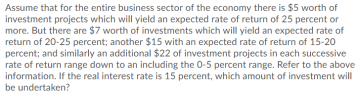 Assume that for the entire business sector of the economy there is $5 worth of investment projects which will yield an expected rate of return of 25 percent or more. But there are $7 worth of investments which will yield an expected rate of return of 20-25 percent; another $15 with an expected rate of return of 15-20 percent; and similarly an additional $22 of investment projects in each successive rate of return range down to an including the 0-5...
Assume that for the entire business sector of the economy there is $0 worth of investment...
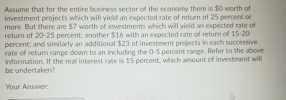 Assume that for the entire business sector of the economy there is $0 worth of investment projects which will yield an expected rate of return of 25 percent or more. But there are $7 worth of investments which will yield an expected rate of return of 20-25 percent; another $16 with an expected rate of return of 15-20 percent; and similarly an additional $23 of investment projects in each successive rate of return range down to an including the 0-5...
What is crowding out? O a reduction in consumption and investment spending that results from government...
 What is crowding out? O a reduction in consumption and investment spending that results from government borrowing O a reduction in consumption and investment spending that results from increased international trade O a reduction in government borrowing resulting from increases in consumption and investment spending O a reduction in investment, but not consumption, that results from government borrowing O a reduction in consumption, but not investment, that results from government borrowing are a mechanism by which crowding out occurs. OIncreases...
9. A__ is a tax on imports levied by the federal government. a. tariff b. sunk...
 9. A__ is a tax on imports levied by the federal government. a. tariff b. sunk cost C. foreign trade zone d. tactical cost 10. The starting point for analyzing the factors that cause a difference between actual and budgeted profit is the a. sales price variance b. gross profit variance C. sales volume variance d. contribution margin variance TRUE FALSE 9. Since depreciation is allocated to future periods, it should be considered a relevant cost in a make-or-buy decision....
Suppose there was a wave of business optimism in the economy. What would the impact be...
 Suppose there was a wave of business optimism in the economy. What would the impact be on the dynamic aggregate demand curve? Awave of business optimism would investment and therefore increase aggregate expenditure at each real Interest rate. This would be reflected in a shift to the night of the dynamic aggregate demand curve. Economy A and Economy Bare similar in every way except that in Economy A, 80 percent of aggregate expenditure is sensitive to changes in the real...
1. The economy has 8 million units of capital and 8 million units of labor. The...
1. The economy has 8 million units of capital and 8 million units of labor. The production function is and A = 1. The consumption function is: C = 1.5 million + 0.75 (Y-T) Investment demand is: I = 3 million – 0.2 million x (r%) Taxes (T) are 2 million. Government purchases (G) are 1 million. Given this information, answer the following questions: a. What it total output (Y) in this economy equal to? b. What is disposable income...
6. Suppose there is a surplus in the market for loanable funds. Is the interest rate...
6. Suppose there is a surplus in the market for loanable funds. Is the interest rate above or below its equilibrium level? How do saving and investment at this interest rate be compared? Which one is greater? 7. If at some interest rate desired investment is $400 billion, desired private saving is $600 billion, and the budget deficit is $300 billion, is there a surplus or a shortage in the market for loanable funds? What does this imply would happen...
 The latest figures show that Thailand’s economy grew by 3.5% in
the second quarter, putting it on track for 3–3.5% growth for the
whole of 2016. Thailand has managed to boost its growth after
several quarters of disappointing performance by increasing public
sector investment in several large infrastructure projects,
including roads, railways and airports. These projects will run
over the next 3 to 5 years and are worth several hundred billion
baht, Thailand’s currency. It is hoped that this public...
The latest figures show that Thailand’s economy grew by 3.5% in
the second quarter, putting it on track for 3–3.5% growth for the
whole of 2016. Thailand has managed to boost its growth after
several quarters of disappointing performance by increasing public
sector investment in several large infrastructure projects,
including roads, railways and airports. These projects will run
over the next 3 to 5 years and are worth several hundred billion
baht, Thailand’s currency. It is hoped that this public...
 6. Suppose the economy is characterized by the following behavioral equations: C = 1,500+.6YD I= 2.000 - 10,000 G= 2,000 T= 2.000 a. At an interest rate of 10%, solve for equilibrium income (Y). disposable income (Y). consumption (C), investment (1), private saving, and public saving. b. What is the marginal propensity to consume in this economy? c. Now suppose that instead of taxes being a fixed quantity, taxes vary with income (as in many countries like the United States)...
 Assume that for the entire business sector of the economy there is $5 worth of investment projects which will yield an expected rate of return of 25 percent or more. But there are $7 worth of investments which will yield an expected rate of return of 20-25 percent; another $15 with an expected rate of return of 15-20 percent; and similarly an additional $22 of investment projects in each successive rate of return range down to an including the 0-5...
 Assume that for the entire business sector of the economy there is $0 worth of investment projects which will yield an expected rate of return of 25 percent or more. But there are $7 worth of investments which will yield an expected rate of return of 20-25 percent; another $16 with an expected rate of return of 15-20 percent; and similarly an additional $23 of investment projects in each successive rate of return range down to an including the 0-5...
 What is crowding out? O a reduction in consumption and investment spending that results from government borrowing O a reduction in consumption and investment spending that results from increased international trade O a reduction in government borrowing resulting from increases in consumption and investment spending O a reduction in investment, but not consumption, that results from government borrowing O a reduction in consumption, but not investment, that results from government borrowing are a mechanism by which crowding out occurs. OIncreases...
 9. A__ is a tax on imports levied by the federal government. a. tariff b. sunk cost C. foreign trade zone d. tactical cost 10. The starting point for analyzing the factors that cause a difference between actual and budgeted profit is the a. sales price variance b. gross profit variance C. sales volume variance d. contribution margin variance TRUE FALSE 9. Since depreciation is allocated to future periods, it should be considered a relevant cost in a make-or-buy decision....
 Suppose there was a wave of business optimism in the economy. What would the impact be on the dynamic aggregate demand curve? Awave of business optimism would investment and therefore increase aggregate expenditure at each real Interest rate. This would be reflected in a shift to the night of the dynamic aggregate demand curve. Economy A and Economy Bare similar in every way except that in Economy A, 80 percent of aggregate expenditure is sensitive to changes in the real...
Most questions answered within 3 hours.
-
Where is the error in this code sequence?
String s1 = "Hello";
String s2 = "ello";...
asked 11 months ago -
Financial data for Joel de Paris, Inc., for last year
follow:
Joel de Paris, Inc.
Balance...
asked 11 months ago -
Consider this reaction:
Al2(SO4)3 (aq)+ BaCl3
(aq) Al2Cl6 (aq)- +
3BaSO4(s) . What is the...
asked 11 months ago -
Suppose that Savneet is considering increasing her
recent random sample from 20 car rentals to 40...
asked 11 months ago -
Trucks arrive at an unloading terminal at an average rate of 120
per hour.
Trucks arrive...
asked 11 months ago -
Why are methanol and ethanol completely soluble in water while
octanol is not very little soluble....
asked 11 months ago -
A facilities manager at a university reads in a research report
that the mean amount of...
asked 11 months ago -
When the CuSO4 is rehydrated by adding water to the anhydrous
compound, is this an endothermic...
asked 11 months ago -
A ray of sunlight is passing from diamond into crown glass; the
angle of incidence is...
asked 11 months ago -
A block of mass 0.249 kg is placed on top of a light, vertical
spring of...
asked 11 months ago -
how do the kidneys compensate in the presences of acidosis
a) trigger hyperventilate
b) reserve acid...
asked 11 months ago -
Question 501 pts
The rental rate of capital to the firm increases. Which of the
following...
asked 11 months ago