1) If the United States imposes a tariff on Honduran blueberries to retaliate against the quotas Honduras previously placed on US goods, then the United States will experience:
a. an additional increase in total surplus
b. a additional decrease in total surplus
c. both an increase in total surplus is possible and a decrease in total surplus is possible
d. no additional change in total surplus
2) Tariffs on imported goods are politically useful because:
a. they generate revenue that can be used to fund public projects
b. they help domestic producers who lobby for tariffs on goods they produce domestically
c. they help domestic consumers who lobby for tariffs on goods they purchase
d. a and b are true
e. b and c are true
3) True or False: Imports decrease the total surplus of a country while Exports increase the total surplus of a country.
4) Refer to Figure 9-1. With trade, Scotland will
a. export 11 units of wool.
b. export 5 units of wool.
c. import 15 units of wool.
d. import 6 units of wool.
*I think the answer might be C for 4 but I am not sure.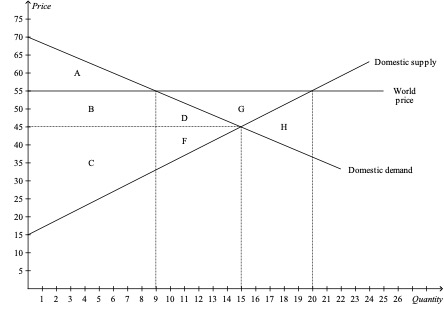
Homework Answers
a) If the US is retaliating then they will experience an additional decrease in the total surplus in the market. the answer is "B".
b) "D"
They raise the revenue of the government and also help the local producers in the market who lobby hard in the market.
c) False, they both increase the total surplus of the country.
d) "A"
They will export 11 units of wool in the international market.
Add Answer to:
1) If the United States imposes a tariff on Honduran blueberries
to retaliate against the quotas...
As a result of U.S. quotas on sugar imports, all of the following are true, EXCEPT:...
As a result of U.S. quotas on sugar imports, all of the following are true, EXCEPT: Question 2 options: a) the United States pays about twice the world price for sugar. b) the gains to American producers are greater than the losses to American consumers. c) foreign sugar producers—mostly in poor countries—suffer. d) a small group of domestic sugar producers benefit. Taxes and quotas on imports can ______ jobs in industries that import and ________ jobs in industries that export....
1.-In the long run, increased import quotas by Mexico's government would tend to: A: Increase Mexico's...
1.-In the long run, increased import quotas by Mexico's government would tend to: A: Increase Mexico's imports and decrease its exports B: Decrease imports and increase exports C: Decrease imports and exports D: Increase imports and exports 2.-For the United States, antidumping laws tend to result in: A: Decrease in consumer surplus B: Lower tax revenue for the U.S. government C: A ceiling imposed on foreign prices D: a decrease in producer surplus The U.S> constitution allows the country to...
Please explain why. Scenario 9-1 The before-trade domestic price of peaches in the United States is...
 Please explain why.
Scenario 9-1 The before-trade domestic price of peaches in the United States is $40 per bushel. The world price of peaches is $52 per bushel. The U.S. is a price-taker in the market for peaches. 30. Refer to Scenario 9-1. If trade in peaches is allowed, the price of peaches in the United States will increase, and this will cause consumer surplus to decrease b. will decrease, and this will cause consumer surplus to increase. will be...
Please explain why.
Scenario 9-1 The before-trade domestic price of peaches in the United States is $40 per bushel. The world price of peaches is $52 per bushel. The U.S. is a price-taker in the market for peaches. 30. Refer to Scenario 9-1. If trade in peaches is allowed, the price of peaches in the United States will increase, and this will cause consumer surplus to decrease b. will decrease, and this will cause consumer surplus to increase. will be...
6. The balance of payments is ..-(A) negative when the nation runs a trade deficit. (B)...
 6. The balance of payments is ..-(A) negative when the nation runs a trade deficit. (B) positive when the nation runs a trade surplus. (C) negative when the country is a borrower in the international apital market. (D) positive when the country is a lender in the international capital market. (E) always equal to zero. 7. If the U.S. dollar increases in value relative to the British pound, (A) U.S. wheat will become cheaper in England. (3) British bicycles will...
Glenwood Laboratories Canada Ltd: Coping with Tariff War 1(a). Why did the United States impose aluminium...
Glenwood Laboratories Canada Ltd: Coping with Tariff War 1(a). Why did the United States impose aluminium tariffs? Why did Canada retaliate with cylinder tariffs? (8.0) (b).What other options might exist for Glenwood? Explain clearly. (4.0)
Question 3 (3 points) If the price level in the United States increases relative to other...
 Question 3 (3 points) If the price level in the United States increases relative to other countries, then the U.S. will export: <Choose: more, fewer or the same amount of goods and services. A And the United States will import: <Choose: more, fewer or the same amount of goods and services. A Therefore, the net effect of an increase in the price level in the United States is that the amount of U.S. goods and services that are purchased will:...
Scenario 9-1 The before-trade domestic price of tomatoes in the United States is $500 per ton....
Scenario 9-1 The before-trade domestic price of tomatoes in the United States is $500 per ton. The world price of tomatoes is $400 per ton. The U.S. is a price-taker in the tomatoes market. Refer to Scenario 9-1. If trade in tomatoes is allowed, the price of tomatoes in the United States a. will be unaffected, and consumer surplus will be unaffected as well. b. will increase, and this will cause consumer surplus to decrease. c. could increase or decrease...
If the United States imposes tariffs on lumber imported from Canada, what will happen to the...
If the United States imposes tariffs on lumber imported from Canada, what will happen to the price of new homes in the U.S. assuming lumber is a major input in the construction of new homes? A. There is no way to know B. the price will decrease C. The price will increase
No need to explain in detail. I just want to check my answer. But please provide...
 No need to explain in detail. I just want to check my answer.
But please provide me a formula.
1. The principle of comparative advantage asserts that a. not all countries can benefit from trade with other countries. b. the world price of a good will prevail in all countries, regardless of whether those countries allow international trade in that good. c. countries can become better off by exporting goods, but they cannot become better off by importing goods. d....
No need to explain in detail. I just want to check my answer.
But please provide me a formula.
1. The principle of comparative advantage asserts that a. not all countries can benefit from trade with other countries. b. the world price of a good will prevail in all countries, regardless of whether those countries allow international trade in that good. c. countries can become better off by exporting goods, but they cannot become better off by importing goods. d....
1. Assume we divide up the world into two regions: the United States and the rest...
 1. Assume we divide up the world into two regions: the United States and the rest of the world. We will examine the competitive market for simple 2 GB flash drives and the trade between the United States and the rest of the world. We know the supply and demand conditions in each region, which are summarized below: Rest of the World: Supply curve: P=3+Qs P: Price of flash drives Qs: Quantity of flash drives supplied (millions) Demand curve: P=...
 Please explain why.
Scenario 9-1 The before-trade domestic price of peaches in the United States is $40 per bushel. The world price of peaches is $52 per bushel. The U.S. is a price-taker in the market for peaches. 30. Refer to Scenario 9-1. If trade in peaches is allowed, the price of peaches in the United States will increase, and this will cause consumer surplus to decrease b. will decrease, and this will cause consumer surplus to increase. will be...
Please explain why.
Scenario 9-1 The before-trade domestic price of peaches in the United States is $40 per bushel. The world price of peaches is $52 per bushel. The U.S. is a price-taker in the market for peaches. 30. Refer to Scenario 9-1. If trade in peaches is allowed, the price of peaches in the United States will increase, and this will cause consumer surplus to decrease b. will decrease, and this will cause consumer surplus to increase. will be...
 6. The balance of payments is ..-(A) negative when the nation runs a trade deficit. (B) positive when the nation runs a trade surplus. (C) negative when the country is a borrower in the international apital market. (D) positive when the country is a lender in the international capital market. (E) always equal to zero. 7. If the U.S. dollar increases in value relative to the British pound, (A) U.S. wheat will become cheaper in England. (3) British bicycles will...
 Question 3 (3 points) If the price level in the United States increases relative to other countries, then the U.S. will export: <Choose: more, fewer or the same amount of goods and services. A And the United States will import: <Choose: more, fewer or the same amount of goods and services. A Therefore, the net effect of an increase in the price level in the United States is that the amount of U.S. goods and services that are purchased will:...
 No need to explain in detail. I just want to check my answer.
But please provide me a formula.
1. The principle of comparative advantage asserts that a. not all countries can benefit from trade with other countries. b. the world price of a good will prevail in all countries, regardless of whether those countries allow international trade in that good. c. countries can become better off by exporting goods, but they cannot become better off by importing goods. d....
No need to explain in detail. I just want to check my answer.
But please provide me a formula.
1. The principle of comparative advantage asserts that a. not all countries can benefit from trade with other countries. b. the world price of a good will prevail in all countries, regardless of whether those countries allow international trade in that good. c. countries can become better off by exporting goods, but they cannot become better off by importing goods. d....
 1. Assume we divide up the world into two regions: the United States and the rest of the world. We will examine the competitive market for simple 2 GB flash drives and the trade between the United States and the rest of the world. We know the supply and demand conditions in each region, which are summarized below: Rest of the World: Supply curve: P=3+Qs P: Price of flash drives Qs: Quantity of flash drives supplied (millions) Demand curve: P=...
Most questions answered within 3 hours.
-
Where is the error in this code sequence?
String s1 = "Hello";
String s2 = "ello";...
asked 11 months ago -
Financial data for Joel de Paris, Inc., for last year
follow:
Joel de Paris, Inc.
Balance...
asked 11 months ago -
Consider this reaction:
Al2(SO4)3 (aq)+ BaCl3
(aq) Al2Cl6 (aq)- +
3BaSO4(s) . What is the...
asked 11 months ago -
Suppose that Savneet is considering increasing her
recent random sample from 20 car rentals to 40...
asked 11 months ago -
Trucks arrive at an unloading terminal at an average rate of 120
per hour.
Trucks arrive...
asked 11 months ago -
Why are methanol and ethanol completely soluble in water while
octanol is not very little soluble....
asked 11 months ago -
A facilities manager at a university reads in a research report
that the mean amount of...
asked 11 months ago -
When the CuSO4 is rehydrated by adding water to the anhydrous
compound, is this an endothermic...
asked 11 months ago -
A ray of sunlight is passing from diamond into crown glass; the
angle of incidence is...
asked 11 months ago -
A block of mass 0.249 kg is placed on top of a light, vertical
spring of...
asked 11 months ago -
how do the kidneys compensate in the presences of acidosis
a) trigger hyperventilate
b) reserve acid...
asked 11 months ago -
Question 501 pts
The rental rate of capital to the firm increases. Which of the
following...
asked 11 months ago