![= 2P(Z > 1 = 2P(Z > 2.95 P -value 2P(Z> 2.95) = 2[1-P(Z < 2.95)]](http://img.homeworklib.com/questions/67cde3e0-7882-11ea-875e-17a53b681560.png?x-oss-process=image/resize,w_560)
How to write this formula in Excel?
Homework Answers
Ans:
Use normsdist Excel function:
Two tailed p-value:
p-value=2*P(Z>2.95)
or
=2*(1-P(Z<2.95))
=2*(1-normsdist(2.95))
=0.0032
How to write this formula in excel NI 0.995-1 0.012 N50 =-2.9463 -2.95
 How to write this formula in excel
NI 0.995-1 0.012 N50 =-2.9463 -2.95
How to write this formula in excel
NI 0.995-1 0.012 N50 =-2.9463 -2.95
3. Find the value of z such that the following are satisfied: a. P(Z < z)...
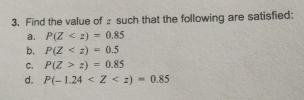 3. Find the value of z such that the following are satisfied: a. P(Z < z) = 0.85 b. P(Z <= z) = 0.5 C. P(Z > z) = 0.85 d. P(-1.24 < Z < z) = 0.85
How to write this formula in Excel? R±z,avn=0.995 ±(2.576)000 0.012 0.995 ± 0.004371 3 (0.990628673, 0.999371327)...
 How to write this formula in Excel?
R±z,avn=0.995 ±(2.576)000 0.012 0.995 ± 0.004371 3 (0.990628673, 0.999371327) (0.9906, 0.9994)
How to write this formula in Excel?
R±z,avn=0.995 ±(2.576)000 0.012 0.995 ± 0.004371 3 (0.990628673, 0.999371327) (0.9906, 0.9994)
3. Let Z be a continuous random variable with Z-N(0,1). (a) Find the value of P(Z...
 3. Let Z be a continuous random variable with Z-N(0,1). (a) Find the value of P(Z <-0.47). (b) Find the value of P(Z < 2.00). Note denotes the absolute value function. (c) Find b such that P(Z > b) = 0.9382. (d) Find the 27th percentile. (e) Find the value of the critical value 20.05-
P(z>0.23 or z<-0.23) = P(-3<z<O) = P(-0.23<z<2.35) = P(z>1.47 or z<-1.47) = P(z<-2 or z>-1) =...
 P(z>0.23 or z<-0.23) = P(-3<z<O) = P(-0.23<z<2.35) = P(z>1.47 or z<-1.47) = P(z<-2 or z>-1) = P(-3<z<3) -
1. Find the value of * that yields the probability shown a. P(Z <**)-0.0075 b. P(Z...
 1. Find the value of * that yields the probability shown a. P(Z <**)-0.0075 b. P(Z <=*) -0.9850 C. P(Z >z*) - 0.8907 d. P(Z >»*) -0.0110 For #1: a) P(Z < z*) = 0.0075 b) P(Z <z*) = 0.9850 c) P(Z > z*) = 0.8997 d) P(Z > z*) = 0.0110
(I point) f(z)-,2+1-1 < z < 0 (i) find P(-0.5sX<0.25). (a) Find the cumulative distribution function...
 (I point) f(z)-,2+1-1 < z < 0 (i) find P(-0.5sX<0.25). (a) Find the cumulative distribution function F(z). Fill in the blanks below. F(z) EE when x when when when x> (b) Evaluate P(Xc0.75X20.25) (c) 35% of the time, X exceeds what value? (d) l Estimate the location of the mean/expected value of X. Once you have done so, find the E(X)
PI-22 Z 41.331 P( 2 21.33) - P(Z <-2 ) o. 9082 - 00228 0.8856 A...
 PI-22 Z 41.331 P( 2 21.33) - P(Z <-2 ) o. 9082 - 00228 0.8856 A large urgent care center with 4 doctors found that they can see an average of 18 patients per hour. Assume the standard deviation is 3.2. A random sample of 42 hours was selected. Find the 99% confidence interval of the mean. 2)
Excel formula for math equation, How do I write this so Excel understands? = $13,750 +...
Excel formula for math equation, How do I write this so Excel understands? = $13,750 + [.34 x (80,000 - $75,000)] = $13,750 + (.34 x $5,000) = $13,750 + $1,700
x, y, and z are three independent Poisson random variables with the same mean. If P(x=1)=2P(x=0),...
x, y, and z are three independent Poisson random variables with the same mean. If P(x=1)=2P(x=0), what is P(x+y+z<=2)
 How to write this formula in excel
NI 0.995-1 0.012 N50 =-2.9463 -2.95
How to write this formula in excel
NI 0.995-1 0.012 N50 =-2.9463 -2.95
 3. Find the value of z such that the following are satisfied: a. P(Z < z) = 0.85 b. P(Z <= z) = 0.5 C. P(Z > z) = 0.85 d. P(-1.24 < Z < z) = 0.85
 How to write this formula in Excel?
R±z,avn=0.995 ±(2.576)000 0.012 0.995 ± 0.004371 3 (0.990628673, 0.999371327) (0.9906, 0.9994)
How to write this formula in Excel?
R±z,avn=0.995 ±(2.576)000 0.012 0.995 ± 0.004371 3 (0.990628673, 0.999371327) (0.9906, 0.9994)
 3. Let Z be a continuous random variable with Z-N(0,1). (a) Find the value of P(Z <-0.47). (b) Find the value of P(Z < 2.00). Note denotes the absolute value function. (c) Find b such that P(Z > b) = 0.9382. (d) Find the 27th percentile. (e) Find the value of the critical value 20.05-
 P(z>0.23 or z<-0.23) = P(-3<z<O) = P(-0.23<z<2.35) = P(z>1.47 or z<-1.47) = P(z<-2 or z>-1) = P(-3<z<3) -
 1. Find the value of * that yields the probability shown a. P(Z <**)-0.0075 b. P(Z <=*) -0.9850 C. P(Z >z*) - 0.8907 d. P(Z >»*) -0.0110 For #1: a) P(Z < z*) = 0.0075 b) P(Z <z*) = 0.9850 c) P(Z > z*) = 0.8997 d) P(Z > z*) = 0.0110
 (I point) f(z)-,2+1-1 < z < 0 (i) find P(-0.5sX<0.25). (a) Find the cumulative distribution function F(z). Fill in the blanks below. F(z) EE when x when when when x> (b) Evaluate P(Xc0.75X20.25) (c) 35% of the time, X exceeds what value? (d) l Estimate the location of the mean/expected value of X. Once you have done so, find the E(X)
 PI-22 Z 41.331 P( 2 21.33) - P(Z <-2 ) o. 9082 - 00228 0.8856 A large urgent care center with 4 doctors found that they can see an average of 18 patients per hour. Assume the standard deviation is 3.2. A random sample of 42 hours was selected. Find the 99% confidence interval of the mean. 2)
Most questions answered within 3 hours.
-
Where is the error in this code sequence?
String s1 = "Hello";
String s2 = "ello";...
asked 10 months ago -
Financial data for Joel de Paris, Inc., for last year
follow:
Joel de Paris, Inc.
Balance...
asked 10 months ago -
Consider this reaction:
Al2(SO4)3 (aq)+ BaCl3
(aq) Al2Cl6 (aq)- +
3BaSO4(s) . What is the...
asked 10 months ago -
Suppose that Savneet is considering increasing her
recent random sample from 20 car rentals to 40...
asked 10 months ago -
Trucks arrive at an unloading terminal at an average rate of 120
per hour.
Trucks arrive...
asked 10 months ago -
Why are methanol and ethanol completely soluble in water while
octanol is not very little soluble....
asked 10 months ago -
A facilities manager at a university reads in a research report
that the mean amount of...
asked 10 months ago -
When the CuSO4 is rehydrated by adding water to the anhydrous
compound, is this an endothermic...
asked 10 months ago -
A ray of sunlight is passing from diamond into crown glass; the
angle of incidence is...
asked 10 months ago -
A block of mass 0.249 kg is placed on top of a light, vertical
spring of...
asked 10 months ago -
how do the kidneys compensate in the presences of acidosis
a) trigger hyperventilate
b) reserve acid...
asked 10 months ago -
Question 501 pts
The rental rate of capital to the firm increases. Which of the
following...
asked 10 months ago