Why use a forwards contract rather than a futures contract?
Why use a forwards contract rather than a futures contract?
Homework Answers
Solutions >
A forward contract is a customized contractual agreement where two private parties agree to trade a particular asset with each other at an agreed specific price and time in the future. Forward contracts are traded privately over the counter, not on an exchange.
A futures contract — often referred to as futures — is a standardized version of a forward contract that is publicly traded on a futures exchanges. Like a forward contract, a futures contract includes an agreed upon price and time in the future to buy or sell an asset — usually Stocks Bonds, or commodities, like gold.
The main differentiating feature between futures and forward contracts — that futures are publicly traded on an exchange while forwards are privately traded — results in several operational differences between them. This comparison examines differences like counter party risk, daily centralized clearing and mark to market, price transparency, and efficiency.
Comparison chart
|
Forward Contract versus Futures Contract comparison chart |
||
|
Forward Contract |
Futures Contract |
|
|
Definition |
A forward contract is an agreement between two parties to buy or sell an asset (which can be of any kind) at a pre-agreed future point in time at a specified price. |
A futures contract is a standardized contract, traded on a futures exchange, to buy or sell a certain underlying instrument at a certain date in the future, at a specified price. |
|
Structure & Purpose |
Customized to customer needs. Usually no initial payment required. Usually used for hedging. |
Standardized. Initial margin payment required. Usually used for speculation. |
|
Transaction method |
Negotiated directly by the buyer and seller |
Quoted and traded on the Exchange |
|
Market regulation |
Not regulated |
Government regulated market (the Commodity Futures Trading Commission or CFTC is the governing body) |
|
Institutional guarantee |
The contracting parties |
Clearing House |
|
Risk |
High counter party risk |
Low counter party risk |
|
Guarantees |
No guarantee of settlement until the date of maturity only the forward price, based on the spot price of the underlying asset is paid |
Both parties must deposit an initial guarantee (margin). The value of the operation is marked to market rates with daily settlement of profits and losses. |
|
Contract Maturity |
Forward contracts generally mature by delivering the commodity. |
Future contracts may not necessarily mature by delivery of commodity. |
|
Expiry date |
Depending on the transaction |
Standardized |
|
Method of pre-termination |
Opposite contract with same or different counter party. Counter party risk remains while terminating with different counter party. |
Opposite contract on the exchange. |
|
Contract size |
Depending on the transaction and the requirements of the contracting parties. |
Standardized |
|
Market |
Primary & Secondary |
Primary |
that's why forward contract use rather than a futures contract.
Forwards vs Futures (10 points) State the main differences between the Forwards contract and Futures contract....
 Forwards vs Futures (10 points) State the main differences between the Forwards contract and Futures contract. Arbitrage (20 points) Suppose the spot rate of the pound today is $1.70 and the three-month forward rate is $1.75 1. (10 points) How can a U.S. importer who has to pay 20,000 pounds in three months hedge her foreign exchange risk? 2. (10 points) What occurs if the U.S. importer does not hedge and the spot rate of the pound in three months...
3. Which of the following statements about futures and forwards is most accurate? Futures a. Are...
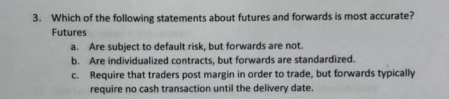 3. Which of the following statements about futures and forwards is most accurate? Futures a. Are subject to default risk, but forwards are not. b. Are individualized contracts, but forwards are standardized. C. Require that traders post margin in order to trade, but forwards typically require no cash transaction until the delivery date.
Why are most futures positions closed out through a reversing trade rather than held to delivery?
Why are most futures positions closed out through a reversing trade rather than held to delivery?
Question 15 (1 point) What is NOT a major difference between forwards and futures? futures are...
 Question 15 (1 point) What is NOT a major difference between forwards and futures? futures are exchange listed O futures are less popular futures are standardized O futures are marked-to-market Question 16 (1 point) Two contracts are the same except one is future and the other is forward. The cumulative payoffs over the life of these two contracts are Always the same Almost nether the same Forward is usually > future Forward is usually < future
Which of the following is true about the futures contract? i. they trade in the over...
Which of the following is true about the futures contract? i. they trade in the over the counter market ii. they are settled daily iii. they are subject to default risk iv. a margin deposit is required for both long and short positions v. a contract specifies a range of delivery dates (rather than a single date) Choices: multiple of the choice might be correct
The forward contract differs from a futures contract in that:A)the forward contract is to be settled...
The forward contract differs from a futures contract in that:A)the forward contract is to be settled immediately. B)the futures contract specifies a fixed amount and arranged date, whereas the forward contract can be for any amount or date. C)the futures contract cannot be traded in a market, whereas the forward contract can be bought in the market. D)forward contracts are standardized, whereas futures contracts are not standardized.
Explain the mark-to-market and margin requirements of a futures contract and use an example.
Explain the mark-to-market and margin requirements of a futures contract and use an example.
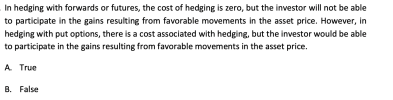
NEED HELP In hedging with forwards or futures, the cost of hedging is zero, but the...
 NEED HELP
In hedging with forwards or futures, the cost of hedging is zero, but the investor will not be able to participate in the gains resulting from favorable movements in the asset price. However, in hedging with put options, there is a cost associated with hedging, but the investor would be able to participate in the gains resulting from favorable movements in the asset price A. True B. False
NEED HELP
In hedging with forwards or futures, the cost of hedging is zero, but the investor will not be able to participate in the gains resulting from favorable movements in the asset price. However, in hedging with put options, there is a cost associated with hedging, but the investor would be able to participate in the gains resulting from favorable movements in the asset price A. True B. False
Currency risk can be hedged by buying swaps, futures, and forwards in the open market. It...
Currency risk can be hedged by buying swaps, futures, and forwards in the open market. It can also be hedged by using U.S. government guarantees through the Import Export Bank. What are the advantages and dis-advantages of this dual system? Should the US government be in this business and is it a mechanism of subsiding certain businesses?
2. What are the differences among a spot contract, a forward contract, and a futures contract?...
2. What are the differences among a spot contract, a forward contract, and a futures contract? 4. What is the purpose of requiring a margin on a futures or option transaction? What is the difference between an initial margin and a maintenance margin? 8. What is an option? How does an option differ from a forward or futures contract? 13. What factors affect the value of an option? 15. What is a swap?
 Forwards vs Futures (10 points) State the main differences between the Forwards contract and Futures contract. Arbitrage (20 points) Suppose the spot rate of the pound today is $1.70 and the three-month forward rate is $1.75 1. (10 points) How can a U.S. importer who has to pay 20,000 pounds in three months hedge her foreign exchange risk? 2. (10 points) What occurs if the U.S. importer does not hedge and the spot rate of the pound in three months...
 3. Which of the following statements about futures and forwards is most accurate? Futures a. Are subject to default risk, but forwards are not. b. Are individualized contracts, but forwards are standardized. C. Require that traders post margin in order to trade, but forwards typically require no cash transaction until the delivery date.
 Question 15 (1 point) What is NOT a major difference between forwards and futures? futures are exchange listed O futures are less popular futures are standardized O futures are marked-to-market Question 16 (1 point) Two contracts are the same except one is future and the other is forward. The cumulative payoffs over the life of these two contracts are Always the same Almost nether the same Forward is usually > future Forward is usually < future
 NEED HELP
In hedging with forwards or futures, the cost of hedging is zero, but the investor will not be able to participate in the gains resulting from favorable movements in the asset price. However, in hedging with put options, there is a cost associated with hedging, but the investor would be able to participate in the gains resulting from favorable movements in the asset price A. True B. False
NEED HELP
In hedging with forwards or futures, the cost of hedging is zero, but the investor will not be able to participate in the gains resulting from favorable movements in the asset price. However, in hedging with put options, there is a cost associated with hedging, but the investor would be able to participate in the gains resulting from favorable movements in the asset price A. True B. False
Most questions answered within 3 hours.
-
Where is the error in this code sequence?
String s1 = "Hello";
String s2 = "ello";...
asked 10 months ago -
Financial data for Joel de Paris, Inc., for last year
follow:
Joel de Paris, Inc.
Balance...
asked 10 months ago -
Consider this reaction:
Al2(SO4)3 (aq)+ BaCl3
(aq) Al2Cl6 (aq)- +
3BaSO4(s) . What is the...
asked 10 months ago -
Suppose that Savneet is considering increasing her
recent random sample from 20 car rentals to 40...
asked 10 months ago -
Trucks arrive at an unloading terminal at an average rate of 120
per hour.
Trucks arrive...
asked 10 months ago -
Why are methanol and ethanol completely soluble in water while
octanol is not very little soluble....
asked 10 months ago -
A facilities manager at a university reads in a research report
that the mean amount of...
asked 10 months ago -
When the CuSO4 is rehydrated by adding water to the anhydrous
compound, is this an endothermic...
asked 10 months ago -
A ray of sunlight is passing from diamond into crown glass; the
angle of incidence is...
asked 10 months ago -
A block of mass 0.249 kg is placed on top of a light, vertical
spring of...
asked 10 months ago -
how do the kidneys compensate in the presences of acidosis
a) trigger hyperventilate
b) reserve acid...
asked 10 months ago -
Question 501 pts
The rental rate of capital to the firm increases. Which of the
following...
asked 10 months ago