
Homework Answers
Add Answer to:
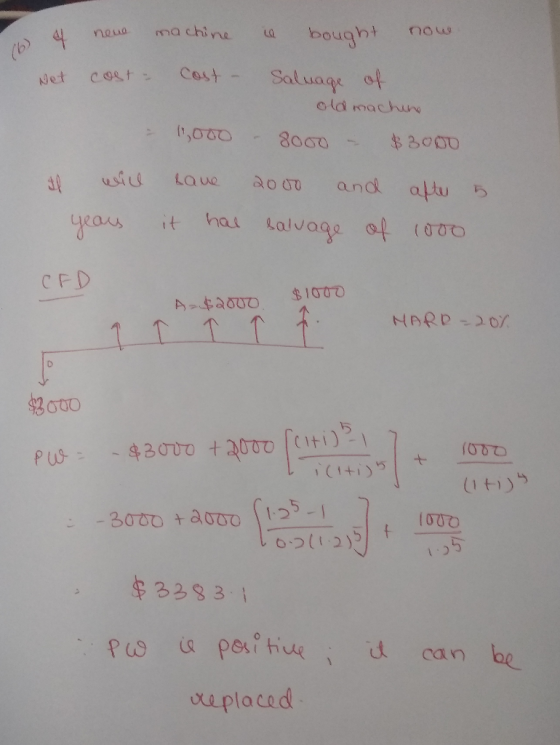
according to engineering economy replacment analysis
b- A Canadian company owns a machine that cost $26...
12. (5 pts) A company is considering replacing a machine that was bought six years ago for $50,000. The machine, however, can be repaired and its life ext five $44,000 and will reduce the operatin...
 12. (5 pts) A company is considering replacing a machine that was bought six years ago for $50,000. The machine, however, can be repaired and its life ext five $44,000 and will reduce the operating expenses by $6,000 per year. The seller of the new machine has offered a trade-in allowance of $15,000 for the old machine. If MARR is 12% per year before taxes, how much can the company spend to repair the existing machine? Choose the closest answer....
12. (5 pts) A company is considering replacing a machine that was bought six years ago...
 12. (5 pts) A company is considering replacing a machine that was bought six years ago for $50,000. The machine, however, can be repaired and its life ext five $44,000 and will reduce the operating expenses by $6,000 per year. The seller of the new machine has offered a trade-in allowance of $15,000 for the old machine. If MARR is 12% per year before taxes, how much can the company spend to repair the existing machine? Choose the closest answer....
A company is considering replacing a machine that was bought six years ago for $45,000. The...
 A company is considering replacing a machine that was bought six years ago for $45,000. The machine, however, can be repaired and its life extended five more years. If the current machine is replaced, the new machine will cost $43,000 and will reduce the operating expenses by $5,500 per year. The seller of the new machine has offered a trade-in allowance of $15,000 for the old machine. If MARR is 8% per year before taxes, how much can the company...
Dallas Engineering purchased a machine five years ago at a cost of $484,000. The machine is...
Dallas Engineering purchased a machine five years ago at a cost of $484,000. The machine is being depreciated using the straight-line method over eight years. The tax rate is 25 percent and the discount rate is 13 percent. If the machine is sold today for $209,000, what will the aftertax salvage value be? $202,125 $227,485 $214,500 $194,000 $186,775
One year ago, your company purchased a machine used in manufacturing for $ 105 000. You...
One year ago, your company purchased a machine used in manufacturing for $ 105 000. You have learned that a new machine is available that offers many advantages; you can purchase it for $ 155 000 today. It will be depreciated on a straight-line basis over ten years and has no salvage value. You expect that the new machine will produce a gross margin (revenues minus operating expenses other than depreciation) of $ 40 000 per year for the next...
One year ago, your company purchased a machine used in manufacturing for $ 105 000. You...
One year ago, your company purchased a machine used in manufacturing for $ 105 000. You have learned that a new machine is available that offers many advantages; you can purchase it for $ 155 000 today. It will be depreciated on a straight-line basis over ten years and has no salvage value. You expect that the new machine will produce a gross margin (revenues minus operating expenses other than depreciation) of $ 45 000 per year for the next...
One year ago, your company purchased a machine used in manufacturing for $ 105 comma 000....
One year ago, your company purchased a machine used in manufacturing for $ 105 comma 000. You have learned that a new machine is available that offers many advantages; you can purchase it for $ 160 comma 000 today. It will be depreciated on a straight-line basis over ten years, after which it has no salvage value. You expect that the new machine will contribute EBITDA (earnings before interest, taxes, depreciation, and amortization) of $ 60 comma 000 per year...
your company purchases a machine for $14,000 with a 6-year tax life. the soyd method is...
your company purchases a machine for $14,000 with a 6-year tax life. the soyd method is used for depreciation, and the tax salvage is zero. Neglect taxes in this part. After the third year of life, the company is thinking about replacing the machine with a new one. it can be sold now for $10,000. Next year it will be worth only $6,000 and in two years, only $4,000. Three years from now the machine will have no resale value....
One year ago, your company purchased a machine used in manufacturing for $ 95 comma 000....
One year ago, your company purchased a machine used in manufacturing for $ 95 comma 000. You have learned that a new machine is available that offers many advantages; you can purchase it for $ 160 comma 000 today. It will be depreciated on a straight-line basis over ten years, after which it has no salvage value. You expect that the new machine will contribute EBITDA (earnings before interest, taxes, depreciation, and amortization) of $ 40 comma 000 per year...
One year ago, your company purchased a machine used in manufacturing for $ 95 comma 000....
One year ago, your company purchased a machine used in manufacturing for $ 95 comma 000. You have learned that a new machine is available that offers many advantages; you can purchase it for $ 160 comma 000 today. It will be depreciated on a straight-line basis over ten years, after which it has no salvage value. You expect that the new machine will contribute EBITDA (earnings before interest, taxes, depreciation, and amortization) of $ 35 comma 000 per year...
 12. (5 pts) A company is considering replacing a machine that was bought six years ago for $50,000. The machine, however, can be repaired and its life ext five $44,000 and will reduce the operating expenses by $6,000 per year. The seller of the new machine has offered a trade-in allowance of $15,000 for the old machine. If MARR is 12% per year before taxes, how much can the company spend to repair the existing machine? Choose the closest answer....
 12. (5 pts) A company is considering replacing a machine that was bought six years ago for $50,000. The machine, however, can be repaired and its life ext five $44,000 and will reduce the operating expenses by $6,000 per year. The seller of the new machine has offered a trade-in allowance of $15,000 for the old machine. If MARR is 12% per year before taxes, how much can the company spend to repair the existing machine? Choose the closest answer....
 A company is considering replacing a machine that was bought six years ago for $45,000. The machine, however, can be repaired and its life extended five more years. If the current machine is replaced, the new machine will cost $43,000 and will reduce the operating expenses by $5,500 per year. The seller of the new machine has offered a trade-in allowance of $15,000 for the old machine. If MARR is 8% per year before taxes, how much can the company...
Most questions answered within 3 hours.
-
Where is the error in this code sequence?
String s1 = "Hello";
String s2 = "ello";...
asked 10 months ago -
Financial data for Joel de Paris, Inc., for last year
follow:
Joel de Paris, Inc.
Balance...
asked 10 months ago -
Consider this reaction:
Al2(SO4)3 (aq)+ BaCl3
(aq) Al2Cl6 (aq)- +
3BaSO4(s) . What is the...
asked 10 months ago -
Suppose that Savneet is considering increasing her
recent random sample from 20 car rentals to 40...
asked 10 months ago -
Trucks arrive at an unloading terminal at an average rate of 120
per hour.
Trucks arrive...
asked 10 months ago -
Why are methanol and ethanol completely soluble in water while
octanol is not very little soluble....
asked 10 months ago -
A facilities manager at a university reads in a research report
that the mean amount of...
asked 10 months ago -
When the CuSO4 is rehydrated by adding water to the anhydrous
compound, is this an endothermic...
asked 10 months ago -
A ray of sunlight is passing from diamond into crown glass; the
angle of incidence is...
asked 10 months ago -
A block of mass 0.249 kg is placed on top of a light, vertical
spring of...
asked 10 months ago -
how do the kidneys compensate in the presences of acidosis
a) trigger hyperventilate
b) reserve acid...
asked 10 months ago -
Question 501 pts
The rental rate of capital to the firm increases. Which of the
following...
asked 10 months ago