The combination of Good A and Good Z that gives consumer equilibrium can be computed by...
The combination of Good A and Good Z that gives consumer equilibrium can be computed by which of the following?
| a. | Marginal utility of Good A/price of Good A = marginal utility of Good Z/price of Good Z | b. | Using the total utility of Good A/price of Good A = total utility of Good Z/price of Good Z |
|---|---|---|---|
| c. | Price of Good A/marginal utility of Good A = price of Good Z/marginal utility of Good Z | d. | Using the marginal utility of Good Z/price of Good A = marginal utility of Good Z/price of Good A |
Homework Answers
Solution: Marginal utility of Good A/price of Good A = marginal utility of Good Z/price of Good Z
Explanation: The consumer equilibrium is achieved at a point where:
MUa/Pa = MUz/Pz
Qa * Pa + Qz * Pz = Y; where Qa: (a) quantity; Qz: (z) quantity; Pa: (a) price; Pz: (z) price
Add Answer to:
The combination of Good A and Good Z that gives consumer
equilibrium can be computed by...
1. The utility added by consuming an additional unit of a good is known as __________...
1. The utility added by consuming an additional unit of a good is known as __________ utility A. total B. increasing C. marginal D. diminishing 2. The combination of Good A and Good Z that gives consumer equilibrium can be computed by which of the following? A. Using the marginal utility of Good Z/price of Good A = marginal utility of Good Z/price of Good A B. Using the total utility of Good A/price of Good A = total utility...
Suppose Mary is in consumer equilibrium. The marginal utility of good A is 30, and the...
 Suppose Mary is in consumer equilibrium. The marginal utility of good A is 30, and the price of good A is $2. a. If the price of good B is $4, the price of good C is $3, the price of good D is $1, and the price of all other goods and services is $5, what is the marginal utility of each of the goods Mary is purchasing? b. If Mary has chosen to keep $10 in savings, what...
Question 13 (1 point) In consumer equilibrium, which of the following is true? The marginal utility...
 Question 13 (1 point) In consumer equilibrium, which of the following is true? The marginal utility from the consumption of each good is the same. The marginal utility from the consumption of each good is zero. The marginal utility from the consumption of the last dollar's worth of each good is the same. The total utility from the consumption of each good is the same.
If you are at the point of consumer equilibrium, which of the following is true? a....
If you are at the point of consumer equilibrium, which of the following is true? a. You have maximized your total utility. b. You have not yet reached the point where marginal utility is zero. c. You have not maximized your marginal utility. d. You have not yet reached your maximum total utility.
of her income in a way that A consumer equilibrium is a situation in which a...
 of her income in a way that A consumer equilibrium is a situation in which a consumer has allocated A. some; increases her marginal utility B. all; maximizes her total utility C. all; maximizes her marginal utility D. some; lowers her household budget
2- Lisa's preference between good X and a composite good of everything else (Z) can be...
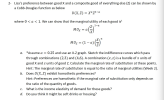 2- Lisa's preference between good X and a composite good of everything else (Z) can be shown by a Cobb-Douglas function as below U(X,Z) = xaz1-a where 0 < a < 1. We can show that the marginal utility of each good is 1-a MUx = a (5)" MU; = (1 –a) (?) a. *Assume a = 0.25 and use an X-Z graph. Sketch the indifference curves which pass through combinations (2,3) and (4,6). A combination (x,z) is a bundle...
3) he theory of consumer behavior assumes that consumers attempt to maximize A) marginal utility. 1)...
 3) he theory of consumer behavior assumes that consumers attempt to maximize A) marginal utility. 1) the difference between total and marginal utility. C) average utility. D) total utility. 34) The law of diminishing marginal utility states that A) beyond some point, additional units of a product will yield less and less extra satisfaction to a consumer. B) price must be lowered to induce firms to supply more of a product C) it will take larger and larger amounts of...
+ A consumer finds only three products, X, Y, and Z are for sale. The amount...
 + A consumer finds only three products, X, Y, and Z are for sale. The amount of which the consumption will yield is shown in the table below. Assume that the prices of X Y and are $10.32 and S8, respectively, and that the consumer has an income of $74 to spend Product X Product Y Product (Price $10) (Price $2) (Price $8) Marginal Utility per $ 4.2 Marginal Utility per $ Marginal Utility pers Quantity Utility Quantity Utility Quantity...
3. Consider a two consumer endowment economy. Consumer 1 and consumer 2 come into the economy...
 3. Consider a two consumer endowment economy. Consumer 1 and consumer 2 come into the economy with an endowment of good x and good y. They can voluntarily trade their endowments. They have the following utility functions and endowments: W:(z,y) = złyt And they have the following endowments: Consumer 1 61 =(4,12) Consumer 2 ez =(8,6) (a) Set up the utility maximization problem for consumer 2. Then solve for the demand functions of good #2 and good y2 as a...
A consumer with a fixed income will maximize utility when each good is purchased in amounts such that the: A-...
A consumer with a fixed income will maximize utility when each good is purchased in amounts such that the: A- Marginal utility per dollar spent is maximized for each good B- Marginal utility of each good is maximized C-Marginal utility per dollar spent is the same for all goods D- Average utility per dollar spent is the same for all goods E- Total utility is the same for each good
 Suppose Mary is in consumer equilibrium. The marginal utility of good A is 30, and the price of good A is $2. a. If the price of good B is $4, the price of good C is $3, the price of good D is $1, and the price of all other goods and services is $5, what is the marginal utility of each of the goods Mary is purchasing? b. If Mary has chosen to keep $10 in savings, what...
 Question 13 (1 point) In consumer equilibrium, which of the following is true? The marginal utility from the consumption of each good is the same. The marginal utility from the consumption of each good is zero. The marginal utility from the consumption of the last dollar's worth of each good is the same. The total utility from the consumption of each good is the same.
 of her income in a way that A consumer equilibrium is a situation in which a consumer has allocated A. some; increases her marginal utility B. all; maximizes her total utility C. all; maximizes her marginal utility D. some; lowers her household budget
 2- Lisa's preference between good X and a composite good of everything else (Z) can be shown by a Cobb-Douglas function as below U(X,Z) = xaz1-a where 0 < a < 1. We can show that the marginal utility of each good is 1-a MUx = a (5)" MU; = (1 –a) (?) a. *Assume a = 0.25 and use an X-Z graph. Sketch the indifference curves which pass through combinations (2,3) and (4,6). A combination (x,z) is a bundle...
 3) he theory of consumer behavior assumes that consumers attempt to maximize A) marginal utility. 1) the difference between total and marginal utility. C) average utility. D) total utility. 34) The law of diminishing marginal utility states that A) beyond some point, additional units of a product will yield less and less extra satisfaction to a consumer. B) price must be lowered to induce firms to supply more of a product C) it will take larger and larger amounts of...
 + A consumer finds only three products, X, Y, and Z are for sale. The amount of which the consumption will yield is shown in the table below. Assume that the prices of X Y and are $10.32 and S8, respectively, and that the consumer has an income of $74 to spend Product X Product Y Product (Price $10) (Price $2) (Price $8) Marginal Utility per $ 4.2 Marginal Utility per $ Marginal Utility pers Quantity Utility Quantity Utility Quantity...
 3. Consider a two consumer endowment economy. Consumer 1 and consumer 2 come into the economy with an endowment of good x and good y. They can voluntarily trade their endowments. They have the following utility functions and endowments: W:(z,y) = złyt And they have the following endowments: Consumer 1 61 =(4,12) Consumer 2 ez =(8,6) (a) Set up the utility maximization problem for consumer 2. Then solve for the demand functions of good #2 and good y2 as a...
Most questions answered within 3 hours.
-
Where is the error in this code sequence?
String s1 = "Hello";
String s2 = "ello";...
asked 11 months ago -
Financial data for Joel de Paris, Inc., for last year
follow:
Joel de Paris, Inc.
Balance...
asked 11 months ago -
Consider this reaction:
Al2(SO4)3 (aq)+ BaCl3
(aq) Al2Cl6 (aq)- +
3BaSO4(s) . What is the...
asked 11 months ago -
Suppose that Savneet is considering increasing her
recent random sample from 20 car rentals to 40...
asked 11 months ago -
Trucks arrive at an unloading terminal at an average rate of 120
per hour.
Trucks arrive...
asked 11 months ago -
Why are methanol and ethanol completely soluble in water while
octanol is not very little soluble....
asked 11 months ago -
A facilities manager at a university reads in a research report
that the mean amount of...
asked 11 months ago -
When the CuSO4 is rehydrated by adding water to the anhydrous
compound, is this an endothermic...
asked 11 months ago -
A ray of sunlight is passing from diamond into crown glass; the
angle of incidence is...
asked 11 months ago -
A block of mass 0.249 kg is placed on top of a light, vertical
spring of...
asked 11 months ago -
how do the kidneys compensate in the presences of acidosis
a) trigger hyperventilate
b) reserve acid...
asked 11 months ago -
Question 501 pts
The rental rate of capital to the firm increases. Which of the
following...
asked 11 months ago