Consider the Prisoner's Dilemma payoff matrix: Player 2 Player 1 Tell Silent Tell 1,1 3,0
Consider the Prisoner's Dilemma payoff matrix:
|
Player 2 |
|||
|
Player 1 |
Tell |
Silent |
|
|
Tell |
1,1 |
3,0 |
|
|
Silent |
0,3 |
2,2 |
|
Suppose that this is a sequential game in which Player 1 moves first and Player 2 follows, after seeing Player 1's action. Draw the game tree and solve for all pure strategy SPNE.
Homework Answers
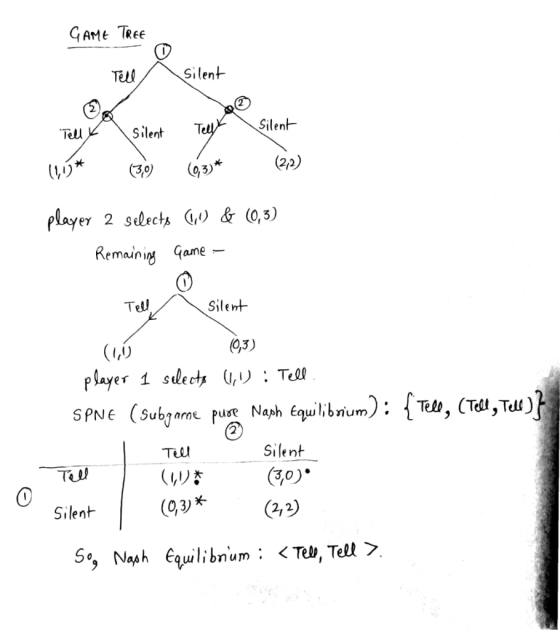
Add Answer to:
Consider the Prisoner's Dilemma payoff matrix:
Player
2
Player 1
Tell
Silent
Tell
1,1
3,0
2. Consider a static game described by the following payoff matrix: LR a,1 2,6 3,0 2,c...
 2. Consider a static game described by the following payoff matrix: LR a,1 2,6 3,0 2,c B The two numbers in each cell is the payoffs to the row player and the column player, respectively. (a) [6] Find all parameter values of a, b, and c for which the strategy profile (T, L) is a weakly dominant strategy equilibrium. (b) [6] Find all parameter values of a, b, and c for which the strategy profile (T, L) is a pure...
Exercise 2 - A variation ofthe Prisoner's Dilemma game. Consider the following Prisoner's Dilemma game. The...
 Exercise 2 - A variation ofthe Prisoner's Dilemma game. Consider the following Prisoner's Dilemma game. The game coincides with that we discussed in class, except for the fact that every player sees his payoff decrease by m>0 when he chooses to confess. For instance, prisoner 1's payoff decreases by m in the top row (where he confesses) but is unaffected when he is at the bottom row (where he does not confess). A similar argument applies to prisoner 2, who...
In the extensive form representation of the game between Player 1 and Player 2, Player 1...
In the extensive form representation of the game between Player 1 and Player 2, Player 1 moves first and chooses L or R. If Player 1 chooses R the game ends, if Player 1 chooses L then Player 1 and 2 play a simultaneous move game. The game has______________ pure strategy Nash equilibria and__________ pure strategy Subgame Perfect Nash Equilibria (SPNE). The maximum payoff Player 2 gets in a SPNE is___________ . (Please, enter only numerical answers like: 1, 2,...
2. (25 pts) Consider a two player game with a payoff matrix (1)/(2) L U D...
 2. (25 pts) Consider a two player game with a payoff matrix (1)/(2) L U D R (2,1) (1,0) (0,0) (3,-4) where e E{-1,1} is a parameter known by player 2 only. Player 1 believes that 0 = 1 with probability 1/2 and 0 = -1 with probability 1/2. Everything above is common knowledge. (a) Write down the strategy space of each player. (b) Find the set of pure strategy Bayesian Nash equilibria.
Player E A Player 3,3 4,2 1,4 2,0 3,0 -1,1 1,1 C 2,-1 0,2 The iterative...
 Player E A Player 3,3 4,2 1,4 2,0 3,0 -1,1 1,1 C 2,-1 0,2 The iterative elimination of dominated strategies (IEDS) solution is the strategy profile consisting in strategy for Player 1 and for Player 2 strategy
Player E A Player 3,3 4,2 1,4 2,0 3,0 -1,1 1,1 C 2,-1 0,2 The iterative elimination of dominated strategies (IEDS) solution is the strategy profile consisting in strategy for Player 1 and for Player 2 strategy
Player E A Player 3,3 4,2 1,4 2,0 3,0 -1,1 1,1 C 2,-1 0,2 The iterative elimination of dominated strategies (IEDS) solution is the strategy profile consisting in strategy for Player 1 and for Player 2 strategy
1. (60 marks) Consider a two-person game, in which every player has two pure strategies to...
 1. (60 marks) Consider a two-person game, in which every player has two pure strategies to play. The payoff matrix of the game is as follows Strategy 2 Player One Player Two Strategy I Strategy II Strategy 1 0,0 1,3 1,1 Find all the Nash equilibria of the game.
Exercise 6 (Difficult),. Consider the following modification of the prisoner's dilemma game. A-1,...
 Exercise 6 (Difficult),. Consider the following modification of the prisoner's dilemma game. A-1,-1-9,0-6,-2 B | 0,-9 |-6-61-5-10 C1-2,-6 |-10,-51-4,-4 You should recognise the payoff's from (A, L), (A, R). (B, L). (B, R) as those in the prisoner's dilemma game studied in class. We added two strategies, one for each player. Also note that strategies A and L are still (when compared to the original prisoner's dilemma game) strictly dominated . What is the set of Nash equilibria of this...
The payoff matrix for a game is 3 -5 2 (a) Find the expected payoff to the row player if the row ...
 The payoff matrix for a game is 3 -5 2 (a) Find the expected payoff to the row player if the row player R uses the maximin pure strategy and the column C player uses the minimax pure strategy (b Find the expected payoff to the row player if R uses the maximin strategy 40% of the time and chooses each of the other two rows 30% of the bme while C uses the miin ax strategy 50% of the...
2. Consider the following simultaneous move game: Column Left Right Top 1,1 7,3 Row Bottom 3,5...
 2. Consider the following simultaneous move game: Column Left Right Top 1,1 7,3 Row Bottom 3,5 11,0 (a) Find all pure-strategy Nash equilibria (b) Now assume that the game is made sequential with Row moving first. Illustrate this new game using a game tree and find the rollback equilibrium (c) List the strategies of the two players in this sequential-move game and give the normal-form representation of the game (the payoff matrix) (d) Use the payoff matrix to find the...
2. Consider the following simultaneous move game: Column Left Right 1,1 3,5 11,0 Тoр 7,3 Row...
 2. Consider the following simultaneous move game: Column Left Right 1,1 3,5 11,0 Тoр 7,3 Row Bottom (a) Find all pure-strategy Nash equilibria (b) Now assume that the game is made sequential with Row moving first. Illustrate this new game using a game tree and find the rollback equilibrium (c) List the strategies of the two players in this sequential-move game and give the normal-form representation of the game (the payoff matrix) (d) Use the payoff matrix to find the...
 2. Consider a static game described by the following payoff matrix: LR a,1 2,6 3,0 2,c B The two numbers in each cell is the payoffs to the row player and the column player, respectively. (a) [6] Find all parameter values of a, b, and c for which the strategy profile (T, L) is a weakly dominant strategy equilibrium. (b) [6] Find all parameter values of a, b, and c for which the strategy profile (T, L) is a pure...
 Exercise 2 - A variation ofthe Prisoner's Dilemma game. Consider the following Prisoner's Dilemma game. The game coincides with that we discussed in class, except for the fact that every player sees his payoff decrease by m>0 when he chooses to confess. For instance, prisoner 1's payoff decreases by m in the top row (where he confesses) but is unaffected when he is at the bottom row (where he does not confess). A similar argument applies to prisoner 2, who...
 2. (25 pts) Consider a two player game with a payoff matrix (1)/(2) L U D R (2,1) (1,0) (0,0) (3,-4) where e E{-1,1} is a parameter known by player 2 only. Player 1 believes that 0 = 1 with probability 1/2 and 0 = -1 with probability 1/2. Everything above is common knowledge. (a) Write down the strategy space of each player. (b) Find the set of pure strategy Bayesian Nash equilibria.
 Player E A Player 3,3 4,2 1,4 2,0 3,0 -1,1 1,1 C 2,-1 0,2 The iterative elimination of dominated strategies (IEDS) solution is the strategy profile consisting in strategy for Player 1 and for Player 2 strategy
Player E A Player 3,3 4,2 1,4 2,0 3,0 -1,1 1,1 C 2,-1 0,2 The iterative elimination of dominated strategies (IEDS) solution is the strategy profile consisting in strategy for Player 1 and for Player 2 strategy
Player E A Player 3,3 4,2 1,4 2,0 3,0 -1,1 1,1 C 2,-1 0,2 The iterative elimination of dominated strategies (IEDS) solution is the strategy profile consisting in strategy for Player 1 and for Player 2 strategy
 1. (60 marks) Consider a two-person game, in which every player has two pure strategies to play. The payoff matrix of the game is as follows Strategy 2 Player One Player Two Strategy I Strategy II Strategy 1 0,0 1,3 1,1 Find all the Nash equilibria of the game.
 Exercise 6 (Difficult),. Consider the following modification of the prisoner's dilemma game. A-1,-1-9,0-6,-2 B | 0,-9 |-6-61-5-10 C1-2,-6 |-10,-51-4,-4 You should recognise the payoff's from (A, L), (A, R). (B, L). (B, R) as those in the prisoner's dilemma game studied in class. We added two strategies, one for each player. Also note that strategies A and L are still (when compared to the original prisoner's dilemma game) strictly dominated . What is the set of Nash equilibria of this...
 The payoff matrix for a game is 3 -5 2 (a) Find the expected payoff to the row player if the row player R uses the maximin pure strategy and the column C player uses the minimax pure strategy (b Find the expected payoff to the row player if R uses the maximin strategy 40% of the time and chooses each of the other two rows 30% of the bme while C uses the miin ax strategy 50% of the...
 2. Consider the following simultaneous move game: Column Left Right Top 1,1 7,3 Row Bottom 3,5 11,0 (a) Find all pure-strategy Nash equilibria (b) Now assume that the game is made sequential with Row moving first. Illustrate this new game using a game tree and find the rollback equilibrium (c) List the strategies of the two players in this sequential-move game and give the normal-form representation of the game (the payoff matrix) (d) Use the payoff matrix to find the...
 2. Consider the following simultaneous move game: Column Left Right 1,1 3,5 11,0 Тoр 7,3 Row Bottom (a) Find all pure-strategy Nash equilibria (b) Now assume that the game is made sequential with Row moving first. Illustrate this new game using a game tree and find the rollback equilibrium (c) List the strategies of the two players in this sequential-move game and give the normal-form representation of the game (the payoff matrix) (d) Use the payoff matrix to find the...
Most questions answered within 3 hours.
-
Where is the error in this code sequence?
String s1 = "Hello";
String s2 = "ello";...
asked 10 months ago -
Financial data for Joel de Paris, Inc., for last year
follow:
Joel de Paris, Inc.
Balance...
asked 10 months ago -
Consider this reaction:
Al2(SO4)3 (aq)+ BaCl3
(aq) Al2Cl6 (aq)- +
3BaSO4(s) . What is the...
asked 10 months ago -
Suppose that Savneet is considering increasing her
recent random sample from 20 car rentals to 40...
asked 10 months ago -
Trucks arrive at an unloading terminal at an average rate of 120
per hour.
Trucks arrive...
asked 10 months ago -
Why are methanol and ethanol completely soluble in water while
octanol is not very little soluble....
asked 10 months ago -
A facilities manager at a university reads in a research report
that the mean amount of...
asked 10 months ago -
When the CuSO4 is rehydrated by adding water to the anhydrous
compound, is this an endothermic...
asked 10 months ago -
A ray of sunlight is passing from diamond into crown glass; the
angle of incidence is...
asked 10 months ago -
A block of mass 0.249 kg is placed on top of a light, vertical
spring of...
asked 10 months ago -
how do the kidneys compensate in the presences of acidosis
a) trigger hyperventilate
b) reserve acid...
asked 10 months ago -
Question 501 pts
The rental rate of capital to the firm increases. Which of the
following...
asked 10 months ago