

Homework Answers
Q9
Answer
after tariff price =2.25
Qd=130 and Qs=70
Import =Qd-Qs=130-70
=60 million
tax revenue =import * tariff
=60*0.25
=15 million
Option B
==========
Q10
Answer
the deadweight loss =0.5* change in Qd*tariff +0.5* change inn Qs *
tariff
before tax
P=2, Qd=140 and Qs=60
DWL=0.5*(70-60)*0.25+0.5*(140-130)*0.25
=$2.5 million
Add Answer to:
$ 2.25 -World price 2.00 60 70 130 140 Q/millions bushels Figure 6.1 9) Based on...
130 140 ons bushels Figure 61 7) 7) Based on Figure 6.1, suppose the government puts a tariff of 50 25 per bushel o...
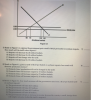 130 140 ons bushels Figure 61 7) 7) Based on Figure 6.1, suppose the government puts a tariff of 50 25 per bushel on soybean imports. How much will the tariff reduce imports A) Imports will decrease by 20 million bushels B) Imports will decrease by 60 million bushels. C) Imports will not change after the tariff D) Imports will decrease by 10 million bushels 3) Based on Figure 6.1. given a tariff of 50 25 per bushel on soybean...
please answer 3,4,16,and 27 correctly. Question 3 Question 4 3 points Save Answer QUESTION 3 Use...
 please answer 3,4,16,and 27 correctly.
Question 3
Question 4
3 points Save Answer QUESTION 3 Use the graph below and the following information to answer the next question(s). The world price of soybeans is $2.00 per bushel, and the importing country is small enough not to affect the world price. 2.25 2.00 World price 60 70 130 140 Qimilions bushels Figure 6.1 225 2.00 -World price 60 70 130 140 Omillions bushels Figure 6.1 Based on Figure 6.1 given a...
please answer 3,4,16,and 27 correctly.
Question 3
Question 4
3 points Save Answer QUESTION 3 Use the graph below and the following information to answer the next question(s). The world price of soybeans is $2.00 per bushel, and the importing country is small enough not to affect the world price. 2.25 2.00 World price 60 70 130 140 Qimilions bushels Figure 6.1 225 2.00 -World price 60 70 130 140 Omillions bushels Figure 6.1 Based on Figure 6.1 given a...
Chapter overview 1. Reasons for international trade Resources reasons Economic reasons Other reasons 2. Difference between...
Chapter overview 1. Reasons for international trade Resources reasons Economic reasons Other reasons 2. Difference between international trade and domestic trade More complex context More difficult and risky Higher management skills required 3. Basic concept s relating to international trade Visible trade & invisible trade Favorable trade & unfavorable trade General trade system & special trade system Volume of international trade & quantum of international trade Commodity composition of international trade Geographical composition of international trade Degree / ratio of...
 130 140 ons bushels Figure 61 7) 7) Based on Figure 6.1, suppose the government puts a tariff of 50 25 per bushel on soybean imports. How much will the tariff reduce imports A) Imports will decrease by 20 million bushels B) Imports will decrease by 60 million bushels. C) Imports will not change after the tariff D) Imports will decrease by 10 million bushels 3) Based on Figure 6.1. given a tariff of 50 25 per bushel on soybean...
 please answer 3,4,16,and 27 correctly.
Question 3
Question 4
3 points Save Answer QUESTION 3 Use the graph below and the following information to answer the next question(s). The world price of soybeans is $2.00 per bushel, and the importing country is small enough not to affect the world price. 2.25 2.00 World price 60 70 130 140 Qimilions bushels Figure 6.1 225 2.00 -World price 60 70 130 140 Omillions bushels Figure 6.1 Based on Figure 6.1 given a...
please answer 3,4,16,and 27 correctly.
Question 3
Question 4
3 points Save Answer QUESTION 3 Use the graph below and the following information to answer the next question(s). The world price of soybeans is $2.00 per bushel, and the importing country is small enough not to affect the world price. 2.25 2.00 World price 60 70 130 140 Qimilions bushels Figure 6.1 225 2.00 -World price 60 70 130 140 Omillions bushels Figure 6.1 Based on Figure 6.1 given a...
Most questions answered within 3 hours.
-
Where is the error in this code sequence?
String s1 = "Hello";
String s2 = "ello";...
asked 11 months ago -
Financial data for Joel de Paris, Inc., for last year
follow:
Joel de Paris, Inc.
Balance...
asked 11 months ago -
Consider this reaction:
Al2(SO4)3 (aq)+ BaCl3
(aq) Al2Cl6 (aq)- +
3BaSO4(s) . What is the...
asked 11 months ago -
Suppose that Savneet is considering increasing her
recent random sample from 20 car rentals to 40...
asked 11 months ago -
Trucks arrive at an unloading terminal at an average rate of 120
per hour.
Trucks arrive...
asked 11 months ago -
Why are methanol and ethanol completely soluble in water while
octanol is not very little soluble....
asked 11 months ago -
A facilities manager at a university reads in a research report
that the mean amount of...
asked 11 months ago -
When the CuSO4 is rehydrated by adding water to the anhydrous
compound, is this an endothermic...
asked 11 months ago -
A ray of sunlight is passing from diamond into crown glass; the
angle of incidence is...
asked 11 months ago -
A block of mass 0.249 kg is placed on top of a light, vertical
spring of...
asked 11 months ago -
how do the kidneys compensate in the presences of acidosis
a) trigger hyperventilate
b) reserve acid...
asked 11 months ago -
Question 501 pts
The rental rate of capital to the firm increases. Which of the
following...
asked 11 months ago