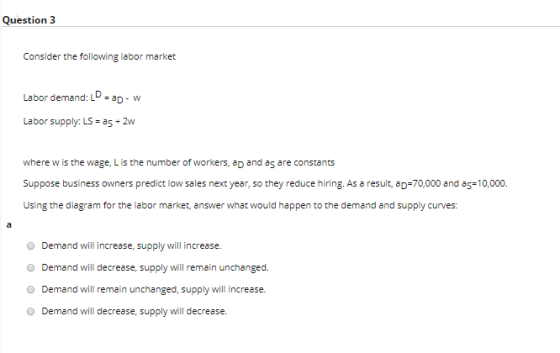
where w is the wage, L is the number of workers, aD and aS are constants
Suppose business owners predict low sales next year, so they reduce hiring. As a result, aD=70,000 and aS=10,000.
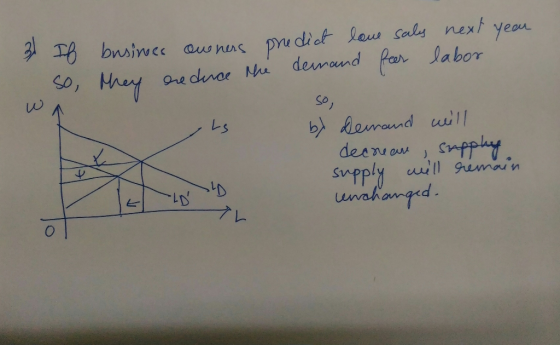
Using the diagram for the labor market, answer what would happen to the demand and supply curves:
Homework Answers
Add Answer to:
where w is the wage, L is the number of workers, aD
and aS are constants...
Consider the following labor market Labor demand: LD = ap - w Labor supply: LS =...
 Consider the following labor market Labor demand: LD = ap - w Labor supply: LS = as + 2w where w is the wage, L is the number of workers, ap and as are constants Now suppose that business owners predict low sales next year so they reduce hiring and as a result, ap=70,000 and ag=10,000. But in this scenario wages are totally rigid and cannot adjust this year from its original level (i.e. when ap=100,000 and ag=10,000): find the...
Consider the following labor market Labor dernand: LD ap- w Labor supply: LS = as+ 2w...
 Consider the following labor market Labor dernand: LD ap- w Labor supply: LS = as+ 2w where w is the wage, L is the number of workers, ap and as are constants Now suppose that business owners predict low sales next year so they reduce hiring and as a result, ap 70,000 and ag 10,000. But in this scenario wages are totally rigid and cannot adjust this year from its original level (i.e. when ap=100,000 and as10,000): find the equilibrium...
demand and supply Question 7 1 points Save Answer Consider the following labor market Labor demand:...
 demand and supply
Question 7 1 points Save Answer Consider the following labor market Labor demand: LD = ad-w Labor supply: LS = as - 2w where w is the wage, L is the number of workers, ap and as are constants Now suppose that business owners predict low sales next year so they reduce hiring and as a result, ap=70,000 and as=10,000. But in this scenario wages are totally rigid and cannot adjust this year from its original level...
demand and supply
Question 7 1 points Save Answer Consider the following labor market Labor demand: LD = ad-w Labor supply: LS = as - 2w where w is the wage, L is the number of workers, ap and as are constants Now suppose that business owners predict low sales next year so they reduce hiring and as a result, ap=70,000 and as=10,000. But in this scenario wages are totally rigid and cannot adjust this year from its original level...
equilibrium wage? Question 6 1 points Save Answer Consider the following labor market Labor demand: Lap-...
 equilibrium wage?
Question 6 1 points Save Answer Consider the following labor market Labor demand: Lap- w Labor supply: LS as 2w where w is the wage, Lis the number of workers, ap and as are constants Now suppose that business owners predict low sales next year so they reduce hiring and as a result, ap-70,0000 and as10,000. But in this scenario wages are totally rigid and cannot adjust this year from its orig level (i.e. when ap=100,000 and as10,000):...
equilibrium wage?
Question 6 1 points Save Answer Consider the following labor market Labor demand: Lap- w Labor supply: LS as 2w where w is the wage, Lis the number of workers, ap and as are constants Now suppose that business owners predict low sales next year so they reduce hiring and as a result, ap-70,0000 and as10,000. But in this scenario wages are totally rigid and cannot adjust this year from its orig level (i.e. when ap=100,000 and as10,000):...
What is the equilibrium employment level? Question 2 Consider the following labor market Labor demand: L...
 What is the equilibrium employment level?
Question 2 Consider the following labor market Labor demand: L ap- w Labor supply: LS = as 2w where w is the wage, Lis the number of workers, ap and as are constants a) Suppose that ap 100,000 and as10,000: find the equilibrium employment level L*30,000 L*35,000 L60,000 L70,000
What is the equilibrium employment level?
Question 2 Consider the following labor market Labor demand: L ap- w Labor supply: LS = as 2w where w is the wage, Lis the number of workers, ap and as are constants a) Suppose that ap 100,000 and as10,000: find the equilibrium employment level L*30,000 L*35,000 L60,000 L70,000
Wage rate Market labor supply curve X W" Market labor demand curve Quantity of labor (workers)...
 Wage rate Market labor supply curve X W" Market labor demand curve Quantity of labor (workers) In the figure, a decrease in the price of the good produced, when everything else stays the same, will lead to a(n). in the equilibrium quantity of labor and a(n). in the equilibrium price of labor. increase; decrease O decrease; increase O decrease; decrease increase; increase
Consider an economy with two labor markets: one for manufacturing workers and one for service workers. Suppose initially that neither is unionized.
 Consider an economy with two labor markets: one for manufacturing workers and one for service workers. Suppose initially that neither is unionized. Which of the following will happen to the manufacturing labor market if manufacturing workers formed a union? Check all that apply. The wage of manufacturing workers will fall. The demand for manufacturing workers will remain unchanged. The supply of manufacturing workers will increase. Some manufacturing workers will become unemployed. Which of the following describes the effect of the changes in the manufacturing labor market...
Wage Number of Workers $7 1 2 $9 $11 | $126 The data in the table...
 Wage Number of Workers $7 1 2 $9 $11 | $126 The data in the table describe the supply schedule for labor in a monopsonistic labor market. The marginal factor cost of the fifth worker is Which of the following will result in a decrease in the supply of labor? Α ). An increase in worker productivity An increase in the wage rate An increase in the preference for leisure A decrease in the price of the product that the...
The demand for labor in Occupation A is LD = 20 - W, where LD = number of workers demanded for that occupation, in thou...
 The demand for labor in Occupation A is LD = 20 - W, where LD = number of workers demanded for that occupation, in thousands. The supply of labor for Occupation A is LA = -1.25 +.5W. For Occupation B, the demand for labor is similar, but the supply of labor is LB=-.5 +.6W, which is indicative of a more pleasant environment associated with that occupation in comparison with Occupation A. What is the compensating wage differential between the two...
16. Suppose labor demand is given by the equation L = 50 −2W, where L is the number of workers and W is the wage rate....
 16. Suppose labor demand is given by the equation
L = 50 −2W,
where L is the number of workers and W is the wage rate.
16a. The slope of the demand curve can be viewed as the amount by which L changes for every 1 unit change in W. This can be expressed formally as C SlopeAL ДW. where A refers to a small change in the value of L or W. Using this definition, find the slope associated...
16. Suppose labor demand is given by the equation
L = 50 −2W,
where L is the number of workers and W is the wage rate.
16a. The slope of the demand curve can be viewed as the amount by which L changes for every 1 unit change in W. This can be expressed formally as C SlopeAL ДW. where A refers to a small change in the value of L or W. Using this definition, find the slope associated...
 Consider the following labor market Labor demand: LD = ap - w Labor supply: LS = as + 2w where w is the wage, L is the number of workers, ap and as are constants Now suppose that business owners predict low sales next year so they reduce hiring and as a result, ap=70,000 and ag=10,000. But in this scenario wages are totally rigid and cannot adjust this year from its original level (i.e. when ap=100,000 and ag=10,000): find the...
 Consider the following labor market Labor dernand: LD ap- w Labor supply: LS = as+ 2w where w is the wage, L is the number of workers, ap and as are constants Now suppose that business owners predict low sales next year so they reduce hiring and as a result, ap 70,000 and ag 10,000. But in this scenario wages are totally rigid and cannot adjust this year from its original level (i.e. when ap=100,000 and as10,000): find the equilibrium...
 demand and supply
Question 7 1 points Save Answer Consider the following labor market Labor demand: LD = ad-w Labor supply: LS = as - 2w where w is the wage, L is the number of workers, ap and as are constants Now suppose that business owners predict low sales next year so they reduce hiring and as a result, ap=70,000 and as=10,000. But in this scenario wages are totally rigid and cannot adjust this year from its original level...
demand and supply
Question 7 1 points Save Answer Consider the following labor market Labor demand: LD = ad-w Labor supply: LS = as - 2w where w is the wage, L is the number of workers, ap and as are constants Now suppose that business owners predict low sales next year so they reduce hiring and as a result, ap=70,000 and as=10,000. But in this scenario wages are totally rigid and cannot adjust this year from its original level...
 equilibrium wage?
Question 6 1 points Save Answer Consider the following labor market Labor demand: Lap- w Labor supply: LS as 2w where w is the wage, Lis the number of workers, ap and as are constants Now suppose that business owners predict low sales next year so they reduce hiring and as a result, ap-70,0000 and as10,000. But in this scenario wages are totally rigid and cannot adjust this year from its orig level (i.e. when ap=100,000 and as10,000):...
equilibrium wage?
Question 6 1 points Save Answer Consider the following labor market Labor demand: Lap- w Labor supply: LS as 2w where w is the wage, Lis the number of workers, ap and as are constants Now suppose that business owners predict low sales next year so they reduce hiring and as a result, ap-70,0000 and as10,000. But in this scenario wages are totally rigid and cannot adjust this year from its orig level (i.e. when ap=100,000 and as10,000):...
 What is the equilibrium employment level?
Question 2 Consider the following labor market Labor demand: L ap- w Labor supply: LS = as 2w where w is the wage, Lis the number of workers, ap and as are constants a) Suppose that ap 100,000 and as10,000: find the equilibrium employment level L*30,000 L*35,000 L60,000 L70,000
What is the equilibrium employment level?
Question 2 Consider the following labor market Labor demand: L ap- w Labor supply: LS = as 2w where w is the wage, Lis the number of workers, ap and as are constants a) Suppose that ap 100,000 and as10,000: find the equilibrium employment level L*30,000 L*35,000 L60,000 L70,000
 Wage rate Market labor supply curve X W" Market labor demand curve Quantity of labor (workers) In the figure, a decrease in the price of the good produced, when everything else stays the same, will lead to a(n). in the equilibrium quantity of labor and a(n). in the equilibrium price of labor. increase; decrease O decrease; increase O decrease; decrease increase; increase
 Wage Number of Workers $7 1 2 $9 $11 | $126 The data in the table describe the supply schedule for labor in a monopsonistic labor market. The marginal factor cost of the fifth worker is Which of the following will result in a decrease in the supply of labor? Α ). An increase in worker productivity An increase in the wage rate An increase in the preference for leisure A decrease in the price of the product that the...
 The demand for labor in Occupation A is LD = 20 - W, where LD = number of workers demanded for that occupation, in thousands. The supply of labor for Occupation A is LA = -1.25 +.5W. For Occupation B, the demand for labor is similar, but the supply of labor is LB=-.5 +.6W, which is indicative of a more pleasant environment associated with that occupation in comparison with Occupation A. What is the compensating wage differential between the two...
 16. Suppose labor demand is given by the equation
L = 50 −2W,
where L is the number of workers and W is the wage rate.
16a. The slope of the demand curve can be viewed as the amount by which L changes for every 1 unit change in W. This can be expressed formally as C SlopeAL ДW. where A refers to a small change in the value of L or W. Using this definition, find the slope associated...
16. Suppose labor demand is given by the equation
L = 50 −2W,
where L is the number of workers and W is the wage rate.
16a. The slope of the demand curve can be viewed as the amount by which L changes for every 1 unit change in W. This can be expressed formally as C SlopeAL ДW. where A refers to a small change in the value of L or W. Using this definition, find the slope associated...
Most questions answered within 3 hours.
-
Where is the error in this code sequence?
String s1 = "Hello";
String s2 = "ello";...
asked 11 months ago -
Financial data for Joel de Paris, Inc., for last year
follow:
Joel de Paris, Inc.
Balance...
asked 11 months ago -
Consider this reaction:
Al2(SO4)3 (aq)+ BaCl3
(aq) Al2Cl6 (aq)- +
3BaSO4(s) . What is the...
asked 11 months ago -
Suppose that Savneet is considering increasing her
recent random sample from 20 car rentals to 40...
asked 11 months ago -
Trucks arrive at an unloading terminal at an average rate of 120
per hour.
Trucks arrive...
asked 11 months ago -
Why are methanol and ethanol completely soluble in water while
octanol is not very little soluble....
asked 11 months ago -
A facilities manager at a university reads in a research report
that the mean amount of...
asked 11 months ago -
When the CuSO4 is rehydrated by adding water to the anhydrous
compound, is this an endothermic...
asked 11 months ago -
A ray of sunlight is passing from diamond into crown glass; the
angle of incidence is...
asked 11 months ago -
A block of mass 0.249 kg is placed on top of a light, vertical
spring of...
asked 11 months ago -
how do the kidneys compensate in the presences of acidosis
a) trigger hyperventilate
b) reserve acid...
asked 11 months ago -
Question 501 pts
The rental rate of capital to the firm increases. Which of the
following...
asked 11 months ago