
Homework Answers
Average labor productivity is found by dividing Real GDP per capita with employment to population
|
Average labor productivity |
||
|
1979 |
2008 |
|
|
Germany |
42403 |
42451 |
|
Japan |
27423 |
44737 |
For Germany, the minute increase in average labor productivity is because of increase in employment to population and not because of increase real GDP per capita.
For Japan, the minute increase in average labor productivity is because of increase in real GDP per capita than increase in employment to population.
Add Answer to:
Question 36 Not yet andwered Points out of 3.00 Real GDP per Employment to population Average...
If real GDP per person in a country equals $40,000 and 60 percent of the population...
If real GDP per person in a country equals $40,000 and 60 percent of the population is employed, then average labor productivity equals: Multiple Choice $66,667. $60,000. $24,000. $40,000.
Real GDP per person can increase: A) only if the share of the population employed decreases....
Real GDP per person can increase: A) only if the share of the population employed decreases. B) if the share of population employed and/or average labor productivity increases. C) only if average labor productivity increases. D) only if the share of the population employed increases.
Canvas > x C @ B. Average Labor Productivity "Share of Population employed Total Labor Productivity...
 Canvas > x C @ B. Average Labor Productivity "Share of Population employed Total Labor Productivity Population Average Labor Productivity/Share of Population Employed Question 7 A country has these statistics: Population = 31 million Number of employed workers * 21 million Real GDP 15,401 million What is Real GDP per capita for this country? Give your answer to 2 decimal places. That is, if your calculator says 23.3577970897, write 23.36 Question 8 A country has these statistics: Population31 million Question...
Here is some data on the economy: 2007 2008 Real GDP $1,300,000 $1,328,000 Populatio 12,227 12,838...
 Here is some data on the economy: 2007 2008 Real GDP $1,300,000 $1,328,000 Populatio 12,227 12,838 2009 $1,429,000 13,480 2010 $1,411,000 14,154 2) Calculate real GDP per capita 3) Calculate the growth rates for each year for real GDP and population. 4) Estimate the growth rates for each year for GDP per capita real using the growth rates from 3). Check your estimate by calculating the actual per capita growth rate. 5) Using the growth rates from 2008 to 2009,...
The following table gives nominal GDP, real GDP, and the population for two years. Find per...
The following table gives nominal GDP, real GDP, and the population for two years. Find per capita real GDP in each year and fill in the table. (Round your answers to two decimal places.) Year Nominal GDP Real GDP Population Per Capita Real GDP 2010 5600 4870 100 2011 6048 5040 104
Consider the following data Country Population (millions) Real GDP ($ billions) 11 22 74 What is...
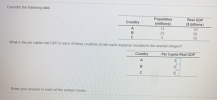 Consider the following data Country Population (millions) Real GDP ($ billions) 11 22 74 What is the per capita real GDP in each of these countries (Enter each response rounded to the nearest integer)? Country Per Capita Real GDP Enter your answer in each of the answer boxes.
9.15. Based on data in Table 9-1 and the rule of 70, if U.S. per capita...
 9.15. Based on data in Table 9-1 and the rule of 70, if U.S. per capita real GDP continues to grow at the average rate it has experienced since 1990, about how many years will be required for it to double? TABLE 9-1 Per Capita Real GDP Growth Rates in Various Countries Average Annual Rate of Growth of Real Country GDP Per Capita, 1990-2017 (%) Japan 0.8 France 0.9 Germany 1.4 Canada 1.4 Sweden 1.5 United States Turkey Chile 3.7...
1. Consider the case where real GDP and population are both growing, and real GDP is growing...
1. Consider the case where real GDP and population are both growing, and real GDP is growing faster than population. Which statement below is TRUE? A Real GDP per capita would increase and faster than real GDP. B Real GDP per capita would increase but slower than real GDP. C Real GDP per capita would remain the same. D Real GDP per capita would fall. Questions 2 and 3. Both Cowen and Tabarrok (Figure 7.1) and the Hans Rosling video illustrate the robust empirical truth that the...
Question 15 Labor productivity 400 Real GDP per capita 300 Private employment Median family income 200...
 Question 15 Labor productivity 400 Real GDP per capita 300 Private employment Median family income 200 1947-100 950 55 '60 65 775 80 85 90952000 050 SOURCE FEDERAL RESERVE BANK OF ST. LOUIS; ERIK BRYNJOLFSSON AND ANDREW MCAFEE FROM "THE GREAT DECOUPLING,"JUNE 2015 eHBR ORG a) The graph above shows various indexes from the US from 1950 where 1947 is treated as 100. Briefly describe the variables in the graph b) What are the implications for workers of the trends...
Table 23.1: Real GDP, Population and the Civilian Labor Force Statistics Labor Force | Real GDP...
 Table 23.1: Real GDP, Population and the Civilian Labor Force Statistics Labor Force | Real GDP Population Participation Unemployment Year (in Billions $) (in Millions) Rates (%) Rates (%) 1,019.00 110.000 0.750 5.00% 1,020.00 111.000 0.756 6.00% 1,030.00 112.000 0.788 6.5096 1,035.00 113.000 0.769 7.0096 millions, and the percentage change in 26) In Year 4, according to Table 23.1, the total employed workers were_ per-capita income was -percent, respectively. A) 80.61; 3.50 B) 78.22; 0.33 C) 80.81; minus 0.40 D)...
 Canvas > x C @ B. Average Labor Productivity "Share of Population employed Total Labor Productivity Population Average Labor Productivity/Share of Population Employed Question 7 A country has these statistics: Population = 31 million Number of employed workers * 21 million Real GDP 15,401 million What is Real GDP per capita for this country? Give your answer to 2 decimal places. That is, if your calculator says 23.3577970897, write 23.36 Question 8 A country has these statistics: Population31 million Question...
 Here is some data on the economy: 2007 2008 Real GDP $1,300,000 $1,328,000 Populatio 12,227 12,838 2009 $1,429,000 13,480 2010 $1,411,000 14,154 2) Calculate real GDP per capita 3) Calculate the growth rates for each year for real GDP and population. 4) Estimate the growth rates for each year for GDP per capita real using the growth rates from 3). Check your estimate by calculating the actual per capita growth rate. 5) Using the growth rates from 2008 to 2009,...
 Consider the following data Country Population (millions) Real GDP ($ billions) 11 22 74 What is the per capita real GDP in each of these countries (Enter each response rounded to the nearest integer)? Country Per Capita Real GDP Enter your answer in each of the answer boxes.
 9.15. Based on data in Table 9-1 and the rule of 70, if U.S. per capita real GDP continues to grow at the average rate it has experienced since 1990, about how many years will be required for it to double? TABLE 9-1 Per Capita Real GDP Growth Rates in Various Countries Average Annual Rate of Growth of Real Country GDP Per Capita, 1990-2017 (%) Japan 0.8 France 0.9 Germany 1.4 Canada 1.4 Sweden 1.5 United States Turkey Chile 3.7...
 Question 15 Labor productivity 400 Real GDP per capita 300 Private employment Median family income 200 1947-100 950 55 '60 65 775 80 85 90952000 050 SOURCE FEDERAL RESERVE BANK OF ST. LOUIS; ERIK BRYNJOLFSSON AND ANDREW MCAFEE FROM "THE GREAT DECOUPLING,"JUNE 2015 eHBR ORG a) The graph above shows various indexes from the US from 1950 where 1947 is treated as 100. Briefly describe the variables in the graph b) What are the implications for workers of the trends...
 Table 23.1: Real GDP, Population and the Civilian Labor Force Statistics Labor Force | Real GDP Population Participation Unemployment Year (in Billions $) (in Millions) Rates (%) Rates (%) 1,019.00 110.000 0.750 5.00% 1,020.00 111.000 0.756 6.00% 1,030.00 112.000 0.788 6.5096 1,035.00 113.000 0.769 7.0096 millions, and the percentage change in 26) In Year 4, according to Table 23.1, the total employed workers were_ per-capita income was -percent, respectively. A) 80.61; 3.50 B) 78.22; 0.33 C) 80.81; minus 0.40 D)...
Most questions answered within 3 hours.
-
Where is the error in this code sequence?
String s1 = "Hello";
String s2 = "ello";...
asked 11 months ago -
Financial data for Joel de Paris, Inc., for last year
follow:
Joel de Paris, Inc.
Balance...
asked 11 months ago -
Consider this reaction:
Al2(SO4)3 (aq)+ BaCl3
(aq) Al2Cl6 (aq)- +
3BaSO4(s) . What is the...
asked 11 months ago -
Suppose that Savneet is considering increasing her
recent random sample from 20 car rentals to 40...
asked 11 months ago -
Trucks arrive at an unloading terminal at an average rate of 120
per hour.
Trucks arrive...
asked 11 months ago -
Why are methanol and ethanol completely soluble in water while
octanol is not very little soluble....
asked 11 months ago -
A facilities manager at a university reads in a research report
that the mean amount of...
asked 11 months ago -
When the CuSO4 is rehydrated by adding water to the anhydrous
compound, is this an endothermic...
asked 11 months ago -
A ray of sunlight is passing from diamond into crown glass; the
angle of incidence is...
asked 11 months ago -
A block of mass 0.249 kg is placed on top of a light, vertical
spring of...
asked 11 months ago -
how do the kidneys compensate in the presences of acidosis
a) trigger hyperventilate
b) reserve acid...
asked 11 months ago -
Question 501 pts
The rental rate of capital to the firm increases. Which of the
following...
asked 11 months ago