. Player 1 and Player 2 are going to play the following stage game twice:
. Player 1 and Player 2 are going to play the following stage game twice:
|
Player 2 |
||||
|
Left |
Middle |
Right |
||
|
Player 1 |
Top |
4, 3 |
0, 0 |
1, 4 |
|
Bottom |
0, 0 |
2, 1 |
0, 0 |
|
There is no discounting in this problem and so a player’s payoff in this repeated game is the sum of her payoffs in the two plays of the stage game.
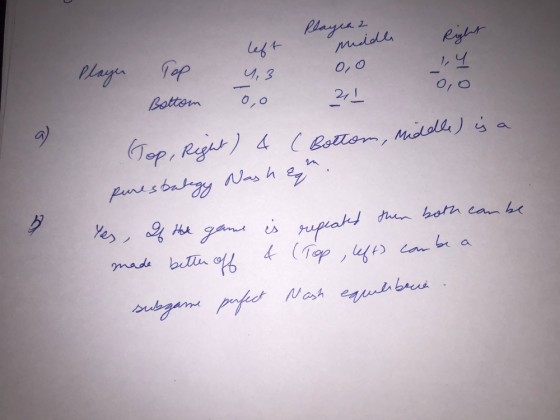
(a) Find the Nash equilibria of the stage game. Is (Top, Left) a Nash of the stage game?
(b) Find a subgame perfect Nash equilibrium of the repeated game where the first time they play the stage game Player 1 chooses Top and Player 2 chooses Left.
Homework Answers
Add Answer to:
. Player 1 and Player 2 are going to play the following stage
game twice:
3. Player 1 and Player 2 are going to play the following stage game twice: &n...
 3. Player 1 and Player 2 are going to play the following stage
game twice:
Player 2
Left
Middle
Right
Player 1
Top
4, 3
0, 0
1, 4
Bottom
0, 0
2, 1
0, 0
There is no discounting in this problem and so a player’s payoff
in this repeated game is the sum of her payoffs in the two plays of
the stage game.
(a) Find the Nash equilibria of the stage game. Is (Top, Left) a...
3. Player 1 and Player 2 are going to play the following stage
game twice:
Player 2
Left
Middle
Right
Player 1
Top
4, 3
0, 0
1, 4
Bottom
0, 0
2, 1
0, 0
There is no discounting in this problem and so a player’s payoff
in this repeated game is the sum of her payoffs in the two plays of
the stage game.
(a) Find the Nash equilibria of the stage game. Is (Top, Left) a...
In the extensive form representation of the game between Player 1 and Player 2, Player 1...
In the extensive form representation of the game between Player 1 and Player 2, Player 1 moves first and chooses L or R. If Player 1 chooses R the game ends, if Player 1 chooses L then Player 1 and 2 play a simultaneous move game. The game has______________ pure strategy Nash equilibria and__________ pure strategy Subgame Perfect Nash Equilibria (SPNE). The maximum payoff Player 2 gets in a SPNE is___________ . (Please, enter only numerical answers like: 1, 2,...
Game: Extensive Form. Suppose player 1 chooses G or H, and player 2 observes this choice....
Game: Extensive Form. Suppose player 1 chooses G or H, and player 2 observes this choice. If player 1 chooses H, then player 2 must choose A or B. Player 1 does not get to observe this choice by player 2, and must then choose X or Y. If A and X are played, the payoff for player 1 is 1 and for player 2 it's 5. If A and Y are played, the payoff for player 1 is 6...
2. Consider the following sequential game. Player A can choose between two tasks, Tl and T2....
 2. Consider the following sequential game. Player A can choose between two tasks, Tl and T2. After having observed the choice of A, Player B chooses between two projects Pl or P2. The payoffs are as follows: If A chooses TI and B chooses P1 the payoffs are (12, 8), where the first payoff is for A and the second for B; if A chooses T1 and B opts for P2 the payoffs are (20, 7); if A chooses T2...
2. Consider the following sequential game. Player A can choose between two tasks, TI and T2....
 2. Consider the following sequential game. Player A can choose between two tasks, TI and T2. After having observed the choice of A, Player B chooses between two projects P1 or P2. The payoffs are as follows: If A chooses TI and B chooses Pl the payoffs are (12.8), where the first payoff is for A and the second for B; if A chooses TI and B opts for P2 the payoffs are (20,7); if A chooses T2 and B...
1. Consider the following normal form game: 112 L CR T 10 102 12 0 13...
 1. Consider the following normal form game: 112 L CR T 10 102 12 0 13 M 12 25 5 0 0 B|13 010 011 a) (Level A) First suppose this game is played only once. What are the pure strategy Nash equilibria? (b) (Level B) Now suppose this game is played twice. Players observe the actions chosen in the first period prior to the second period. Each player's total payoff is the sum of his/her payoff in the two...
1. Consider the following normal form game 112 L CR T|10 1012 1210 13 M 12...
 1. Consider the following normal form game 112 L CR T|10 1012 1210 13 M 12 25 5 0 (0 B113 0100 (a) (Level A) First suppose this game is played only once. What are the pure strategy Nash equilibria? (b) (Level B) Now suppose this game is played twice. Players observe the actions chosen in the first period prior to the second period. Each player's total payoff is the sum of his/her payoff in the two periods. Consider the...
Consider the following two-period repeated game. The stage game is the following: payoff S H C...
Consider the following two-period repeated game. The stage game is the following: payoff S H C S 3,3 0,1 0,0 H 1,0 1,1 6,0 C 0,0 0,6 5,5 (a) Find all pure-strategy Nash equilibria if the stage game is played only once. (b) Now consider the two-period game. Suppose the discount factor δ = 1 for both players. Find a subgame perfect equilibrium in which each player receives a total payoff of at least 8. (c) For what other values...
2. Consider the extensive form game shown in the figure below. The top payoff at a terminal node ...
 2. Consider the extensive form game shown in the figure below. The top payoff at a terminal node is for player 1. Find all subgame perfect Nash equilibria P1 P2 P2 P1 P1 0 10 4 4 4
2. Consider the extensive form game shown in the figure below. The top payoff at a terminal node is for player 1. Find all subgame perfect Nash equilibria P1 P2 P2 P1 P1 0 10 4 4 4
2. Consider the extensive form game shown in the figure below. The top payoff at a terminal node is for player 1. Find all subgame perfect Nash equilibria P1 P2 P2 P1 P1 0 10 4 4 4
Consider the following extensive-form game with two players, 1 and 2. a). Find the pure-strategy Nash...
 Consider the following extensive-form game with two players, 1
and 2.
a). Find the pure-strategy Nash equilibria of the game. [8
Marks]
b). Find the pure-strategy subgame-perfect equilibria of the
game. [6 Marks]
c). Derive the mixed strategy Nash equilibrium of the subgame.
If players play this mixed Nash equilibrium in the subgame, would 1
player In or Out at the initial mode? [6 Marks]
[Hint: Write down the normal-form of the subgame and derive the
mixed Nash equilibrium of...
Consider the following extensive-form game with two players, 1
and 2.
a). Find the pure-strategy Nash equilibria of the game. [8
Marks]
b). Find the pure-strategy subgame-perfect equilibria of the
game. [6 Marks]
c). Derive the mixed strategy Nash equilibrium of the subgame.
If players play this mixed Nash equilibrium in the subgame, would 1
player In or Out at the initial mode? [6 Marks]
[Hint: Write down the normal-form of the subgame and derive the
mixed Nash equilibrium of...
 3. Player 1 and Player 2 are going to play the following stage
game twice:
Player 2
Left
Middle
Right
Player 1
Top
4, 3
0, 0
1, 4
Bottom
0, 0
2, 1
0, 0
There is no discounting in this problem and so a player’s payoff
in this repeated game is the sum of her payoffs in the two plays of
the stage game.
(a) Find the Nash equilibria of the stage game. Is (Top, Left) a...
3. Player 1 and Player 2 are going to play the following stage
game twice:
Player 2
Left
Middle
Right
Player 1
Top
4, 3
0, 0
1, 4
Bottom
0, 0
2, 1
0, 0
There is no discounting in this problem and so a player’s payoff
in this repeated game is the sum of her payoffs in the two plays of
the stage game.
(a) Find the Nash equilibria of the stage game. Is (Top, Left) a...
 2. Consider the following sequential game. Player A can choose between two tasks, Tl and T2. After having observed the choice of A, Player B chooses between two projects Pl or P2. The payoffs are as follows: If A chooses TI and B chooses P1 the payoffs are (12, 8), where the first payoff is for A and the second for B; if A chooses T1 and B opts for P2 the payoffs are (20, 7); if A chooses T2...
 2. Consider the following sequential game. Player A can choose between two tasks, TI and T2. After having observed the choice of A, Player B chooses between two projects P1 or P2. The payoffs are as follows: If A chooses TI and B chooses Pl the payoffs are (12.8), where the first payoff is for A and the second for B; if A chooses TI and B opts for P2 the payoffs are (20,7); if A chooses T2 and B...
 1. Consider the following normal form game: 112 L CR T 10 102 12 0 13 M 12 25 5 0 0 B|13 010 011 a) (Level A) First suppose this game is played only once. What are the pure strategy Nash equilibria? (b) (Level B) Now suppose this game is played twice. Players observe the actions chosen in the first period prior to the second period. Each player's total payoff is the sum of his/her payoff in the two...
 1. Consider the following normal form game 112 L CR T|10 1012 1210 13 M 12 25 5 0 (0 B113 0100 (a) (Level A) First suppose this game is played only once. What are the pure strategy Nash equilibria? (b) (Level B) Now suppose this game is played twice. Players observe the actions chosen in the first period prior to the second period. Each player's total payoff is the sum of his/her payoff in the two periods. Consider the...
 2. Consider the extensive form game shown in the figure below. The top payoff at a terminal node is for player 1. Find all subgame perfect Nash equilibria P1 P2 P2 P1 P1 0 10 4 4 4
2. Consider the extensive form game shown in the figure below. The top payoff at a terminal node is for player 1. Find all subgame perfect Nash equilibria P1 P2 P2 P1 P1 0 10 4 4 4
2. Consider the extensive form game shown in the figure below. The top payoff at a terminal node is for player 1. Find all subgame perfect Nash equilibria P1 P2 P2 P1 P1 0 10 4 4 4
 Consider the following extensive-form game with two players, 1
and 2.
a). Find the pure-strategy Nash equilibria of the game. [8
Marks]
b). Find the pure-strategy subgame-perfect equilibria of the
game. [6 Marks]
c). Derive the mixed strategy Nash equilibrium of the subgame.
If players play this mixed Nash equilibrium in the subgame, would 1
player In or Out at the initial mode? [6 Marks]
[Hint: Write down the normal-form of the subgame and derive the
mixed Nash equilibrium of...
Consider the following extensive-form game with two players, 1
and 2.
a). Find the pure-strategy Nash equilibria of the game. [8
Marks]
b). Find the pure-strategy subgame-perfect equilibria of the
game. [6 Marks]
c). Derive the mixed strategy Nash equilibrium of the subgame.
If players play this mixed Nash equilibrium in the subgame, would 1
player In or Out at the initial mode? [6 Marks]
[Hint: Write down the normal-form of the subgame and derive the
mixed Nash equilibrium of...
Most questions answered within 3 hours.
-
Where is the error in this code sequence?
String s1 = "Hello";
String s2 = "ello";...
asked 10 months ago -
Financial data for Joel de Paris, Inc., for last year
follow:
Joel de Paris, Inc.
Balance...
asked 10 months ago -
Consider this reaction:
Al2(SO4)3 (aq)+ BaCl3
(aq) Al2Cl6 (aq)- +
3BaSO4(s) . What is the...
asked 10 months ago -
Suppose that Savneet is considering increasing her
recent random sample from 20 car rentals to 40...
asked 10 months ago -
Trucks arrive at an unloading terminal at an average rate of 120
per hour.
Trucks arrive...
asked 10 months ago -
Why are methanol and ethanol completely soluble in water while
octanol is not very little soluble....
asked 10 months ago -
A facilities manager at a university reads in a research report
that the mean amount of...
asked 10 months ago -
When the CuSO4 is rehydrated by adding water to the anhydrous
compound, is this an endothermic...
asked 10 months ago -
A ray of sunlight is passing from diamond into crown glass; the
angle of incidence is...
asked 10 months ago -
A block of mass 0.249 kg is placed on top of a light, vertical
spring of...
asked 10 months ago -
how do the kidneys compensate in the presences of acidosis
a) trigger hyperventilate
b) reserve acid...
asked 10 months ago -
Question 501 pts
The rental rate of capital to the firm increases. Which of the
following...
asked 10 months ago