Is a monopolist subject to any competitive pressures? Would an unregulated monopolist have an incentive to...
Is a monopolist subject to any competitive pressures? Would an unregulated monopolist have an incentive to operate and produce efficiently?
Homework Answers
A monopolist is a single seller in the market that is able to block the potential entry. There are however competitive pressures from potential entrance for which the monopolist continues to use different practices such as predatory pricing, limit pricing, etc. However it is really occurs when a potential entrant has the ability to turn the Monopoly market into a competitive one
An unregulated monopolist does not have an incentive to produce efficiently at the minimum efficient scale. This is because this increases the production and reduces the price which reduces Monopoly profit.
Add Answer to:
Is a monopolist subject to any competitive pressures? Would an
unregulated monopolist have an incentive to...
Name at least 3 things that a perfectly competitive firm and a monopolist have in common....
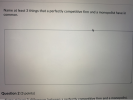 Name at least 3 things that a perfectly competitive firm and a monopolist have in common. Question 2 (3 points) Nama tinent difference hetween a nerfectly competitive firm and a monopolist.
When a perfectly competitive market is in long-run equilibrium: O firms have an incentive to enter...
 When a perfectly competitive market is in long-run equilibrium: O firms have an incentive to enter the market. O firms have an incentive to leave the market. O no firm has an incentive to enter or leave the market. When a firm operating in a perfectly competitive market is experiencing losses, it should continue operations if: O P< AVC O P=AVC O P > AVC If, in a perfectly competitive market, P= (a firm's) ATC, then the firm: earns an...
3. In each of the following, identify if true/false. Self-interested business decision makers operating in competitive...
3. In each of the following, identify if true/false. Self-interested business decision makers operating in competitive markets have a strong incentive to: a. produce efficiently (at a low-cost). b. give consumers what they want. c. search for innovative improvements.
Price Discriminating Monopolist vs. Single Price Monopolist I have 4/5 answers to the question correct, but I do not kno...
 Price Discriminating Monopolist vs. Single Price Monopolist
I have 4/5 answers to the question correct, but I do not know
which ones, and I cannot seem to figure out which one I have
incorrect. My answers are:
8
4
8
increases
Less Than
3. (Figure: Price-Discriminating Monopolist 2) The perfectly price-discriminating monopolist in this diagram will produce units of output, and a single-price monopolist would produce units of output. Consumer surplus under a perfectly price discriminating monopolist is_ dollars less...
Price Discriminating Monopolist vs. Single Price Monopolist
I have 4/5 answers to the question correct, but I do not know
which ones, and I cannot seem to figure out which one I have
incorrect. My answers are:
8
4
8
increases
Less Than
3. (Figure: Price-Discriminating Monopolist 2) The perfectly price-discriminating monopolist in this diagram will produce units of output, and a single-price monopolist would produce units of output. Consumer surplus under a perfectly price discriminating monopolist is_ dollars less...
MICROECONOMICS QUESTIONS 1.Monopolistically competitive firms have an incentive to: A. engage in tactics for bringing in...
MICROECONOMICS QUESTIONS 1.Monopolistically competitive firms have an incentive to: A. engage in tactics for bringing in more customers. B. advertise. C. engage in brand promotion. D. All of these statements are true. 2.The good or service that firms in an oligopoly sell: A. has no close substitutes. B. has close substitutes. C. is standardized. D. can be either standardized or have close substitutes
Tuscaloosa Cable is a monopolist who has sole authority to operate in Tuscaloosa. The demand and...
 Tuscaloosa Cable is a monopolist who has sole authority to operate in Tuscaloosa. The demand and marginal revenue curves that this monopolist face is given by P - 250-Q and MR-250-20, respectively. Marginal cost is $50 a. What is the profit maximizing quantity that the monopolist will supply? b. What price will the profit maximizing quantity be sold for in the market? c. Calculate the Lerner Index for this monopolist (If your answer has decimals, round to TWO DECIMAL PLACES):...
Tuscaloosa Cable is a monopolist who has sole authority to operate in Tuscaloosa. The demand and...
 Tuscaloosa Cable is a monopolist who has sole authority to operate in Tuscaloosa. The demand and marginal revenue curves that thi monopolist face is given by P - 250 - Q and MR=250-26, respectively. Marginal cost is $50 a. What is the profit maximizing quantity that the monopolist will supply? b. What price will the profit maximizing quantity be sold for in the market? c. Calculate the Lerner Index for this monopolist (If your answer has decimals, round to TWO...
1. Perfectly competitive firms do not have competitive behavior because a. the actions of any one...
 1. Perfectly competitive firms do not have competitive behavior because a. the actions of any one firm would have no effect on any other firm. b. the firms are regulated. c. government legislation prevents it. d None of the above.
Exercise 2: Please help! A monopolist manufacturer sells to competitive retailers. The competitive retailers currently provide...
Exercise 2: Please help! A monopolist manufacturer sells to competitive retailers. The competitive retailers currently provide no services for the manufacturer’s good. Suppose the final consumer demand for the good at the retailer level is P = 100–Q and the costs for the manufacturer of producing the good are represented by MC = AC = 20. Currently, the manufacturer sell the good to the retailer at w=60. 1. Calculate the profit of the retailers and of the manufacturer The manufacturer...
1.) What is the main difference between a competitive firm and a monopoly? a. A competitive...
1.) What is the main difference between a competitive firm and a monopoly? a. A competitive firm owns a key resource, but a monopoly firm does not. b. A competitive firm is a price taker, and a monopoly is a price maker. c. A competitive firm produces output at a lower cost than a monopoly firm. d. A competitive firm is subject to government regulations, but a monopoly firm is not. 2.) What is the main social problem caused by...
 Name at least 3 things that a perfectly competitive firm and a monopolist have in common. Question 2 (3 points) Nama tinent difference hetween a nerfectly competitive firm and a monopolist.
 When a perfectly competitive market is in long-run equilibrium: O firms have an incentive to enter the market. O firms have an incentive to leave the market. O no firm has an incentive to enter or leave the market. When a firm operating in a perfectly competitive market is experiencing losses, it should continue operations if: O P< AVC O P=AVC O P > AVC If, in a perfectly competitive market, P= (a firm's) ATC, then the firm: earns an...
 Price Discriminating Monopolist vs. Single Price Monopolist
I have 4/5 answers to the question correct, but I do not know
which ones, and I cannot seem to figure out which one I have
incorrect. My answers are:
8
4
8
increases
Less Than
3. (Figure: Price-Discriminating Monopolist 2) The perfectly price-discriminating monopolist in this diagram will produce units of output, and a single-price monopolist would produce units of output. Consumer surplus under a perfectly price discriminating monopolist is_ dollars less...
Price Discriminating Monopolist vs. Single Price Monopolist
I have 4/5 answers to the question correct, but I do not know
which ones, and I cannot seem to figure out which one I have
incorrect. My answers are:
8
4
8
increases
Less Than
3. (Figure: Price-Discriminating Monopolist 2) The perfectly price-discriminating monopolist in this diagram will produce units of output, and a single-price monopolist would produce units of output. Consumer surplus under a perfectly price discriminating monopolist is_ dollars less...
 Tuscaloosa Cable is a monopolist who has sole authority to operate in Tuscaloosa. The demand and marginal revenue curves that this monopolist face is given by P - 250-Q and MR-250-20, respectively. Marginal cost is $50 a. What is the profit maximizing quantity that the monopolist will supply? b. What price will the profit maximizing quantity be sold for in the market? c. Calculate the Lerner Index for this monopolist (If your answer has decimals, round to TWO DECIMAL PLACES):...
 Tuscaloosa Cable is a monopolist who has sole authority to operate in Tuscaloosa. The demand and marginal revenue curves that thi monopolist face is given by P - 250 - Q and MR=250-26, respectively. Marginal cost is $50 a. What is the profit maximizing quantity that the monopolist will supply? b. What price will the profit maximizing quantity be sold for in the market? c. Calculate the Lerner Index for this monopolist (If your answer has decimals, round to TWO...
 1. Perfectly competitive firms do not have competitive behavior because a. the actions of any one firm would have no effect on any other firm. b. the firms are regulated. c. government legislation prevents it. d None of the above.
Most questions answered within 3 hours.
-
Where is the error in this code sequence?
String s1 = "Hello";
String s2 = "ello";...
asked 10 months ago -
Financial data for Joel de Paris, Inc., for last year
follow:
Joel de Paris, Inc.
Balance...
asked 10 months ago -
Consider this reaction:
Al2(SO4)3 (aq)+ BaCl3
(aq) Al2Cl6 (aq)- +
3BaSO4(s) . What is the...
asked 10 months ago -
Suppose that Savneet is considering increasing her
recent random sample from 20 car rentals to 40...
asked 10 months ago -
Trucks arrive at an unloading terminal at an average rate of 120
per hour.
Trucks arrive...
asked 10 months ago -
Why are methanol and ethanol completely soluble in water while
octanol is not very little soluble....
asked 10 months ago -
A facilities manager at a university reads in a research report
that the mean amount of...
asked 10 months ago -
When the CuSO4 is rehydrated by adding water to the anhydrous
compound, is this an endothermic...
asked 10 months ago -
A ray of sunlight is passing from diamond into crown glass; the
angle of incidence is...
asked 10 months ago -
A block of mass 0.249 kg is placed on top of a light, vertical
spring of...
asked 10 months ago -
how do the kidneys compensate in the presences of acidosis
a) trigger hyperventilate
b) reserve acid...
asked 10 months ago -
Question 501 pts
The rental rate of capital to the firm increases. Which of the
following...
asked 10 months ago