Consider continuous-time model and five-month European call option on a non- dividend stock which a stock...
Homework Answers
Here, the S0 = 200; X = 190; r = 3%, t = 5/12 = 0.42. q = 0%, C = 40. Using this information, implied volatility is determined by applying Black-Scholes' option pricing model.
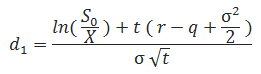
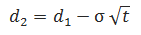

using these equations in excel, when sigma = 50%, C = 31.51 & when sigma = 100%, C = 55.47. Therefore, sigma should be between 50% & 100%. Similarly checking, we can find that 60%<sigma<70%. Iterating this process further, C = 40 when sigma = 67.59%.
Add Answer to:
Consider continuous-time model and five-month European call option
on a non- dividend stock which a stock...
4) A nine-month European call option is written on a stock that provides a continuous dividend...
 4) A nine-month European call option is written on a stock that provides a continuous dividend yield of 4%; the strike price is $110, the risk-free rate is 2% and the stock's volatility is 30%. Assume that the stock is currently selling for $115. What is the price of the call?
Question 3 - 20 Points Consider a European call option on a non-dividend-paying stock where the...
 Question 3 - 20 Points Consider a European call option on a non-dividend-paying stock where the stock price is $33, the strike price is $36, the risk-free rate is 6% per annum, the volatility is 25% per annum and the time to maturity is 6 months. (a) Calculate u and d for a one-step binomial tree. (b) Value the option using a non arbitrage argument. (c) Assume that the option is a put instead of a call. Value the option...
Consider a European put option on a non-dividend-paying stock. The current stock price is $69, the...
Consider a European put option on a non-dividend-paying stock. The current stock price is $69, the strike price is $70, the risk-free interest rate is 5% per annum, the volatility is 35% per annum and the time to maturity is 6 months. a. Use the Black-Scholes model to calculate the put price. b. Calculate the corresponding call option using the put-call parity relation. Use the Option Calculator Spreadsheet to verify your result.
Calculate the price of a three-month European put option on a non-dividend-paying stock with a strike...
Calculate the price of a three-month European put option on a non-dividend-paying stock with a strike price of $50 when the current stock price is $50, the risk-free interest rate is 10% per annum, and the volatility is 30% per annum
Problem 12.25. Consider a European call option on a non-dividend-paying stock where the stock price is $40, the strike price is $40, the risk-free rate is 4% per annum, the volatility is 30% per annu...
 Problem 12.25. Consider a European call option on a non-dividend-paying stock where the stock price is $40, the strike price is $40, the risk-free rate is 4% per annum, the volatility is 30% per annum, and the time to maturity is six months a. Calculate u, d, and p for a two step tree b. Value the option using a two step tree. c. Verify that DerivaGem gives the same answer d. Use DerivaGem to value the option with 5,...
Use the BSM model to calculate the price of a 13-month European call option with a...
Use the BSM model to calculate the price of a 13-month European call option with a strike price of $40 on a stock that is currently $48 and is expected to pay a $5 dividend in 6 months. The risk-free interest rate is 4% (annualized, continuously compounded), and the volatility of the stock’s returns is 55% per annum. (Reminder: your answer can have N(.) terms in it.)
(b) A 6-month European call option on a non-dividend paying stock is cur- rently selling for $3. The stock price is...
 (b) A 6-month European call option on a non-dividend paying stock is cur- rently selling for $3. The stock price is $50, the strike price is $55, and the risk-free interest rate is 6% per annum continuously compounded. The price for 6-months European put option with same strike, underlying and maturity is 82. What opportunities are there for an arbitrageur? Describe the strategy and compute the gain.
The price of a non-dividend paying stock is $15 and the price of a six-month European...
The price of a non-dividend paying stock is $15 and the price of a six-month European call option on the stock with a strike price of $22 is $2. The risk-free rate is 5% per annum. What is the price of a six-month European put option with a strike price of $22?
5) A three-month European put option is written on a stock that provides a continuous dividend...
 5) A three-month European put option is written on a stock that provides a continuous dividend yield of 2%; the strike price is $95, the risk-free rate is 2% and the stock's volatility is 40%. Assume that the stock is currently selling for $90. What is the price of the put?
(a) State the Black-Scholes formulas for the prices at time 0 of a European call and put options on a non-dividend-paying stock ABC
2. (a) State the Black-Scholes formulas for the prices at time 0 of a European call and put options on a non-dividend-paying stock ABC.(b) Consider an option on a non-dividend paying stock when the stock price is $30, the exercise price is $29, the risk-free interest rate is 5% per annum, the volatility is 20% per annum, and the time to maturity is 5 months. What is the price of the option if it is a European call?
 4) A nine-month European call option is written on a stock that provides a continuous dividend yield of 4%; the strike price is $110, the risk-free rate is 2% and the stock's volatility is 30%. Assume that the stock is currently selling for $115. What is the price of the call?
 Question 3 - 20 Points Consider a European call option on a non-dividend-paying stock where the stock price is $33, the strike price is $36, the risk-free rate is 6% per annum, the volatility is 25% per annum and the time to maturity is 6 months. (a) Calculate u and d for a one-step binomial tree. (b) Value the option using a non arbitrage argument. (c) Assume that the option is a put instead of a call. Value the option...
 Problem 12.25. Consider a European call option on a non-dividend-paying stock where the stock price is $40, the strike price is $40, the risk-free rate is 4% per annum, the volatility is 30% per annum, and the time to maturity is six months a. Calculate u, d, and p for a two step tree b. Value the option using a two step tree. c. Verify that DerivaGem gives the same answer d. Use DerivaGem to value the option with 5,...
 (b) A 6-month European call option on a non-dividend paying stock is cur- rently selling for $3. The stock price is $50, the strike price is $55, and the risk-free interest rate is 6% per annum continuously compounded. The price for 6-months European put option with same strike, underlying and maturity is 82. What opportunities are there for an arbitrageur? Describe the strategy and compute the gain.
 5) A three-month European put option is written on a stock that provides a continuous dividend yield of 2%; the strike price is $95, the risk-free rate is 2% and the stock's volatility is 40%. Assume that the stock is currently selling for $90. What is the price of the put?
Most questions answered within 3 hours.
-
Where is the error in this code sequence?
String s1 = "Hello";
String s2 = "ello";...
asked 10 months ago -
Financial data for Joel de Paris, Inc., for last year
follow:
Joel de Paris, Inc.
Balance...
asked 10 months ago -
Consider this reaction:
Al2(SO4)3 (aq)+ BaCl3
(aq) Al2Cl6 (aq)- +
3BaSO4(s) . What is the...
asked 10 months ago -
Suppose that Savneet is considering increasing her
recent random sample from 20 car rentals to 40...
asked 10 months ago -
Trucks arrive at an unloading terminal at an average rate of 120
per hour.
Trucks arrive...
asked 10 months ago -
Why are methanol and ethanol completely soluble in water while
octanol is not very little soluble....
asked 10 months ago -
A facilities manager at a university reads in a research report
that the mean amount of...
asked 10 months ago -
When the CuSO4 is rehydrated by adding water to the anhydrous
compound, is this an endothermic...
asked 10 months ago -
A ray of sunlight is passing from diamond into crown glass; the
angle of incidence is...
asked 10 months ago -
A block of mass 0.249 kg is placed on top of a light, vertical
spring of...
asked 10 months ago -
how do the kidneys compensate in the presences of acidosis
a) trigger hyperventilate
b) reserve acid...
asked 10 months ago -
Question 501 pts
The rental rate of capital to the firm increases. Which of the
following...
asked 10 months ago