
Homework Answers
Answer D Real Deficit is $60 billion
Explanation: Real Deficit formula= Nominal deficit - (Rate of inflation x Total debt)
= $300 billion-(12/100x$2 trillion)
=$300 billion -$240 billion
= $60 billion
Add Answer to:
Inflation is 12 percent. Debt is $2 trillion. The nominal deficit is $300 billion. Is there...
Inflation is 20 percent. Debt is $2 trillion. The nominal deficit is $300 billion. If the...
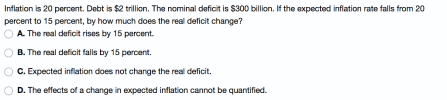 Inflation is 20 percent. Debt is $2 trillion. The nominal deficit is $300 billion. If the expected inflation rate falls from 20 percent to 15 percent, by how much does the real deficit change? A. The real deficit rises by 15 percent. B. The real deficit falls by 15 percent. O C. Expected inflation does not change the real deficit. D. The effects of a change in expected inflation cannot be quantified.
The nominal deficit is $150 billion, inflation is 4%, and the total debt is $8 trillion....
The nominal deficit is $150 billion, inflation is 4%, and the total debt is $8 trillion. Does this economy have a real deficit or a real surplus? Show your calculations.
Suppose that this year's money supply is $500 billion, nominal GDP is $10 trillion and real...
Suppose that this year's money supply is $500 billion, nominal GDP is $10 trillion and real GDP is $5 trillion. a. What is the price level? b. What is the velocity of money? (Please calculate your answers in billions, i.e. leave off the zeros (0) if necessary.) c. Suppose that velocity is constant and the economy's output of goods and services rises by five percent each year. What will happen to nominal GDP and the price level next year if the Fed...
Suppose that this years money supply is $500 billion, nominal GDP is $6 trillion, and real...
Suppose that this years money supply is $500 billion, nominal GDP is $6 trillion, and real GDP is $2 trillion. a. What is the price level? What is the velocity of money? b. Suppose that velocity is constant and the economy's output of goods and services rises by 3% each year. What will happen to nominal GDP and the price level next year if the Fed keeps the money supply constant? c. What money supply should the Fed set next...
Question 2 (1 point) In an open economy suppose that GDP is $12 trillion. Consumption is...
 Question 2 (1 point) In an open economy suppose that GDP is $12 trillion. Consumption is $8 trillion and government spending is $2 trillion, Taxes are $0.5 trillion. Exports are $1 trillion and imports are $3 trillion. What is private saving? $4 trillion $3.5 trillion $2.5 trillion $1.5 trillion Question 1 (1 point) Interest rate (%) Supply of loanable funds Demand for loanable funds 0 10 20 30 40 50 60 70 80 90 100 Quantity of loanable funds (billions...
At the end of 2007, the government had a debt of about $5,000 billion. During 2007,...
At the end of 2007, the government had a debt of about $5,000 billion. During 2007, real GDP grew by about 0.8 percent and inflation was about 2.7 percent. About what is the largest deficit the government could have run without raising the debt-to-GDP ratio? a. 135 billion b. 143 billion c. 169 billion d. 175 billion
Suppose that money supply is $4 trillion, nominal GDP is $20 trillion, and real GDP is...
Suppose that money supply is $4 trillion, nominal GDP is $20 trillion, and real GDP is $16 trillion. a. What is the price level? What is the velocity of money? Suppose that velocity is constant and the economy’s output of goods and services rises by 3 percent each year. b. What will happen to nominal GDP and the price level next year if the Fed increases the money supply by 5 percent? c. What money supply should the Fed set...
Suppose that a country has no public debt in year 1 but experiences a budget deficit...
 Suppose that a country has no public debt in year 1 but experiences a budget deficit of $30 billion in year 2, a budget deficit of $20 billion in year 3, a budget surplus of $10 billion in year 4, and a budget deficit of $2 billion in year 5. a. What is the absolute size of its public debt in year 5? Instructions: Enter your answer as a whole number. For the absolute size of its public debt, enter...
Suppose that a country has no public debt in year 1 but experiences a budget deficit...
Suppose that a country has no public debt in year 1 but experiences a budget deficit of $30 billion in year 2, a budget deficit of $30 billion in year 3, a budget surplus of $20 billion in year 4, and a budget deficit of $2 billion in year 5. a. What is the absolute size of its public debt in year 5? Instructions: Enter your answer as a whole number. For the absolute size of its public debt,...
The nominal interest rate is 8 percent and the inflation rate is 3 percent. What is...
The nominal interest rate is 8 percent and the inflation rate is 3 percent. What is the real interest rate? a. 8 percent b. 2 percent c. 11 percent d. 5 percent
 Inflation is 20 percent. Debt is $2 trillion. The nominal deficit is $300 billion. If the expected inflation rate falls from 20 percent to 15 percent, by how much does the real deficit change? A. The real deficit rises by 15 percent. B. The real deficit falls by 15 percent. O C. Expected inflation does not change the real deficit. D. The effects of a change in expected inflation cannot be quantified.
 Question 2 (1 point) In an open economy suppose that GDP is $12 trillion. Consumption is $8 trillion and government spending is $2 trillion, Taxes are $0.5 trillion. Exports are $1 trillion and imports are $3 trillion. What is private saving? $4 trillion $3.5 trillion $2.5 trillion $1.5 trillion Question 1 (1 point) Interest rate (%) Supply of loanable funds Demand for loanable funds 0 10 20 30 40 50 60 70 80 90 100 Quantity of loanable funds (billions...
 Suppose that a country has no public debt in year 1 but experiences a budget deficit of $30 billion in year 2, a budget deficit of $20 billion in year 3, a budget surplus of $10 billion in year 4, and a budget deficit of $2 billion in year 5. a. What is the absolute size of its public debt in year 5? Instructions: Enter your answer as a whole number. For the absolute size of its public debt, enter...
Most questions answered within 3 hours.
-
Where is the error in this code sequence?
String s1 = "Hello";
String s2 = "ello";...
asked 11 months ago -
Financial data for Joel de Paris, Inc., for last year
follow:
Joel de Paris, Inc.
Balance...
asked 11 months ago -
Consider this reaction:
Al2(SO4)3 (aq)+ BaCl3
(aq) Al2Cl6 (aq)- +
3BaSO4(s) . What is the...
asked 11 months ago -
Suppose that Savneet is considering increasing her
recent random sample from 20 car rentals to 40...
asked 11 months ago -
Trucks arrive at an unloading terminal at an average rate of 120
per hour.
Trucks arrive...
asked 11 months ago -
Why are methanol and ethanol completely soluble in water while
octanol is not very little soluble....
asked 11 months ago -
A facilities manager at a university reads in a research report
that the mean amount of...
asked 11 months ago -
When the CuSO4 is rehydrated by adding water to the anhydrous
compound, is this an endothermic...
asked 11 months ago -
A ray of sunlight is passing from diamond into crown glass; the
angle of incidence is...
asked 11 months ago -
A block of mass 0.249 kg is placed on top of a light, vertical
spring of...
asked 11 months ago -
how do the kidneys compensate in the presences of acidosis
a) trigger hyperventilate
b) reserve acid...
asked 11 months ago -
Question 501 pts
The rental rate of capital to the firm increases. Which of the
following...
asked 11 months ago