“Opportunity cost” in economics basically is what you have to give up to get something—not necessarily...
- “Opportunity cost” in economics basically is what you have to give up to get something—not necessarily restricted to dollar amounts. What is the opportunity cost of your going to college? (Note that this is not necessarily something that you can just look up or copy from a friend—you need to think about it and the answers may very well be different for each student. Also, I am not looking for any exact monetary calculation.)
- Draw a production possibilities curve for food and clothing. If you are operating on the curve, what is the opportunity cost of producing more clothing? If you are on the curve, is it possible to increase production of one good without decreasing the production of the other?
- What is the difference between absolute and comparative advantage? If Country A has an absolute advantage in computers and food over Country B, Country A has a comparative advantage in computers and Country B has a comparative advantage in food, what should happen in terms of specialization and trade?
- Why is the demand curve downward sloping?
- What are two factors that would cause the demand curve to shift to the left?
- Why is the supply curve upward sloping?
- What are two factors that would cause the supply curve to shift to the right?
Homework Answers
- If someone is going to college he gives up searching for a new job by which he could earn $150. So here the opportunity cost of going college is $150.
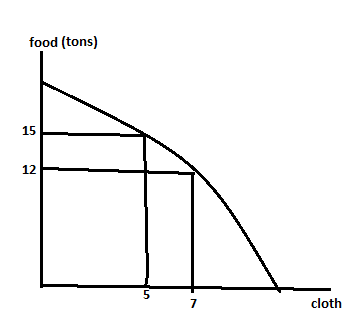
the opportunity cost of producing more cloth is to sacrifice food. It is not possible to produce more of one good without decreasing another if operating on the PPF as resources are fully utilized when operating on the PPF.
- Absolute advantage shows the difference in productivity, who is more productive has an absolute advantage. Comparative advantage shows the difference in opportunity cost. Who needs lower opportunity cost has a comparative advantage. Both countries can have an absolute advantage in the same products but two countries can have a comparative advantage in different products. So if country A has a comparative advantage in computers country A should specialize in the computer. Country B has a comparative advantage in food so country B should specialize in food. Country A should export computer and import food from B after specialization.
- The demand curve is downward sloping because there is an inverse relationship between price and quantity demand.
Demand curve shifts left when demand decreases because of some factors other than the change in price. The following factors can be responsible. a) Price of substitute is decreased. b) Income is decreased. In both case consider the good is a normal good.
- The supply curve is upward sloping as there is a positive relationship between price and quantity supplied. When the price is increased quantity supply is increased or vice versa.
Supply curve shifts right when supply is increased because of some factors other than the price change. The following factors can be responsible. a) Cost of production is decreased. b) Technology is improved so production is increased.
Add Answer to:
“Opportunity cost” in economics basically is what you have to
give up to get something—not necessarily...
“Opportunity cost” in economics basically is what you have to give up to get something—not necessarily...
“Opportunity cost” in economics basically is what you have to give up to get something—not necessarily restricted to dollar amounts. What is the opportunity cost of your going to college? (Note that this is not necessarily something that you can just look up or copy from a friend—you need to think about it and the answers may very well be different for each student. Also, I am not looking for any exact monetary calculation.)
1. Comparative Advantage (5 points) The following chart represents the production capabilities of the US and...
1. Comparative Advantage (5 points) The following chart represents the production capabilities of the US and Japan:. Output per worker-day Country Food Clothing US 2 1 Japan 3 9 a) Which country has an absolute advantage in food production? In clothing? Why? b) What is the US opportunity cost of producing food? Of clothing? Why? c) What is Japan's opportunity cost of producing food? Of clothing? Why? d) Which country has a comparative advantage in producing food? Why? e) Which...
If Mary can bake a cake at a lower opportunity cost than Sarah can, then: Mary...
 If Mary can bake a cake at a lower opportunity cost than Sarah can, then: Mary should not bake cakes. O Mary can bake more cakes than Sarah can in a given amount of time. Mary has a comparative adrantage in balking cakes. Sarah has a comparative advantage in baking cakes. The table shows the tons of steel or number of computers a worker can produce per week in Germany and South Korea. Use this table to answer the question....
1.While you do not have to state any of the definitions, you should have a conceptual...
1.While you do not have to state any of the definitions, you should have a conceptual understanding of each key term and key concept. For example, how are marginal benefits and marginal costs related to making decisions at the margin? How can we compare marginal benefits and marginal costs to determine efficiency? What is an unintended effect? What does “ceteris paribus” thinking mean? 2.What is a production possibilities frontier (PPF)? Which points on the frontier illustrate production that is efficient?...
Suppose the government imposes a tax on each case of beer. The consumers will pay the...
 Suppose the government imposes a tax on each case of beer. The consumers will pay the majority of tax when demand is: a. perfectly elastic b. unit elastic. 24. c. elastic d. inelastic e. none of the above. Producers always pay the majority of taxes. A perfectly elastic demand curve is represented by a curve that is a. downward sloping to the right. b. upward sloping to the right c. vertical d. almost vertical e. horizontal 25. Country A is...
Section B B22 Expansionary demand management policy measures tend to… [1] raise the real GDP and...
 Section B
B22 Expansionary demand management policy measures tend
to…
[1] raise the real GDP and inflation.
[2] increase price level and decrease real output.
[3] increase both inflation and the level of unemployment.
[4] Increase the production cost, which will decrease total
production.
B24 Which of the following is NOT the cause of
demand-pull inflation?
[1] increase in consumption spending.
[2] a decrease in interest rates.
[3] increase in net exports.
[4] rising commodity (e.g. oil) price.
B25 Cost-push...
Section B
B22 Expansionary demand management policy measures tend
to…
[1] raise the real GDP and inflation.
[2] increase price level and decrease real output.
[3] increase both inflation and the level of unemployment.
[4] Increase the production cost, which will decrease total
production.
B24 Which of the following is NOT the cause of
demand-pull inflation?
[1] increase in consumption spending.
[2] a decrease in interest rates.
[3] increase in net exports.
[4] rising commodity (e.g. oil) price.
B25 Cost-push...
Remember the goal: You want to prove Ricardo’s assertion that by specializing in their area of...
Remember the goal: You want to prove Ricardo’s assertion that by specializing in their area of comparative advantage and trading, two countries (or individuals) can both end up better off. You can prove this if you can show that after specializing and trading, each country consumes at least as much of both products, and more of at least one product. You do this in a three-step process. Step 1: Figure out which country has the comparative advantage in which product...
Fall 2019 Economics 2100 MY9 Section First Exam-Version A 4. The marginal opportunity cost of the...
 Fall 2019 Economics 2100 MY9 Section First Exam-Version A 4. The marginal opportunity cost of the 32nd unit of corn is equal to: 55 units of wheat 5 units of wheat 145 units of wheat. 10 units of wheat c) d) Suppose that a new genetically altered cherry tree produces twice as many cherries than the original trees. This will cause: 5. the equilibrium price and quantity of cherries to both fall the equilibrium price and quantity of cherries to...
To get the most out of life, to think like an economist, you have to be know what you're giving up in order to get some...
 To get the most out of life, to think like an economist, you have to be know what you're giving up in order to get something else. So, opportunity cost is the value of what you get expressed as the amount of what you give up the opportunity cost of "X" is the amount of "Y" forgone by the choice of "X"). Comment on the five examples below; either ask a question about any of the 5 examples, explain any...
answer these 4. will rate after According to Table 18.1 below. The opportunity cost of a...
 answer these 4. will rate after
According to Table 18.1 below. The opportunity cost of a bagpipe in Scotland is Daily Output of Scotland Poland Bag pipes 50 75 Accordions 25 150 1/2 accordian O 2 accordians. 6 accordions O 1/3 accordion Which of the following organizations has over 152 member nations and oversees the General Agreement on Trade and Tariffs? O World Trade Organization O North American Free Trade Agreement The General Agreement on Tariffs and Trade the European...
answer these 4. will rate after
According to Table 18.1 below. The opportunity cost of a bagpipe in Scotland is Daily Output of Scotland Poland Bag pipes 50 75 Accordions 25 150 1/2 accordian O 2 accordians. 6 accordions O 1/3 accordion Which of the following organizations has over 152 member nations and oversees the General Agreement on Trade and Tariffs? O World Trade Organization O North American Free Trade Agreement The General Agreement on Tariffs and Trade the European...
 If Mary can bake a cake at a lower opportunity cost than Sarah can, then: Mary should not bake cakes. O Mary can bake more cakes than Sarah can in a given amount of time. Mary has a comparative adrantage in balking cakes. Sarah has a comparative advantage in baking cakes. The table shows the tons of steel or number of computers a worker can produce per week in Germany and South Korea. Use this table to answer the question....
 Suppose the government imposes a tax on each case of beer. The consumers will pay the majority of tax when demand is: a. perfectly elastic b. unit elastic. 24. c. elastic d. inelastic e. none of the above. Producers always pay the majority of taxes. A perfectly elastic demand curve is represented by a curve that is a. downward sloping to the right. b. upward sloping to the right c. vertical d. almost vertical e. horizontal 25. Country A is...
 Section B
B22 Expansionary demand management policy measures tend
to…
[1] raise the real GDP and inflation.
[2] increase price level and decrease real output.
[3] increase both inflation and the level of unemployment.
[4] Increase the production cost, which will decrease total
production.
B24 Which of the following is NOT the cause of
demand-pull inflation?
[1] increase in consumption spending.
[2] a decrease in interest rates.
[3] increase in net exports.
[4] rising commodity (e.g. oil) price.
B25 Cost-push...
Section B
B22 Expansionary demand management policy measures tend
to…
[1] raise the real GDP and inflation.
[2] increase price level and decrease real output.
[3] increase both inflation and the level of unemployment.
[4] Increase the production cost, which will decrease total
production.
B24 Which of the following is NOT the cause of
demand-pull inflation?
[1] increase in consumption spending.
[2] a decrease in interest rates.
[3] increase in net exports.
[4] rising commodity (e.g. oil) price.
B25 Cost-push...
 Fall 2019 Economics 2100 MY9 Section First Exam-Version A 4. The marginal opportunity cost of the 32nd unit of corn is equal to: 55 units of wheat 5 units of wheat 145 units of wheat. 10 units of wheat c) d) Suppose that a new genetically altered cherry tree produces twice as many cherries than the original trees. This will cause: 5. the equilibrium price and quantity of cherries to both fall the equilibrium price and quantity of cherries to...
 To get the most out of life, to think like an economist, you have to be know what you're giving up in order to get something else. So, opportunity cost is the value of what you get expressed as the amount of what you give up the opportunity cost of "X" is the amount of "Y" forgone by the choice of "X"). Comment on the five examples below; either ask a question about any of the 5 examples, explain any...
 answer these 4. will rate after
According to Table 18.1 below. The opportunity cost of a bagpipe in Scotland is Daily Output of Scotland Poland Bag pipes 50 75 Accordions 25 150 1/2 accordian O 2 accordians. 6 accordions O 1/3 accordion Which of the following organizations has over 152 member nations and oversees the General Agreement on Trade and Tariffs? O World Trade Organization O North American Free Trade Agreement The General Agreement on Tariffs and Trade the European...
answer these 4. will rate after
According to Table 18.1 below. The opportunity cost of a bagpipe in Scotland is Daily Output of Scotland Poland Bag pipes 50 75 Accordions 25 150 1/2 accordian O 2 accordians. 6 accordions O 1/3 accordion Which of the following organizations has over 152 member nations and oversees the General Agreement on Trade and Tariffs? O World Trade Organization O North American Free Trade Agreement The General Agreement on Tariffs and Trade the European...
Most questions answered within 3 hours.
-
Where is the error in this code sequence?
String s1 = "Hello";
String s2 = "ello";...
asked 10 months ago -
Financial data for Joel de Paris, Inc., for last year
follow:
Joel de Paris, Inc.
Balance...
asked 10 months ago -
Consider this reaction:
Al2(SO4)3 (aq)+ BaCl3
(aq) Al2Cl6 (aq)- +
3BaSO4(s) . What is the...
asked 10 months ago -
Suppose that Savneet is considering increasing her
recent random sample from 20 car rentals to 40...
asked 10 months ago -
Trucks arrive at an unloading terminal at an average rate of 120
per hour.
Trucks arrive...
asked 10 months ago -
Why are methanol and ethanol completely soluble in water while
octanol is not very little soluble....
asked 10 months ago -
A facilities manager at a university reads in a research report
that the mean amount of...
asked 10 months ago -
When the CuSO4 is rehydrated by adding water to the anhydrous
compound, is this an endothermic...
asked 10 months ago -
A ray of sunlight is passing from diamond into crown glass; the
angle of incidence is...
asked 10 months ago -
A block of mass 0.249 kg is placed on top of a light, vertical
spring of...
asked 10 months ago -
how do the kidneys compensate in the presences of acidosis
a) trigger hyperventilate
b) reserve acid...
asked 10 months ago -
Question 501 pts
The rental rate of capital to the firm increases. Which of the
following...
asked 10 months ago