Refer to the Figure.
If there are no fixed costs of production, monopoly prot with
perfect price discrimination equals
Group of answer choices
$2,000.
$4,000.
$0.
$1,000.
Homework Answers
Ans) Perfect price discrimination or first degree price discrimination is when the seller is able to identify each individuals willingness to pay and hence charges each individual differently. This enables the monopolist to capture all the consumer surplus and there is no deadweightloss.
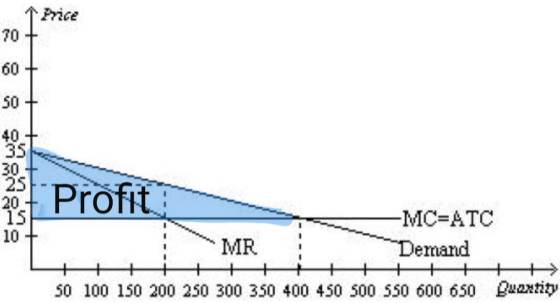
Profit = 1/2× base × height = 1/2× 400×(35-15) = 1/2×400×20 = $4000
Option b.
Add Answer to:
Refer to the Figure.
If there are no fixed costs of production, monopoly prot with
perfect...
1. If the monopoly firm perfectly price discriminates, then the deadweight loss amounts to _______________________________ 2....
 1. If the monopoly firm perfectly price discriminates,
then the deadweight loss amounts to
_______________________________
2. If there are no fixed costs of production, monopoly
profit without price discrimination equals
_______________________________
3. If there are no fixed costs of production, monopoly
profit with perfect price discrimination equals
_______________________________
Monopoly so 1 Price 45+ 40+ 35 30+ in 15+ 10 MC-ATC Demand MR 50 100 150 200 250 300 350 400 450 500 550 600 650 700 750 800 Quantity
1. If the monopoly firm perfectly price discriminates,
then the deadweight loss amounts to
_______________________________
2. If there are no fixed costs of production, monopoly
profit without price discrimination equals
_______________________________
3. If there are no fixed costs of production, monopoly
profit with perfect price discrimination equals
_______________________________
Monopoly so 1 Price 45+ 40+ 35 30+ in 15+ 10 MC-ATC Demand MR 50 100 150 200 250 300 350 400 450 500 550 600 650 700 750 800 Quantity
a. If the monopoly firm is not allowed to price discriminate, then consumer surplus amounts to ________________________...
 a. If the monopoly firm is not allowed to price discriminate,
then consumer surplus amounts to
_______________________________
b. If the monopoly firm perfectly price discriminates, then
consumer surplus amounts to _______________________________
c. If the monopoly firm is not allowed to price discriminate,
then the deadweight loss amounts
_______________________________
d. If the monopoly firm perfectly price discriminates, then the
deadweight loss amounts to _______________________________
e. If there are no fixed costs of production, monopoly profit
without price discrimination equals
_______________________________
f....
a. If the monopoly firm is not allowed to price discriminate,
then consumer surplus amounts to
_______________________________
b. If the monopoly firm perfectly price discriminates, then
consumer surplus amounts to _______________________________
c. If the monopoly firm is not allowed to price discriminate,
then the deadweight loss amounts
_______________________________
d. If the monopoly firm perfectly price discriminates, then the
deadweight loss amounts to _______________________________
e. If there are no fixed costs of production, monopoly profit
without price discrimination equals
_______________________________
f....
QUESTION 1 Refer to the figure below. Assume this firm is a single-price monopoly. How many...
 QUESTION 1 Refer to the figure below. Assume this firm is a single-price monopoly. How many units of output does this monopolist sell to maximize economic profit? Price 8.00 5.00 МC 3.00 D 0 300 450 600 1100 Quantity MR a. 100 units. b. 300 units. C. 450 units. d. 600 units. QUESTION 2 A single-price monopolist's demand curve a. shows that demand for the good is inelastic. Click Save and Submit to save and submit. Click Save All Answers...
Figure 15-7 The figure below depicts the demand, marginal revenue, and marginal cost curves of a...
 Figure 15-7 The figure below depicts the demand, marginal revenue, and marginal cost curves of a profit- maximizing monopolist. Price $40 30 20 Marginal Cost Demand 10 Margina Revenue 100 200 300 400 Quantity Refer to Figure 15-7. If fixed costs of production = $1,000, monopoly profit without price discrimination equals o $2,000. O $500 O $4,000. $1,000.
Refer to the table to answer the questions that follow. Marginal Cost Average Variable Cost Average...
 Refer to the table to answer the questions that follow. Marginal Cost Average Variable Cost Average Total Cost Output Profit at $450 per ton -$1,000 $200 $150 -$750 Total Cost ($ Per Ton) $1,000 $1,200 $1,350 $1,550 $1,900 $2,300 $2,750 $3,250 $3,800 $4,400 $5,150 $200 $1,200 $675 $517 $475 Profit at $500 per ton -$1,000 -$700 -$350 -$50 $100 $200 Profit at $550 per ton -$1,000 -$650 -$250 $100 $300 $450 $550 $600 $600 $550 $350 -$450 -$200 -$100 $200...
If the profit-maximizing output for the monopoly firm below is Q=4. What is the marginal revenue...
If the profit-maximizing output for the monopoly firm below is Q=4. What is the marginal revenue at Q=4? Quantity (Q) Marginal Revenue (MR) Marginal Cost (MC) Marginal Profit (MP) 1 650 300 350 2 450 250 200 3 350 225 125 4 ? 200 0 5 0 150 −150
Part 1 Suppose a firm operating in a competitive market has the following cost curves: a....
 Part 1
Suppose a firm operating in a competitive market has the
following cost curves:
a. If the market price is $10, what is the firm’s economic
profit?
b. If the market price is $10, what is the firm’s total cost?
c. If the market price is $10, what is the firm’s total
revenue?
d. The firm will earn zero economic profit if the market price
is
e. If the market price is $4, what is the firm’s decision in...
Part 1
Suppose a firm operating in a competitive market has the
following cost curves:
a. If the market price is $10, what is the firm’s economic
profit?
b. If the market price is $10, what is the firm’s total cost?
c. If the market price is $10, what is the firm’s total
revenue?
d. The firm will earn zero economic profit if the market price
is
e. If the market price is $4, what is the firm’s decision in...
I need help calculating the revenue and costs. In a Monopoly market, a firm is a...
 I need help calculating the revenue and costs.
In a Monopoly market, a firm is a price maker since there are no close substitutes to the product. You are asked to find the company's Profit-Maximization and Social-Optimal points. Fixed Costs remains at $1,000.00. Graph the D, MR, MC, ATC, AFC, and AVC on one graph. Calculate the revenue, costs, and profits. TC TR TVC 0 АТС AVCAFCMC MR 0 199.99 $1,000 o 10 $189.99 3,000 1,899.9 2,000 300200100200 189.99 20...
I need help calculating the revenue and costs.
In a Monopoly market, a firm is a price maker since there are no close substitutes to the product. You are asked to find the company's Profit-Maximization and Social-Optimal points. Fixed Costs remains at $1,000.00. Graph the D, MR, MC, ATC, AFC, and AVC on one graph. Calculate the revenue, costs, and profits. TC TR TVC 0 АТС AVCAFCMC MR 0 199.99 $1,000 o 10 $189.99 3,000 1,899.9 2,000 300200100200 189.99 20...
Only THIS SIDE MONOPOLY Woreksiteet Hint: Under perfect competition price is fixed for a small producer...
 Only THIS SIDE MONOPOLY Woreksiteet Hint: Under perfect competition price is fixed for a small producer and MR is the same as price. Under monopoly demand is down sloping and price changes at different quantities. Therefore under monopoly MR is no longer the same as price. You need to calculate it. MR equals change in TR divided by change in Q. TR is still the product of price multiplied by quantity and the rules of profit maximization are the same...
1A Marginal revenue for a monopoly firm is: not related to the price that the monopolist...
1A Marginal revenue for a monopoly firm is: not related to the price that the monopolist charges for its products. less than the price that the monopolist charges for its products. always greater than the price that the monopolist charges for its products. equal to the price that the monopolist charges for its products. 1B Regarding monopoly firms, our text concludes that: firms which have been granted monopoly status by a government are less-efficient and provide a lower-quality and higher-priced...
 1. If the monopoly firm perfectly price discriminates,
then the deadweight loss amounts to
_______________________________
2. If there are no fixed costs of production, monopoly
profit without price discrimination equals
_______________________________
3. If there are no fixed costs of production, monopoly
profit with perfect price discrimination equals
_______________________________
Monopoly so 1 Price 45+ 40+ 35 30+ in 15+ 10 MC-ATC Demand MR 50 100 150 200 250 300 350 400 450 500 550 600 650 700 750 800 Quantity
1. If the monopoly firm perfectly price discriminates,
then the deadweight loss amounts to
_______________________________
2. If there are no fixed costs of production, monopoly
profit without price discrimination equals
_______________________________
3. If there are no fixed costs of production, monopoly
profit with perfect price discrimination equals
_______________________________
Monopoly so 1 Price 45+ 40+ 35 30+ in 15+ 10 MC-ATC Demand MR 50 100 150 200 250 300 350 400 450 500 550 600 650 700 750 800 Quantity
 a. If the monopoly firm is not allowed to price discriminate,
then consumer surplus amounts to
_______________________________
b. If the monopoly firm perfectly price discriminates, then
consumer surplus amounts to _______________________________
c. If the monopoly firm is not allowed to price discriminate,
then the deadweight loss amounts
_______________________________
d. If the monopoly firm perfectly price discriminates, then the
deadweight loss amounts to _______________________________
e. If there are no fixed costs of production, monopoly profit
without price discrimination equals
_______________________________
f....
a. If the monopoly firm is not allowed to price discriminate,
then consumer surplus amounts to
_______________________________
b. If the monopoly firm perfectly price discriminates, then
consumer surplus amounts to _______________________________
c. If the monopoly firm is not allowed to price discriminate,
then the deadweight loss amounts
_______________________________
d. If the monopoly firm perfectly price discriminates, then the
deadweight loss amounts to _______________________________
e. If there are no fixed costs of production, monopoly profit
without price discrimination equals
_______________________________
f....
 QUESTION 1 Refer to the figure below. Assume this firm is a single-price monopoly. How many units of output does this monopolist sell to maximize economic profit? Price 8.00 5.00 МC 3.00 D 0 300 450 600 1100 Quantity MR a. 100 units. b. 300 units. C. 450 units. d. 600 units. QUESTION 2 A single-price monopolist's demand curve a. shows that demand for the good is inelastic. Click Save and Submit to save and submit. Click Save All Answers...
 Figure 15-7 The figure below depicts the demand, marginal revenue, and marginal cost curves of a profit- maximizing monopolist. Price $40 30 20 Marginal Cost Demand 10 Margina Revenue 100 200 300 400 Quantity Refer to Figure 15-7. If fixed costs of production = $1,000, monopoly profit without price discrimination equals o $2,000. O $500 O $4,000. $1,000.
 Refer to the table to answer the questions that follow. Marginal Cost Average Variable Cost Average Total Cost Output Profit at $450 per ton -$1,000 $200 $150 -$750 Total Cost ($ Per Ton) $1,000 $1,200 $1,350 $1,550 $1,900 $2,300 $2,750 $3,250 $3,800 $4,400 $5,150 $200 $1,200 $675 $517 $475 Profit at $500 per ton -$1,000 -$700 -$350 -$50 $100 $200 Profit at $550 per ton -$1,000 -$650 -$250 $100 $300 $450 $550 $600 $600 $550 $350 -$450 -$200 -$100 $200...
 Part 1
Suppose a firm operating in a competitive market has the
following cost curves:
a. If the market price is $10, what is the firm’s economic
profit?
b. If the market price is $10, what is the firm’s total cost?
c. If the market price is $10, what is the firm’s total
revenue?
d. The firm will earn zero economic profit if the market price
is
e. If the market price is $4, what is the firm’s decision in...
Part 1
Suppose a firm operating in a competitive market has the
following cost curves:
a. If the market price is $10, what is the firm’s economic
profit?
b. If the market price is $10, what is the firm’s total cost?
c. If the market price is $10, what is the firm’s total
revenue?
d. The firm will earn zero economic profit if the market price
is
e. If the market price is $4, what is the firm’s decision in...
 I need help calculating the revenue and costs.
In a Monopoly market, a firm is a price maker since there are no close substitutes to the product. You are asked to find the company's Profit-Maximization and Social-Optimal points. Fixed Costs remains at $1,000.00. Graph the D, MR, MC, ATC, AFC, and AVC on one graph. Calculate the revenue, costs, and profits. TC TR TVC 0 АТС AVCAFCMC MR 0 199.99 $1,000 o 10 $189.99 3,000 1,899.9 2,000 300200100200 189.99 20...
I need help calculating the revenue and costs.
In a Monopoly market, a firm is a price maker since there are no close substitutes to the product. You are asked to find the company's Profit-Maximization and Social-Optimal points. Fixed Costs remains at $1,000.00. Graph the D, MR, MC, ATC, AFC, and AVC on one graph. Calculate the revenue, costs, and profits. TC TR TVC 0 АТС AVCAFCMC MR 0 199.99 $1,000 o 10 $189.99 3,000 1,899.9 2,000 300200100200 189.99 20...
 Only THIS SIDE MONOPOLY Woreksiteet Hint: Under perfect competition price is fixed for a small producer and MR is the same as price. Under monopoly demand is down sloping and price changes at different quantities. Therefore under monopoly MR is no longer the same as price. You need to calculate it. MR equals change in TR divided by change in Q. TR is still the product of price multiplied by quantity and the rules of profit maximization are the same...
Most questions answered within 3 hours.
-
Where is the error in this code sequence?
String s1 = "Hello";
String s2 = "ello";...
asked 11 months ago -
Financial data for Joel de Paris, Inc., for last year
follow:
Joel de Paris, Inc.
Balance...
asked 11 months ago -
Consider this reaction:
Al2(SO4)3 (aq)+ BaCl3
(aq) Al2Cl6 (aq)- +
3BaSO4(s) . What is the...
asked 11 months ago -
Suppose that Savneet is considering increasing her
recent random sample from 20 car rentals to 40...
asked 11 months ago -
Trucks arrive at an unloading terminal at an average rate of 120
per hour.
Trucks arrive...
asked 11 months ago -
Why are methanol and ethanol completely soluble in water while
octanol is not very little soluble....
asked 11 months ago -
A facilities manager at a university reads in a research report
that the mean amount of...
asked 11 months ago -
When the CuSO4 is rehydrated by adding water to the anhydrous
compound, is this an endothermic...
asked 11 months ago -
A ray of sunlight is passing from diamond into crown glass; the
angle of incidence is...
asked 11 months ago -
A block of mass 0.249 kg is placed on top of a light, vertical
spring of...
asked 11 months ago -
how do the kidneys compensate in the presences of acidosis
a) trigger hyperventilate
b) reserve acid...
asked 11 months ago -
Question 501 pts
The rental rate of capital to the firm increases. Which of the
following...
asked 11 months ago