Matrix B Textiles (Labor-hours/unit of Output) Wine (Labor-hours/Unit of output) Portugal 90 80 England 100 120...
Matrix B
|
Textiles (Labor-hours/unit of Output) |
Wine (Labor-hours/Unit of output) |
|
|
Portugal |
90 |
80 |
|
England |
100 |
120 |
(Numbers in the above matrix reflect labor hours per unit of output)
What would you recommend for the above matrix??? Reflect on all pertinent points of our analysis.
Homework Answers
First, we compute Opportunity cost (OC) as follows.
In Portugal,
OC of Textile = 90/80 = 1.125 Wine
OC of Wine = 80/90 = 0.890 Textile
In England,
OC of Textile = 100/120 = 0.83 Wine
OC of Wine = 120/100 = 1.20 Textile
Since England can produce Textile at lower OC (0.83 < 1.125), England has comparative advantage in and should specialize in Textile.
Since Portugal can produce Wine at lower OC (0.890 < 1.20), Portugal has comparative advantage in and should specialize in Wine.
So, after trade, England should export Textile and import Wine, and Portugal should export Wine and import Textile.
Trade is mutually beneficial if terms of trade (TOT) lies between the OC in each country. So acceptable TOT are:
0.83 Wine < TOT of 1 unit of Textile < 1.125 Wine, or equivalently,
0.89 Textile < TOT of 1 unit of Wine < 1.20 Textile.
Add Answer to:
Matrix B
Textiles (Labor-hours/unit of Output)
Wine (Labor-hours/Unit of output)
Portugal
90
80
England
100
120...
The graphs below show autarkic equilibriums for Portugal and England. Portugal England Food Food 120 100 90 80 100...
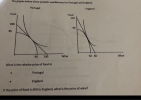 The graphs below show autarkic equilibriums for Portugal and England. Portugal England Food Food 120 100 90 80 100 Wine 50 60 Wine What is the relative price of food in Portugal England If the price of food is £60 in England, what is the price of wine?
Consider a two countries, Portugal and England, that produce two goods, wine and cheese, with only...
Consider a two countries, Portugal and England, that produce two goods, wine and cheese, with only one factor of production, Labor. In England, one unit of labor can produce 2 units of wine or 1 unit of cheese. In Portugal, one unit of labor can produce 3 units of wine or 1/2 of cheese. There are 100 units of labor in Portugal, and 100 in England. Countries share the same tastes, and there is perfect competition. 1) Fill in the...
David Ricardo, the British political economist, used the example of two commodities —wine and cloth —produced...
David Ricardo, the British political economist, used the example of two commodities —wine and cloth —produced by England and Portugal to explain trade. The following table shows the number of labor hours it would take England and Portugal to produce one unit each of wine and cloth: Portugal England Wine 120 80 Cloth 100 90 Portugal can produce both wine and cloth using fewer labor hours than England. A group of Mercantilists, who believe that nations build their wealth by...
Revisiting Ricardo's Example Ricardo (1817) posited a world of two countries, England and Portuga...
 Revisiting Ricardo's Example Ricardo (1817) posited a world of two countries, England and Portugal, whiclh can make each of two goods, cloth and wine. What he assumed about how many workers it takes to make a unit of each good in each country appears in Table 1 Since the workers required to make one unit of a good are the same no matter hov many units are produced, Ricardo was assuming constant returns to scale Ricardo argued that trade could...
Brief Exercise 23-5 Mordica Company’s standard labor cost per unit of output is $20.14 (1.90 hours...
 Brief Exercise 23-5
Mordica Company’s standard labor cost per unit of output is
$20.14 (1.90 hours x $10.60 per hour). During August, the company
incurs 2,581 hours of direct labor at an hourly cost of $10.71 per
hour in making 1,300 units of finished product.
Compute the total, price, and quantity labor variances.
(Round answers to 2 decimal places, e.g.
52.75.)
Total labor variance
$
FavorableNeither favorable nor unfavorableUnfavorable
Labor price variance
$
UnfavorableNeither favorable nor unfavorableFavorable
Labor quantity variance...
Brief Exercise 23-5
Mordica Company’s standard labor cost per unit of output is
$20.14 (1.90 hours x $10.60 per hour). During August, the company
incurs 2,581 hours of direct labor at an hourly cost of $10.71 per
hour in making 1,300 units of finished product.
Compute the total, price, and quantity labor variances.
(Round answers to 2 decimal places, e.g.
52.75.)
Total labor variance
$
FavorableNeither favorable nor unfavorableUnfavorable
Labor price variance
$
UnfavorableNeither favorable nor unfavorableFavorable
Labor quantity variance...
Exercise #2: 10 M gals water per day 71-80 81-90 91-100 101-110 111-120 121-130 131-140 10...
Exercise #2: 10 M gals water per day 71-80 81-90 91-100 101-110 111-120 121-130 131-140 10 M gals water per day 71-80 91-100 101-110 111-120 121-130 131-140 Create a data file named water.dat with the following data: 123 134 122 128 111 110 98 99 78 98 100 120 122 110 111 123 134 122 128 111 110 98 99 78 98 100 120 122 110 111. Each number represents the number of millions of gallons of water provided to...
Direct materials Direct labor Variable manufacturing overhead Total standard cost per unit Standard Quantity or Hours...
 Direct materials Direct labor Variable manufacturing overhead Total standard cost per unit Standard Quantity or Hours 2.50 ounces 0.50 hours 0.50 hours Standard Price or Rate $28.00 per ounce $13.00 per hour $ 3.60 per hour Standard Cost $ 70.00 6.50 1.80 $ 78.30 For the month of August, Yankee Distilling recorded the following activity related to the production of Ripit: a. Materials purchased, 13,500 ounces at a cost of $361,800. b. There was no beginning inventory of materials; however,...
Selling Price $70 $90 $120 $100 Unit Sales 1,200,000 900,000 700.000 1,000,000 Interest Expense 3,390,000 2,716,667...
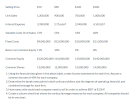 Selling Price $70 $90 $120 $100 Unit Sales 1,200,000 900,000 700.000 1,000,000 Interest Expense 3,390,000 2,716,667 2,948,000 4,142,857 Variable Costs (% of Sales) 57% 55% 53% 60% Fixed Costs $9,000,000 $12,000,000 $10,000,000 $11,000,000 Return on Common Equity 11% 10% 9% 8% Common Equity $120,000,000 110,000,000 150,000,000 $140,000,000 Common Shares 13,000,000 12,000,000 15,000,000 14,000,000 1. Using the financial data given in the above table, create income statements for each firm. Assume a common tax rate of 40% for each company. 2....
In a period, the labor efficiency variance was $54,000 F. The standard direct labor wage rate is $12.00 per hour and 30 direct labor hours are allowed for each unit of output. Given that 43,500 direc...
 In a period, the labor efficiency variance was $54,000 F. The standard direct labor wage rate is $12.00 per hour and 30 direct labor hours are allowed for each unit of output. Given that 43,500 direct labor hours were worked, how many units of output were actually produced? 150 c. 1,450 d. 1,600 The overhead variance that is a measure of capacity utilization is: a. The overhead spending variance The overhead efficiency variance c. The overhead budget variance d. The...
QUESTION 26 1 points Save Answer If the per unit profit associated with each pair of deluxe gloves is increase...
 QUESTION 26 1 points Save Answer If the per unit profit associated with each pair of deluxe gloves is increased by $5, what is the impact on the optimal solution and on the total profit? Objective Cell (Max) Name Cell Original Value Final Value SBS4 Objective Function (Maximize Profit) 294 Variable Cells Cell Name Orginal Value Final Value Integer 24 Contin SBSI X11# of standard goes) X2 ( ะ of de luxe doves) SBS2 14 Contirn Constraints Cell Value Cell...
 The graphs below show autarkic equilibriums for Portugal and England. Portugal England Food Food 120 100 90 80 100 Wine 50 60 Wine What is the relative price of food in Portugal England If the price of food is £60 in England, what is the price of wine?
 Revisiting Ricardo's Example Ricardo (1817) posited a world of two countries, England and Portugal, whiclh can make each of two goods, cloth and wine. What he assumed about how many workers it takes to make a unit of each good in each country appears in Table 1 Since the workers required to make one unit of a good are the same no matter hov many units are produced, Ricardo was assuming constant returns to scale Ricardo argued that trade could...
 Brief Exercise 23-5
Mordica Company’s standard labor cost per unit of output is
$20.14 (1.90 hours x $10.60 per hour). During August, the company
incurs 2,581 hours of direct labor at an hourly cost of $10.71 per
hour in making 1,300 units of finished product.
Compute the total, price, and quantity labor variances.
(Round answers to 2 decimal places, e.g.
52.75.)
Total labor variance
$
FavorableNeither favorable nor unfavorableUnfavorable
Labor price variance
$
UnfavorableNeither favorable nor unfavorableFavorable
Labor quantity variance...
Brief Exercise 23-5
Mordica Company’s standard labor cost per unit of output is
$20.14 (1.90 hours x $10.60 per hour). During August, the company
incurs 2,581 hours of direct labor at an hourly cost of $10.71 per
hour in making 1,300 units of finished product.
Compute the total, price, and quantity labor variances.
(Round answers to 2 decimal places, e.g.
52.75.)
Total labor variance
$
FavorableNeither favorable nor unfavorableUnfavorable
Labor price variance
$
UnfavorableNeither favorable nor unfavorableFavorable
Labor quantity variance...
 Direct materials Direct labor Variable manufacturing overhead Total standard cost per unit Standard Quantity or Hours 2.50 ounces 0.50 hours 0.50 hours Standard Price or Rate $28.00 per ounce $13.00 per hour $ 3.60 per hour Standard Cost $ 70.00 6.50 1.80 $ 78.30 For the month of August, Yankee Distilling recorded the following activity related to the production of Ripit: a. Materials purchased, 13,500 ounces at a cost of $361,800. b. There was no beginning inventory of materials; however,...
 Selling Price $70 $90 $120 $100 Unit Sales 1,200,000 900,000 700.000 1,000,000 Interest Expense 3,390,000 2,716,667 2,948,000 4,142,857 Variable Costs (% of Sales) 57% 55% 53% 60% Fixed Costs $9,000,000 $12,000,000 $10,000,000 $11,000,000 Return on Common Equity 11% 10% 9% 8% Common Equity $120,000,000 110,000,000 150,000,000 $140,000,000 Common Shares 13,000,000 12,000,000 15,000,000 14,000,000 1. Using the financial data given in the above table, create income statements for each firm. Assume a common tax rate of 40% for each company. 2....
 In a period, the labor efficiency variance was $54,000 F. The standard direct labor wage rate is $12.00 per hour and 30 direct labor hours are allowed for each unit of output. Given that 43,500 direct labor hours were worked, how many units of output were actually produced? 150 c. 1,450 d. 1,600 The overhead variance that is a measure of capacity utilization is: a. The overhead spending variance The overhead efficiency variance c. The overhead budget variance d. The...
 QUESTION 26 1 points Save Answer If the per unit profit associated with each pair of deluxe gloves is increased by $5, what is the impact on the optimal solution and on the total profit? Objective Cell (Max) Name Cell Original Value Final Value SBS4 Objective Function (Maximize Profit) 294 Variable Cells Cell Name Orginal Value Final Value Integer 24 Contin SBSI X11# of standard goes) X2 ( ะ of de luxe doves) SBS2 14 Contirn Constraints Cell Value Cell...
Most questions answered within 3 hours.
-
Where is the error in this code sequence?
String s1 = "Hello";
String s2 = "ello";...
asked 10 months ago -
Financial data for Joel de Paris, Inc., for last year
follow:
Joel de Paris, Inc.
Balance...
asked 10 months ago -
Consider this reaction:
Al2(SO4)3 (aq)+ BaCl3
(aq) Al2Cl6 (aq)- +
3BaSO4(s) . What is the...
asked 10 months ago -
Suppose that Savneet is considering increasing her
recent random sample from 20 car rentals to 40...
asked 10 months ago -
Trucks arrive at an unloading terminal at an average rate of 120
per hour.
Trucks arrive...
asked 10 months ago -
Why are methanol and ethanol completely soluble in water while
octanol is not very little soluble....
asked 10 months ago -
A facilities manager at a university reads in a research report
that the mean amount of...
asked 10 months ago -
When the CuSO4 is rehydrated by adding water to the anhydrous
compound, is this an endothermic...
asked 10 months ago -
A ray of sunlight is passing from diamond into crown glass; the
angle of incidence is...
asked 10 months ago -
A block of mass 0.249 kg is placed on top of a light, vertical
spring of...
asked 10 months ago -
how do the kidneys compensate in the presences of acidosis
a) trigger hyperventilate
b) reserve acid...
asked 10 months ago -
Question 501 pts
The rental rate of capital to the firm increases. Which of the
following...
asked 10 months ago