U = 8x10.5+ 2x2, where x1 is the quantity of good 1 consumed, and x2 is...
U = 8x10.5+ 2x2, where x1 is the quantity of good 1 consumed, and x2 is the quantity of good 2 consumed. (Yes the x is raised) 8x1.5
Suppose that the consumer has a budget of M = $400 to spend and that good 1 has a price of p1= 2, and good 2 has a price of p2= 8.
Answer the following questions, and write your answers in the Answer Sheet.
-
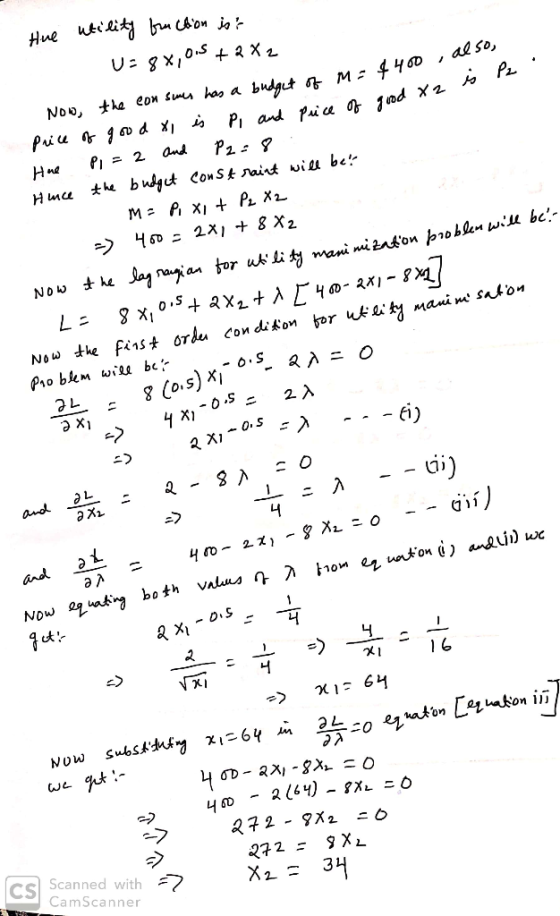
Write the person’s budget constraint as an equation, with two variables (x1 and x2).
-
Write the utility maximization problem. This involves rewriting the utility function with the budget constraint substituted in.
-
Find the first-order condition.
-
Find the combination of goods (x1 and x2) that maximizes the consumer’s utility at these prices.
-
What is the optimal x1?
-
What is the optimal x2?
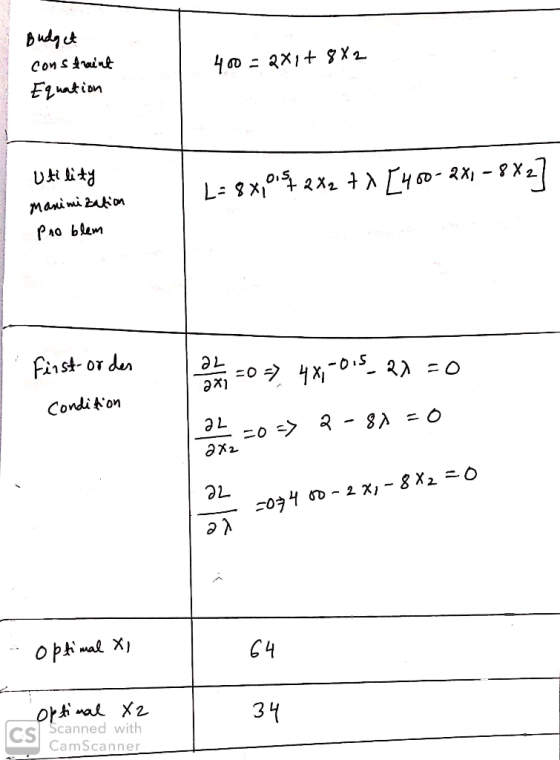
Budget Constraint Equation 400 = 2x1 + 8x2 Utility Maximization Problem Max U = 8x10.5 − 0.5x1 + 100 First-order condition 4x1−0.5 − 0.5 = 0
Optimal x1 x1= Optimal x2 x2=
-
Homework Answers
Add Answer to:
U =
8x10.5+
2x2, where
x1 is the quantity of good 1 consumed, and
x2 is...
The consumer has the utility function U(x1 , x2) = (x1-2)4 (x2-3)3
 The consumer has the utility function U(x1 , x2) = (x1-2)4 (x2-3)3, subject to her budget constraint 10 = 4x1 + 3x2. Write the utility maximization of this consumer using the Lagrangian method and find the optimal value of x1 and x2.
Problem 1 Suppose that a person has a utility U = 3x1 + 9x2, where x1...
Problem 1 Suppose that a person has a utility U = 3x1 + 9x2, where x1 is the quantity of good 1 consumed, and x2 is the quantity of good 2 consumed. Answer the following questions, and write your answers in the Answer Sheet. Find the equation representing the person’s indifference curve for a level of utility represented by the constant K. (Hint: Isolate x1 on one side.) Find the person’s marginal utility with respect to good 1 (MUx1 )....
A consumer has utility function: u(x1 , x2 ) = x1 + 2x2 . The consumer...
A consumer has utility function: u(x1 , x2 ) = x1 + 2x2 . The consumer has income m > 0 tospendongood1andgood2. Ifthepriceofx1 isp1 =1andthepriceofx2 isp2 =0.5, then, in order to maximize her utility, the consumer must consume: a) x1 = x2 (b) x1 = 2x2 (c) 2x1 = x2 (d) x1 = 4x2 (e) None of the above
Let the consumer’s utility function be given by U(x1,x2)=(x1-c1)α(x2-c2)1-α, where c1,c2>0 and 0<α<1. Let the prices...
Let the consumer’s utility function be given by U(x1,x2)=(x1-c1)α(x2-c2)1-α, where c1,c2>0 and 0<α<1. Let the prices of the two goods be p1 and p2 and consumer’s income be M. solve for the optimal quantity of x1 and x2
Consider two goods, good 1 and good 2. The consumer’s utility function is given by U(x1,x2)=V(x1)+x2....
Consider two goods, good 1 and good 2. The consumer’s utility function is given by U(x1,x2)=V(x1)+x2. Derive the ordinary demand function of good 1. When the market price of good 1 is given P1=P1' , derive the consumer’s surplus. If the price is changed to P1=P1", prove that the change measured by consumer’s surplus is the same as the Compensating variation. Also prove that it is the same as Equivalent variation.
The weekly utility function of a consumer is: U = 2AB where A and B are...
The weekly utility function of a consumer is: U = 2AB where A and B are two goods in the consumer’s consumption bundle. Based on this utility function the marginal utility of good A is: MUA = 2B and the marginal utility of good B is: MUB = 2A, where A and B represent the quantities of good A and good B, respectively. The price of good A is $5 whereas the price good B is $10. a. Write the...
Luke's choice behavior can be represented by the utility function u(x1,x2)= x1 + x2
Luke's choice behavior can be represented by the utility function u(x1,x2)= x1 + x2.The prices of x1 and x2 are denoted as p1 and p2, and his income is m. 1. Draw at least three indifference curves and find its slope (i.e. MRS). Is the MRS changing depending on the points of (x1, x2) at which it is evaluated, or constant? 2. Draw a budget constraint assuming that p1 < P2. Find the optimal bundle (x1*,x2*) as a function of income and prices. 3....
The utility function of the consumer is u(x1,x2) = (10x1 + x2). a) Plot all the...
 The utility function of the consumer is u(x1,x2) = (10x1 + x2). a) Plot all the consumption bundles that gives the consumer utility 100. (3 points) b) Plot all the consumption bundles that gives the consumer utility 144. (3 points) c) Plot the budget constraint when p. = 10,P2 = 10 and m = 100 (3 points) d) Plot the budget constraint when P1 = 20, P2 = 5 and m = 60 (3 points) e) What is the optimal...
The utility function is u = x1½ + x2, and the budget constraint is m =...
The utility function is u = x1½ + x2, and the budget constraint is m = p1x1 + p2x2. Derive the optimal demand curve for good 1, x1(p1, p2), and good 2, x2(m, p1, p2). Looking at the cross price effects (∂x1/∂p2 and ∂x2/∂p1) are goods x1 and x2 substitutes or complements? Looking at income effects (∂x1/∂m and ∂x2/∂m) are goods x1 and x2 inferior, normal or neither? Assume m=100, p1=0.5 and p2=1. Using the demand function you derived in...
Find the optimal bundle for the following utility functions and for budget line (P1X1+P2X2=m) a) U(X1,X2)=X1X2...
Find the optimal bundle for the following utility functions and for budget line (P1X1+P2X2=m) a) U(X1,X2)=X1X2 b) U(X1,X2)=X1^2X2^3 c) U(X1,X2)=X1^2+2X2 d)U(X1,X2)= ln (x1^3X2^4) e) U(X1,X2)= 2X1+X2 f) U(X1,X2)= min (2X1,X2)
 The consumer has the utility function U(x1 , x2) = (x1-2)4 (x2-3)3, subject to her budget constraint 10 = 4x1 + 3x2. Write the utility maximization of this consumer using the Lagrangian method and find the optimal value of x1 and x2.
 The utility function of the consumer is u(x1,x2) = (10x1 + x2). a) Plot all the consumption bundles that gives the consumer utility 100. (3 points) b) Plot all the consumption bundles that gives the consumer utility 144. (3 points) c) Plot the budget constraint when p. = 10,P2 = 10 and m = 100 (3 points) d) Plot the budget constraint when P1 = 20, P2 = 5 and m = 60 (3 points) e) What is the optimal...
Most questions answered within 3 hours.
-
Where is the error in this code sequence?
String s1 = "Hello";
String s2 = "ello";...
asked 11 months ago -
Financial data for Joel de Paris, Inc., for last year
follow:
Joel de Paris, Inc.
Balance...
asked 11 months ago -
Consider this reaction:
Al2(SO4)3 (aq)+ BaCl3
(aq) Al2Cl6 (aq)- +
3BaSO4(s) . What is the...
asked 11 months ago -
Suppose that Savneet is considering increasing her
recent random sample from 20 car rentals to 40...
asked 11 months ago -
Trucks arrive at an unloading terminal at an average rate of 120
per hour.
Trucks arrive...
asked 11 months ago -
Why are methanol and ethanol completely soluble in water while
octanol is not very little soluble....
asked 11 months ago -
A facilities manager at a university reads in a research report
that the mean amount of...
asked 11 months ago -
When the CuSO4 is rehydrated by adding water to the anhydrous
compound, is this an endothermic...
asked 11 months ago -
A ray of sunlight is passing from diamond into crown glass; the
angle of incidence is...
asked 11 months ago -
A block of mass 0.249 kg is placed on top of a light, vertical
spring of...
asked 11 months ago -
how do the kidneys compensate in the presences of acidosis
a) trigger hyperventilate
b) reserve acid...
asked 11 months ago -
Question 501 pts
The rental rate of capital to the firm increases. Which of the
following...
asked 11 months ago