1. Recall the game that we played in class during week 1: a pair of students...
1. Recall the game that we played in class during week 1: a pair of students received either 0,1, or 2 red dots. Each red dot entitled them to choose an action. They could either “keep “their red dot(s) for a gain of $4 or “play” their red(s) so that all pairs of students (including the pair playing their red dot) gained $1. Pairs with two red dots could choose to “keep “both, “keep” one and “play” one, or “play” both. Suppose that 5 pairs of students received no red dots, 5 pairs of students received one red dot, and 5 pairs of students received two red dots. (NOTE: These #s are purposefully different from what actually happened in class.)
(a) Show that “keep” is the dominant strategy for each pair of students with at least one red dot. What are the payoffs in the dominant strategy equilibrium (DSE) of this game?
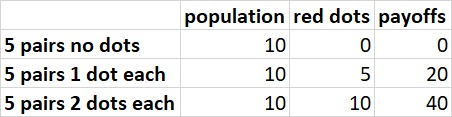
(b) Create a table that shows the share of pairs of the population who started with 0, 1, and 2 red dots, their share of the total endowments, and their share of the payoffs in the DSE.
(c) Sketch the Lorenz curve that shows the distribution of red dots at the beginning (the endowments).
(d) Calculate the Gini coefficient that represents the level of inequality in endowments. Section 4.8 in BFH may be of help.
(e) How does the inequality in the distribution of payoffs in the DSE compare to the inequality in the initial endowments of red dots?
(f) Describe one outcome that is Pareto-superior to the DSE and not Pareto-comparable to the “social play” outcome (when all red dots are played). How does the level of inequality in the outcome you described compare to the DSE and the “social play” outcome?
Homework Answers
a) In case of the group of 5 pairs with no red dots, there is no decision to make. In case of the group of 5 pairs with 1 red dot each, for all of them, choosing 'keep' in any scenario means (+4) and choosing play means (+1) in payoff. For the group of 5 pairs with 2 red dots each, choosing keep in any scenario means (+4*2 = +8) and choosing play means (+1*2 = +2) in payoff. For the 2 choice making groups of 5 pairs, 'keep' would mean the better choice (dominant strategy) given all other players' choices are constant in any scenario.
Therefore KEEP IS THE DOMINANT STRATEGY.
b) 5 groups* (1 red dot each) * $4 payoff for each dot. Then following from (a), we have
c) LORENZ CURVE
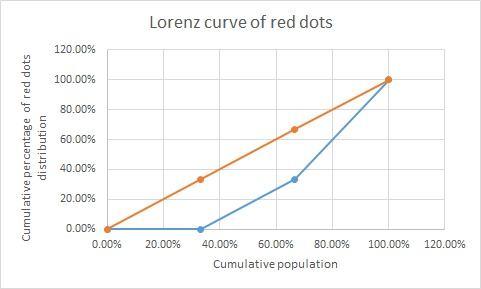
d) GINI COEFFICIENT is the ratio of area between the curve and the lower half of triangle formed due to the equality line.
= 0.277/0.5 = 0.554.
Add Answer to:
1. Recall the game that we played in class during week 1: a pair
of students...
Question 1 (1 point) Saved A random sample of 200 University of Manitoba students is asked...
Question 1 (1 point) Saved A random sample of 200 University of Manitoba students is asked whether their parents have a university degree. What is the population of interest for this survey? Question 1 options: all University of Manitoba students who were included in the sample all parents of University of Manitoba students who have a university degree all University of Manitoba students all parents of University of Manitoba students all University of Manitoba students whose parents have a university...
Most questions answered within 3 hours.
-
Where is the error in this code sequence?
String s1 = "Hello";
String s2 = "ello";...
asked 10 months ago -
Financial data for Joel de Paris, Inc., for last year
follow:
Joel de Paris, Inc.
Balance...
asked 10 months ago -
Consider this reaction:
Al2(SO4)3 (aq)+ BaCl3
(aq) Al2Cl6 (aq)- +
3BaSO4(s) . What is the...
asked 10 months ago -
Suppose that Savneet is considering increasing her
recent random sample from 20 car rentals to 40...
asked 10 months ago -
Trucks arrive at an unloading terminal at an average rate of 120
per hour.
Trucks arrive...
asked 10 months ago -
Why are methanol and ethanol completely soluble in water while
octanol is not very little soluble....
asked 10 months ago -
A facilities manager at a university reads in a research report
that the mean amount of...
asked 10 months ago -
When the CuSO4 is rehydrated by adding water to the anhydrous
compound, is this an endothermic...
asked 10 months ago -
A ray of sunlight is passing from diamond into crown glass; the
angle of incidence is...
asked 10 months ago -
A block of mass 0.249 kg is placed on top of a light, vertical
spring of...
asked 10 months ago -
how do the kidneys compensate in the presences of acidosis
a) trigger hyperventilate
b) reserve acid...
asked 10 months ago -
Question 501 pts
The rental rate of capital to the firm increases. Which of the
following...
asked 10 months ago