Please show your work.
Please show your work.
Homework Answers
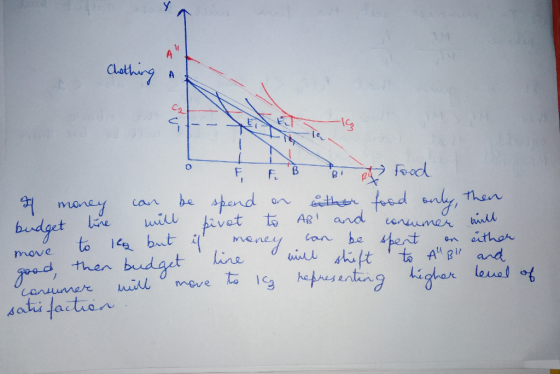
False. The consumer is not indifferent between receiving the money that can be spent only on food and the money that can be spend either on food or clothing. The consumer will be better off and move to an higher indifference curve when the money can be spent on either food or clothing. This can be depicted in the diagram below:
Add Answer to:
Please show your work.
Please show your work.
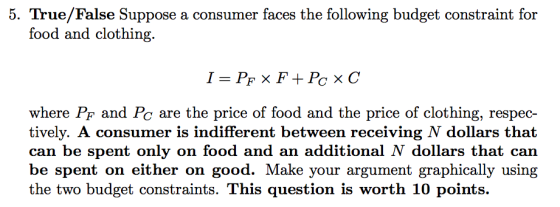
5. True/False Suppose a consumer faces the following...
Please show your work. Please show your work. 3. Graph the following budget set. The two...
 Please show your work.
3. Graph the following budget set. The two goods in question are food and clothing. Suppose that the individual has 500 dollars that can be spent on either food or clothing and that a 200 dollar subsidy is available for food and a 150 dollar subsidy is available for clothing. The price of a unit of food is 10 dollars and the price of a unit of clothing is 25 dollars. The...
Please show your work.
Please show your work.
3. Graph the following budget set. The two goods in question are food and clothing. Suppose that the individual has 500 dollars that can be spent on either food or clothing and that a 200 dollar subsidy is available for food and a 150 dollar subsidy is available for clothing. The price of a unit of food is 10 dollars and the price of a unit of clothing is 25 dollars. The...
Please show your work. Please show your work. 10. Determine if the following statement is either...
 Please show your work.
10. Determine if the following statement is either True or False. A consumer is indifferent between the original budget set and the budget set emerges when we decrease income by one-half and reduce each price by 75 percent. This question is worth 10 points.
Please show your work.
Please show your work.
10. Determine if the following statement is either True or False. A consumer is indifferent between the original budget set and the budget set emerges when we decrease income by one-half and reduce each price by 75 percent. This question is worth 10 points.
Please show your work. Please show your work. 6. Consider the following demand function for Juuls:...
 Please show your work.
6. Consider the following demand function for Juuls: 2Pj where I is the level of income and Pf is the price of food. Using the calculus, show that demand for Juuls is an increasing function of income and that the quantity of Juuls demanded is a decreasing function of the price of Juuls. This question is worth 10 points.
Please show your work.
Please show your work.
6. Consider the following demand function for Juuls: 2Pj where I is the level of income and Pf is the price of food. Using the calculus, show that demand for Juuls is an increasing function of income and that the quantity of Juuls demanded is a decreasing function of the price of Juuls. This question is worth 10 points.
Cursue a consumer with preferences described by (x1, x2) = x1 + x2 Suppose she faces...
 Cursue a consumer with preferences described by (x1, x2) = x1 + x2 Suppose she faces prices pi 1 and P2 = 1/2 and that she has an income of I = 2. For your reference, the marginal utilities at a bundle (x1, x2) in this setting are given by MU (x1, x2) = 1 MU?(x), x2) = 2V x2 3(a) Write down the two equations which characterize the consumer's utility-maximizing bundle (X1.3) in this situation. In other words, write...
2 and 3 please. A consumer purchases two goods, food (F) and clothing (C). Her utility...
 2 and 3 please.
A consumer purchases two goods, food (F) and clothing (C). Her utility function is given by U(F,C)= FC +F. The marginal utilities are MU, = C +1 and MUS = F. The price of food is Pc , the price of clothing is Pc, and the consumer's income is I. 1) What is the demand curve for clothing? 2) Is clothing a normal good in this case? Charlie consumes two goods, professional baseball games (B) and...
2 and 3 please.
A consumer purchases two goods, food (F) and clothing (C). Her utility function is given by U(F,C)= FC +F. The marginal utilities are MU, = C +1 and MUS = F. The price of food is Pc , the price of clothing is Pc, and the consumer's income is I. 1) What is the demand curve for clothing? 2) Is clothing a normal good in this case? Charlie consumes two goods, professional baseball games (B) and...
Please answer question 2 and show the work. This is Q1 and answer for Q1 needed...
 Please answer question 2 and show the work.
This is Q1 and answer for Q1 needed to answer question
2
2. Assume the consumer from Q1 has the following indifference map, where the MRS = -20 along Ray #1 and MRS = -15 along Ray #2. ce (Sk) toys 350 300 360 200 333% What is this consumer's best affordable bundle (BAB) before she receives the gift card? Please provide the rationale for your answer. 2pt (b) Draw this consumer's...
Please answer question 2 and show the work.
This is Q1 and answer for Q1 needed to answer question
2
2. Assume the consumer from Q1 has the following indifference map, where the MRS = -20 along Ray #1 and MRS = -15 along Ray #2. ce (Sk) toys 350 300 360 200 333% What is this consumer's best affordable bundle (BAB) before she receives the gift card? Please provide the rationale for your answer. 2pt (b) Draw this consumer's...
Please show your work. Please show your work. 8. The following function is an example of...
 Please show your work.
8. The following function is an example of a utility function. In Economics we use it to rank bundles of X and Y. Bundles with higher values are preferred to bundles with lower values. 2yr4 Compute the marginal utility of receiving an additional unit of X holding the quantity of Y constant. Compute the marginal utility of receiving an additional unit of Y holding the quantity of X constant. This question is...
Please show your work.
Please show your work.
8. The following function is an example of a utility function. In Economics we use it to rank bundles of X and Y. Bundles with higher values are preferred to bundles with lower values. 2yr4 Compute the marginal utility of receiving an additional unit of X holding the quantity of Y constant. Compute the marginal utility of receiving an additional unit of Y holding the quantity of X constant. This question is...
Please show work and explain EXERCISE 2 A consumer consumes one consumption good x and hours...
 Please show work and explain
EXERCISE 2 A consumer consumes one consumption good x and hours of leisure h. The price of the consumption good is 1. The consumer earns wage rate s per hour for the first eight hours of work, and s' > s for additional overtime hours. He also faces a tax rate per dollar on labor income earned above amount M. Draw the budget set. Assume M < 8s, which means that the consumer does not...
Please show work and explain
EXERCISE 2 A consumer consumes one consumption good x and hours of leisure h. The price of the consumption good is 1. The consumer earns wage rate s per hour for the first eight hours of work, and s' > s for additional overtime hours. He also faces a tax rate per dollar on labor income earned above amount M. Draw the budget set. Assume M < 8s, which means that the consumer does not...
5. A consumer has the utility function U= In C+In (24-N), where C is consump- tion...
 5. A consumer has the utility function U= In C+In (24-N), where C is consump- tion and Nis labor supply. Her budget constraint is pC MwN, where p is the price of the consumption good, w the wage rate, and M the consumer's non- wage income. (a) Formulate the problem of utility maximization subject to the budget con- straint, and derive the first-order conditions, using the Lagrange multi- plier approach and ignoring the nonnegativity constraints. 80 1 Static optimization Find...
Suppose that a consumer has a utility function given by u(x1, x2) = 2x1 + x2. Initially the consumer faces prices (2, 2) and has income 24. i. Graph the budget constraint and indifference curves. Find...
Suppose that a consumer has a utility function given by u(x1, x2) = 2x1 + x2. Initially the consumer faces prices (2, 2) and has income 24. i. Graph the budget constraint and indifference curves. Find the initial optimal bundle. ii. If the prices change to (6, 2), find the new optimal bundle. Show this in your graph in (i). iii. How much of the change in demand for x1 is due to the substitution effect? How much due to...
 Please show your work.
3. Graph the following budget set. The two goods in question are food and clothing. Suppose that the individual has 500 dollars that can be spent on either food or clothing and that a 200 dollar subsidy is available for food and a 150 dollar subsidy is available for clothing. The price of a unit of food is 10 dollars and the price of a unit of clothing is 25 dollars. The...
Please show your work.
Please show your work.
3. Graph the following budget set. The two goods in question are food and clothing. Suppose that the individual has 500 dollars that can be spent on either food or clothing and that a 200 dollar subsidy is available for food and a 150 dollar subsidy is available for clothing. The price of a unit of food is 10 dollars and the price of a unit of clothing is 25 dollars. The...
 Please show your work.
10. Determine if the following statement is either True or False. A consumer is indifferent between the original budget set and the budget set emerges when we decrease income by one-half and reduce each price by 75 percent. This question is worth 10 points.
Please show your work.
Please show your work.
10. Determine if the following statement is either True or False. A consumer is indifferent between the original budget set and the budget set emerges when we decrease income by one-half and reduce each price by 75 percent. This question is worth 10 points.
 Please show your work.
6. Consider the following demand function for Juuls: 2Pj where I is the level of income and Pf is the price of food. Using the calculus, show that demand for Juuls is an increasing function of income and that the quantity of Juuls demanded is a decreasing function of the price of Juuls. This question is worth 10 points.
Please show your work.
Please show your work.
6. Consider the following demand function for Juuls: 2Pj where I is the level of income and Pf is the price of food. Using the calculus, show that demand for Juuls is an increasing function of income and that the quantity of Juuls demanded is a decreasing function of the price of Juuls. This question is worth 10 points.
 Cursue a consumer with preferences described by (x1, x2) = x1 + x2 Suppose she faces prices pi 1 and P2 = 1/2 and that she has an income of I = 2. For your reference, the marginal utilities at a bundle (x1, x2) in this setting are given by MU (x1, x2) = 1 MU?(x), x2) = 2V x2 3(a) Write down the two equations which characterize the consumer's utility-maximizing bundle (X1.3) in this situation. In other words, write...
 2 and 3 please.
A consumer purchases two goods, food (F) and clothing (C). Her utility function is given by U(F,C)= FC +F. The marginal utilities are MU, = C +1 and MUS = F. The price of food is Pc , the price of clothing is Pc, and the consumer's income is I. 1) What is the demand curve for clothing? 2) Is clothing a normal good in this case? Charlie consumes two goods, professional baseball games (B) and...
2 and 3 please.
A consumer purchases two goods, food (F) and clothing (C). Her utility function is given by U(F,C)= FC +F. The marginal utilities are MU, = C +1 and MUS = F. The price of food is Pc , the price of clothing is Pc, and the consumer's income is I. 1) What is the demand curve for clothing? 2) Is clothing a normal good in this case? Charlie consumes two goods, professional baseball games (B) and...
 Please answer question 2 and show the work.
This is Q1 and answer for Q1 needed to answer question
2
2. Assume the consumer from Q1 has the following indifference map, where the MRS = -20 along Ray #1 and MRS = -15 along Ray #2. ce (Sk) toys 350 300 360 200 333% What is this consumer's best affordable bundle (BAB) before she receives the gift card? Please provide the rationale for your answer. 2pt (b) Draw this consumer's...
Please answer question 2 and show the work.
This is Q1 and answer for Q1 needed to answer question
2
2. Assume the consumer from Q1 has the following indifference map, where the MRS = -20 along Ray #1 and MRS = -15 along Ray #2. ce (Sk) toys 350 300 360 200 333% What is this consumer's best affordable bundle (BAB) before she receives the gift card? Please provide the rationale for your answer. 2pt (b) Draw this consumer's...
 Please show your work.
8. The following function is an example of a utility function. In Economics we use it to rank bundles of X and Y. Bundles with higher values are preferred to bundles with lower values. 2yr4 Compute the marginal utility of receiving an additional unit of X holding the quantity of Y constant. Compute the marginal utility of receiving an additional unit of Y holding the quantity of X constant. This question is...
Please show your work.
Please show your work.
8. The following function is an example of a utility function. In Economics we use it to rank bundles of X and Y. Bundles with higher values are preferred to bundles with lower values. 2yr4 Compute the marginal utility of receiving an additional unit of X holding the quantity of Y constant. Compute the marginal utility of receiving an additional unit of Y holding the quantity of X constant. This question is...
 Please show work and explain
EXERCISE 2 A consumer consumes one consumption good x and hours of leisure h. The price of the consumption good is 1. The consumer earns wage rate s per hour for the first eight hours of work, and s' > s for additional overtime hours. He also faces a tax rate per dollar on labor income earned above amount M. Draw the budget set. Assume M < 8s, which means that the consumer does not...
Please show work and explain
EXERCISE 2 A consumer consumes one consumption good x and hours of leisure h. The price of the consumption good is 1. The consumer earns wage rate s per hour for the first eight hours of work, and s' > s for additional overtime hours. He also faces a tax rate per dollar on labor income earned above amount M. Draw the budget set. Assume M < 8s, which means that the consumer does not...
 5. A consumer has the utility function U= In C+In (24-N), where C is consump- tion and Nis labor supply. Her budget constraint is pC MwN, where p is the price of the consumption good, w the wage rate, and M the consumer's non- wage income. (a) Formulate the problem of utility maximization subject to the budget con- straint, and derive the first-order conditions, using the Lagrange multi- plier approach and ignoring the nonnegativity constraints. 80 1 Static optimization Find...
Most questions answered within 3 hours.
-
Where is the error in this code sequence?
String s1 = "Hello";
String s2 = "ello";...
asked 10 months ago -
Financial data for Joel de Paris, Inc., for last year
follow:
Joel de Paris, Inc.
Balance...
asked 10 months ago -
Consider this reaction:
Al2(SO4)3 (aq)+ BaCl3
(aq) Al2Cl6 (aq)- +
3BaSO4(s) . What is the...
asked 10 months ago -
Suppose that Savneet is considering increasing her
recent random sample from 20 car rentals to 40...
asked 10 months ago -
Trucks arrive at an unloading terminal at an average rate of 120
per hour.
Trucks arrive...
asked 10 months ago -
Why are methanol and ethanol completely soluble in water while
octanol is not very little soluble....
asked 10 months ago -
A facilities manager at a university reads in a research report
that the mean amount of...
asked 10 months ago -
When the CuSO4 is rehydrated by adding water to the anhydrous
compound, is this an endothermic...
asked 10 months ago -
A ray of sunlight is passing from diamond into crown glass; the
angle of incidence is...
asked 10 months ago -
A block of mass 0.249 kg is placed on top of a light, vertical
spring of...
asked 10 months ago -
how do the kidneys compensate in the presences of acidosis
a) trigger hyperventilate
b) reserve acid...
asked 10 months ago -
Question 501 pts
The rental rate of capital to the firm increases. Which of the
following...
asked 10 months ago