


Homework Answers
1. (B) Bayes Theorem states that extraordinary claims need extraordinary evidence. This determine the conditional probability existing in market.
2. (C) Tornadoes
3. (D) Ingroup/ outgroup division
NoTe :- Question 4-5 belong to Probability. Probability is not subject of economics , hence these cant be answered.
Add Answer to:
1. Which of the following is an implication of Bayes' Theorem? A. It is irrational to...
18. The Axiom of Closure prevents what pathology of decision making? A. Violation of the "sure...
 18. The Axiom of Closure prevents what pathology of decision making? A. Violation of the "sure thing" principle B. Becoming a "money pump C. Inability to make choices under risk D. Obsession with infinitely improbable alternatives E. Neglecting base rates 19. Consider the following simultaneous game (payoff pairs (a, b) indicate the payoffs to Player 1 (a) and Player 2 (b), respectively) Player 1 R. Player 2 L (2,-2) (0,2) R (2,0) (0,0) What is the best response of Player...
e. Application of Bayes: Using Bayes theorem driven in item d, show that in the following problem switching is the bett...
 e. Application of Bayes: Using Bayes theorem driven in item d, show that in the following problem switching is the better strategy for the player and makes the probability of wining as 2/3, while not switching gives the probability of wining 1/3. Monty Hall: There are 3 doors 1, 2, 3. Randomly, and equally likely, behind one of the door there is a prize, and other two are empty. The player choose one door. He does not open the door...
Problem 4 ((30 points) Bayes Theorem). The local barber shop is home to three barbers The...
 Problem 4 ((30 points) Bayes Theorem). The local barber shop is home to three barbers The barbers appear identical but vary in their ability to provide good haircuts. Denote the event that you receive a good haircut by G, the event that you do not receive a good haircut by NG, and the event that your hair is cut by barber i by Bi, where i E 1,2, 3) The probability that any particular barber cuts your hair is 1/3....
The following applies to questions 4-6 below. Assume the following notation: p(A) is the probability of...
 The following applies to questions 4-6 below. Assume the following notation: p(A) is the probability of event A; P(AB) is the probability of A and B; p(AVB) is the probability of A or B; p(AB) is the probability of A given B; S is the universe of possibilities; -A is the negation of A; and is the null event. 4. p(AB) where xis A. p(A) P(B) B. P(AlB)p(B) C. p(BIA) D. p(B)2 E. p(A V B) 5. For all A...
Bayes’ Theorem is an important probability result relating the condition probabilities P(A|B) and P(B|A). Here we...
Bayes’ Theorem is an important probability result relating the condition probabilities P(A|B) and P(B|A). Here we develop the formula. (a) Let A and B be events. What is the definition of P(A|B)? What is the definition of (B|A)? (b) Compute P(A|B)·P(B) and P(B|A)·P(A). (c) Find an expression for P(B|A) in terms of P(A), P(B) and P(A|B). (d) Suppose P(B) =P(A) and P(A|B) = 0.7, find P(B|A).
Bayes theorem is related to : a)Independent Probabilities b)Exhaustive probabilities c)Conditional probabilities d)None of the above...
Bayes theorem is related to : a)Independent Probabilities b)Exhaustive probabilities c)Conditional probabilities d)None of the above e)All of the above
Show all work and steps! 1-Answer the following questions about conditional probability and Bayes theorem a....
 Show all work and steps!
1-Answer the following questions about conditional probability and Bayes theorem a. You roll 2 dice and record the sum i. ii. iii. Write the sample space What is the probability of the sum being 10? What is the probability that at least one of the die values was a 6 given that the sum was greater than or equal to 7?
Show all work and steps!
1-Answer the following questions about conditional probability and Bayes theorem a. You roll 2 dice and record the sum i. ii. iii. Write the sample space What is the probability of the sum being 10? What is the probability that at least one of the die values was a 6 given that the sum was greater than or equal to 7?
Please use Bayes theorem and show work/reasoning. Thank you :) PROBLEM 2 It is known that...
 Please use Bayes theorem and show work/reasoning. Thank you
:)
PROBLEM 2 It is known that there is a 5% probability that a visitor to a particular e-commerce website will actually buy something. Assume that you are interested in a group of 20 visitors to this we bsite. a) What is the probability that none of the 20 visitors will buy something? b) How many of the 20 visitors do you expect to buy something? c) What is the probability...
Please use Bayes theorem and show work/reasoning. Thank you
:)
PROBLEM 2 It is known that there is a 5% probability that a visitor to a particular e-commerce website will actually buy something. Assume that you are interested in a group of 20 visitors to this we bsite. a) What is the probability that none of the 20 visitors will buy something? b) How many of the 20 visitors do you expect to buy something? c) What is the probability...
What is the correct formula for Bayes' theorem? a) P(XY) = am b) P(XY) = P(xor...
 What is the correct formula for Bayes' theorem? a) P(XY) = am b) P(XY) = P(xor PY) c) P(X|Y) = PRAXIS d) P(X\Y) = POUR Submit Answer format: Text unanswered not_submitted #2 From the following new information, given low demand, what is the probability of an improving economy? Improving Economy Not improving economy 0.76 Given high demand 0.5 Given Low demand Points: 5/17 Grade: 29.4% Progress: 29.4% Hide
1 Independence in Bayes Net. Answer the following questions for the Baysian network shown in Fig....
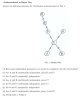 1 Independence in Bayes Net. Answer the following questions for the Baysian network shown in Fig. 4 氐 FIG. 1: Bayes Net. (a) How many independent parameters are needed to completely describe the problem? (b) Are A and B conditionally independent, given D and F? (c) Are A and B (marginally) independent? (d) Are A and B conditionally independent, given C? (e) Are D and E conditionally independent, given C? (f) Are D and E (marginally) independent? (g) Are D...
 18. The Axiom of Closure prevents what pathology of decision making? A. Violation of the "sure thing" principle B. Becoming a "money pump C. Inability to make choices under risk D. Obsession with infinitely improbable alternatives E. Neglecting base rates 19. Consider the following simultaneous game (payoff pairs (a, b) indicate the payoffs to Player 1 (a) and Player 2 (b), respectively) Player 1 R. Player 2 L (2,-2) (0,2) R (2,0) (0,0) What is the best response of Player...
 e. Application of Bayes: Using Bayes theorem driven in item d, show that in the following problem switching is the better strategy for the player and makes the probability of wining as 2/3, while not switching gives the probability of wining 1/3. Monty Hall: There are 3 doors 1, 2, 3. Randomly, and equally likely, behind one of the door there is a prize, and other two are empty. The player choose one door. He does not open the door...
 Problem 4 ((30 points) Bayes Theorem). The local barber shop is home to three barbers The barbers appear identical but vary in their ability to provide good haircuts. Denote the event that you receive a good haircut by G, the event that you do not receive a good haircut by NG, and the event that your hair is cut by barber i by Bi, where i E 1,2, 3) The probability that any particular barber cuts your hair is 1/3....
 The following applies to questions 4-6 below. Assume the following notation: p(A) is the probability of event A; P(AB) is the probability of A and B; p(AVB) is the probability of A or B; p(AB) is the probability of A given B; S is the universe of possibilities; -A is the negation of A; and is the null event. 4. p(AB) where xis A. p(A) P(B) B. P(AlB)p(B) C. p(BIA) D. p(B)2 E. p(A V B) 5. For all A...
 Show all work and steps!
1-Answer the following questions about conditional probability and Bayes theorem a. You roll 2 dice and record the sum i. ii. iii. Write the sample space What is the probability of the sum being 10? What is the probability that at least one of the die values was a 6 given that the sum was greater than or equal to 7?
Show all work and steps!
1-Answer the following questions about conditional probability and Bayes theorem a. You roll 2 dice and record the sum i. ii. iii. Write the sample space What is the probability of the sum being 10? What is the probability that at least one of the die values was a 6 given that the sum was greater than or equal to 7?
 Please use Bayes theorem and show work/reasoning. Thank you
:)
PROBLEM 2 It is known that there is a 5% probability that a visitor to a particular e-commerce website will actually buy something. Assume that you are interested in a group of 20 visitors to this we bsite. a) What is the probability that none of the 20 visitors will buy something? b) How many of the 20 visitors do you expect to buy something? c) What is the probability...
Please use Bayes theorem and show work/reasoning. Thank you
:)
PROBLEM 2 It is known that there is a 5% probability that a visitor to a particular e-commerce website will actually buy something. Assume that you are interested in a group of 20 visitors to this we bsite. a) What is the probability that none of the 20 visitors will buy something? b) How many of the 20 visitors do you expect to buy something? c) What is the probability...
 What is the correct formula for Bayes' theorem? a) P(XY) = am b) P(XY) = P(xor PY) c) P(X|Y) = PRAXIS d) P(X\Y) = POUR Submit Answer format: Text unanswered not_submitted #2 From the following new information, given low demand, what is the probability of an improving economy? Improving Economy Not improving economy 0.76 Given high demand 0.5 Given Low demand Points: 5/17 Grade: 29.4% Progress: 29.4% Hide
 1 Independence in Bayes Net. Answer the following questions for the Baysian network shown in Fig. 4 氐 FIG. 1: Bayes Net. (a) How many independent parameters are needed to completely describe the problem? (b) Are A and B conditionally independent, given D and F? (c) Are A and B (marginally) independent? (d) Are A and B conditionally independent, given C? (e) Are D and E conditionally independent, given C? (f) Are D and E (marginally) independent? (g) Are D...
Most questions answered within 3 hours.
-
Where is the error in this code sequence?
String s1 = "Hello";
String s2 = "ello";...
asked 11 months ago -
Financial data for Joel de Paris, Inc., for last year
follow:
Joel de Paris, Inc.
Balance...
asked 11 months ago -
Consider this reaction:
Al2(SO4)3 (aq)+ BaCl3
(aq) Al2Cl6 (aq)- +
3BaSO4(s) . What is the...
asked 11 months ago -
Suppose that Savneet is considering increasing her
recent random sample from 20 car rentals to 40...
asked 11 months ago -
Trucks arrive at an unloading terminal at an average rate of 120
per hour.
Trucks arrive...
asked 11 months ago -
Why are methanol and ethanol completely soluble in water while
octanol is not very little soluble....
asked 11 months ago -
A facilities manager at a university reads in a research report
that the mean amount of...
asked 11 months ago -
When the CuSO4 is rehydrated by adding water to the anhydrous
compound, is this an endothermic...
asked 11 months ago -
A ray of sunlight is passing from diamond into crown glass; the
angle of incidence is...
asked 11 months ago -
A block of mass 0.249 kg is placed on top of a light, vertical
spring of...
asked 11 months ago -
how do the kidneys compensate in the presences of acidosis
a) trigger hyperventilate
b) reserve acid...
asked 11 months ago -
Question 501 pts
The rental rate of capital to the firm increases. Which of the
following...
asked 11 months ago