
Homework Answers
Add Answer to:
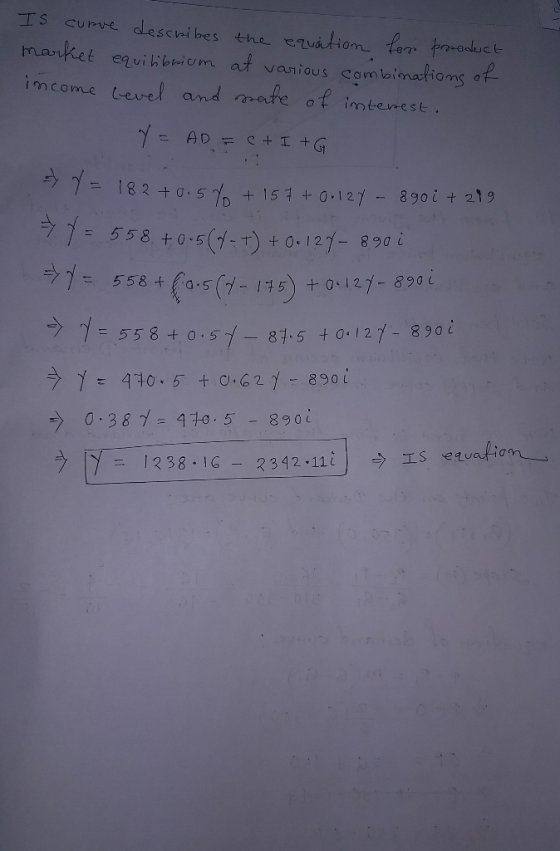
Consider the following numerical example of the IS-LM model: C = 182 +0.5Y) 1 = 157...
Consider the following numerical example of the IS-LM model: C = 241 +0.62Y) | = 151...
 Consider the following numerical example of the IS-LM model: C = 241 +0.62Y) | = 151 +0.12Y-8981 G = 204 T = 163 i = 0.05 Derive the IS relation. (Hint: You want an equation with Y on the left side of the equation and everything else on the right.) Y=||- | i. (Round your calculations of the intercept and slope terms to two decimal places.) The central bank sets an interest rate of 5%. In the equations given above,...
1. Consider an economy described by the following: C = 400 +0SY -IA - TRỊ I...
 1. Consider an economy described by the following: C = 400 +0SY -IA - TRỊ I = 150 -0.18-10 G = 200, T = 2Y, TR = 100 transfers, G- Where consumption, I investment, t is the marginal tax rate, TR government purchases, and is the interest rate. a. Derive the Is relation. (Hint: You want an equation with Y on the left hand side and everything else on the right.) b. What is equilibrium Y if the interest rate...
1. Consider the following numerical example of the IS-LM model: C = 100 + 0.3YD I...
1. Consider the following numerical example of the IS-LM model: C = 100 + 0.3YD I = 150 + 0.2Y - 1000i T = 100 G = 200 i = .01 (M/P)s = 1200 (M/P)d = 2Y - 4000i a. Find the equation for aggregate demand (Y). b. Derive the IS relation. c. Derive the LM relation if the central bank sets an interest rate of 1%. d. Solve for the equilibrium values of output, interest rate, C and I....
please help me Consider the following numerical example of the IS-LM model: C = 100 +...
please help me Consider the following numerical example of the IS-LM model: C = 100 + 0.3YD I = 150 + 0.2Y - 1000i T = 100 G = 200 i = .01 (M/P)s = 1200 (M/P)d = 2Y - 4000i Find the equation for aggregate demand (Y). Derive the IS relation. Derive the LM relation if the central bank sets an interest rate of 1%. Solve for the equilibrium values of output, interest rate, C and I. Expansionary monetary...
Just e) f) and g) if possible please Question 5: The IS-LM model Consider the following...
 Just e) f) and g) if possible please
Question 5: The IS-LM model Consider the following IS-LM model: Consumption: C = 200 +0.25YD Investment: I=150 + 0.25Y - 10001 Government spending: G=250 Taxes: T=200 Money demand: L(i,Y)-2Y - 8000 Money supply: Ms /P=1600 (a) Derive the equation for the IS curve. (Hint: You want an equation with Y on the lefthand side and all else on the right) (b) Derive the equation for the LM curve. (Hint: It will be...
Just e) f) and g) if possible please
Question 5: The IS-LM model Consider the following IS-LM model: Consumption: C = 200 +0.25YD Investment: I=150 + 0.25Y - 10001 Government spending: G=250 Taxes: T=200 Money demand: L(i,Y)-2Y - 8000 Money supply: Ms /P=1600 (a) Derive the equation for the IS curve. (Hint: You want an equation with Y on the lefthand side and all else on the right) (b) Derive the equation for the LM curve. (Hint: It will be...
4. Consider the following numerical example of the IS-LM model C 0.8(Y T); I 1520 240i;...
 4. Consider the following numerical example of the IS-LM model C 0.8(Y T); I 1520 240i; T 150 0.25Y; G 200; (M/P)s 1800 (M/P)D 300 0.75Y 300i a. Derive the IS and LM relation. (10%) b. Solove for the equilibrium values of output, interest rate, disposable income.(10%) 400 and T becomes T 350 0.25Y c. Suppose that G rises by 200 to G = Simultaneously, the central bank decreases money supply to 1500. Calculate what will happen to Y* and...
d 21. Consider the following IS-LM model: C = co +61 (Y – T) I =...
 d 21. Consider the following IS-LM model: C = co +61 (Y – T) I = bo + b Y – bai M d¡Y – dzi Р M P Р a. where (b+c) <1 b. Derive IS equation. Derive and determine its sign. [5 points]- di di c. b. Derive LM equation. Derive and determine its sign. [5 points]- d. c. Assume that LM curve is ** dY t dY () M P =dY Solve for the equilibrium output and...
Consider the following example of the IS-LM model: C = 300 + 0.5(Y–T) I = 400...
Consider the following example of the IS-LM model: C = 300 + 0.5(Y–T) I = 400 – 1000(r + x) G = 250 T = 200 x=0.03 πe = 0.02 Derive the IS equation. Suppose that the nominal interest rate is 4% (i = 0.04). Find the equilibrium value of Y. Suppose that the risk premium x has increased to x=0.1. Suppose that the Fed wants to maintain the equilibrium value of Y at the value of Y...
Consider the following IS-LM model: C = 218 +0.44YD 1 = 148 +0.19Y-1,0211 G = 283...
 Consider the following IS-LM model: C = 218 +0.44YD 1 = 148 +0.19Y-1,0211 G = 283 T = 226 i = 0.04 The IS equation is determined to be Y = 1,485.30 - 2,759.46i. The LM equation is given as i = 0.04. Using the IS and LM equations, the equilibrium real output, Y. is (Round your response to the nearest integer.) Using the IS-LM model, the equilibrium value of consumption, C, is . (Round your response to the nearest...
Consider the following numerical model: C = 700 + 0.8YD I = 500-2000i+0.1Y G = 400...
Consider the following numerical model: C = 700 + 0.8YD I = 500-2000i+0.1Y G = 400 T = 500 - Find the equation for the IS curve (keep in mind that YD=Y-T). If you were to draw the IS curve, what would the intercept (where the IS curve crosses the Y vertical axis) be? (and find the intercept in relation to Y - ie in the form Y=a-bi where a is the intercept) - If G increases from 400 to...
 Consider the following numerical example of the IS-LM model: C = 241 +0.62Y) | = 151 +0.12Y-8981 G = 204 T = 163 i = 0.05 Derive the IS relation. (Hint: You want an equation with Y on the left side of the equation and everything else on the right.) Y=||- | i. (Round your calculations of the intercept and slope terms to two decimal places.) The central bank sets an interest rate of 5%. In the equations given above,...
 1. Consider an economy described by the following: C = 400 +0SY -IA - TRỊ I = 150 -0.18-10 G = 200, T = 2Y, TR = 100 transfers, G- Where consumption, I investment, t is the marginal tax rate, TR government purchases, and is the interest rate. a. Derive the Is relation. (Hint: You want an equation with Y on the left hand side and everything else on the right.) b. What is equilibrium Y if the interest rate...
 Just e) f) and g) if possible please
Question 5: The IS-LM model Consider the following IS-LM model: Consumption: C = 200 +0.25YD Investment: I=150 + 0.25Y - 10001 Government spending: G=250 Taxes: T=200 Money demand: L(i,Y)-2Y - 8000 Money supply: Ms /P=1600 (a) Derive the equation for the IS curve. (Hint: You want an equation with Y on the lefthand side and all else on the right) (b) Derive the equation for the LM curve. (Hint: It will be...
Just e) f) and g) if possible please
Question 5: The IS-LM model Consider the following IS-LM model: Consumption: C = 200 +0.25YD Investment: I=150 + 0.25Y - 10001 Government spending: G=250 Taxes: T=200 Money demand: L(i,Y)-2Y - 8000 Money supply: Ms /P=1600 (a) Derive the equation for the IS curve. (Hint: You want an equation with Y on the lefthand side and all else on the right) (b) Derive the equation for the LM curve. (Hint: It will be...
 4. Consider the following numerical example of the IS-LM model C 0.8(Y T); I 1520 240i; T 150 0.25Y; G 200; (M/P)s 1800 (M/P)D 300 0.75Y 300i a. Derive the IS and LM relation. (10%) b. Solove for the equilibrium values of output, interest rate, disposable income.(10%) 400 and T becomes T 350 0.25Y c. Suppose that G rises by 200 to G = Simultaneously, the central bank decreases money supply to 1500. Calculate what will happen to Y* and...
 d 21. Consider the following IS-LM model: C = co +61 (Y – T) I = bo + b Y – bai M d¡Y – dzi Р M P Р a. where (b+c) <1 b. Derive IS equation. Derive and determine its sign. [5 points]- di di c. b. Derive LM equation. Derive and determine its sign. [5 points]- d. c. Assume that LM curve is ** dY t dY () M P =dY Solve for the equilibrium output and...
 Consider the following IS-LM model: C = 218 +0.44YD 1 = 148 +0.19Y-1,0211 G = 283 T = 226 i = 0.04 The IS equation is determined to be Y = 1,485.30 - 2,759.46i. The LM equation is given as i = 0.04. Using the IS and LM equations, the equilibrium real output, Y. is (Round your response to the nearest integer.) Using the IS-LM model, the equilibrium value of consumption, C, is . (Round your response to the nearest...
Most questions answered within 3 hours.
-
Where is the error in this code sequence?
String s1 = "Hello";
String s2 = "ello";...
asked 10 months ago -
Financial data for Joel de Paris, Inc., for last year
follow:
Joel de Paris, Inc.
Balance...
asked 10 months ago -
Consider this reaction:
Al2(SO4)3 (aq)+ BaCl3
(aq) Al2Cl6 (aq)- +
3BaSO4(s) . What is the...
asked 10 months ago -
Suppose that Savneet is considering increasing her
recent random sample from 20 car rentals to 40...
asked 10 months ago -
Trucks arrive at an unloading terminal at an average rate of 120
per hour.
Trucks arrive...
asked 10 months ago -
Why are methanol and ethanol completely soluble in water while
octanol is not very little soluble....
asked 10 months ago -
A facilities manager at a university reads in a research report
that the mean amount of...
asked 10 months ago -
When the CuSO4 is rehydrated by adding water to the anhydrous
compound, is this an endothermic...
asked 10 months ago -
A ray of sunlight is passing from diamond into crown glass; the
angle of incidence is...
asked 10 months ago -
A block of mass 0.249 kg is placed on top of a light, vertical
spring of...
asked 10 months ago -
how do the kidneys compensate in the presences of acidosis
a) trigger hyperventilate
b) reserve acid...
asked 10 months ago -
Question 501 pts
The rental rate of capital to the firm increases. Which of the
following...
asked 10 months ago