
Homework Answers
BEHAVIOURAL ECONOMICS INSIGHTS AND EXAMPLE:
Behavioural economics (BE) has been called the science of decision-making. It is a growing academic discipline, which uses experiments that observe human behaviour in order to uncover how we think. It addresses such fundamental questions as how do we process information and how are we influenced to behave. Behavioural economics is valuable to marketers on many levels. It provides ‘big picture’ answers to vital questions such as:
- How emotional or rational is consumer decision-making?
- How quick or considered is consumer decision-making?
- How much information can consumers take in?
- How important is context in affecting perceptions of a brand and influencing behaviour?
Your answers to these fundamental questions affect your beliefs about effectiveness and what activities you choose to invest in. Behavioural economics also illuminates why small things can make a huge difference and provide explanations as to why a specific execution performs or fails. Behavioural economics gives marketers a sharp reminder that grand strategies can fail unless we pay attention to details.
How behavioural economics all started?
In 2008, Thaler and Cass Sunstein published the book “Nudge: Improving Decisions about Health, Wealth, and Happiness” which started the revolution. It used principles of behavioral science to show that you can influence people or “nudge” them towards a specific choice without restrictions, prohibitions or a change in costs. You do that by designing the choice architecture differently – the way in which options are presented so for example, if we want to encourage people to choose more vegetarian then featuring the vegetarian options on the menu in the middle and in a larger font is a nudge (in behavioural economics in parlance we have just increased their salience). It is easy to see why these ideas were so well received (not that we are biased). Nudges are cheaper than other traditional governmental tools (like tax cuts), and they are less inclined to evoke negative responses than say prohibiting something altogether. Thaler and Sunstein were very clear that some ethical principles must be kept – nudges should be transparent, easily opted out of, and promote behavior that is in the best interest of the individual.
What is the thinking and science behind Behavioural
economics?
Daniel Kahneman (the father of behavioural economics) provided the
frameworks on which other academics and thinkers have built on. His
big idea is that we have a two-system brain, which he calls System
1 and System 2.
System 1 integrates perception and intuition. It is fast, automatic and instinctive. It is the thinking that you are doing without being aware of it and, because it is automatic, it consumes less energy. This is the part of your brain that has evolved to help you survive; it processes stimuli through all the senses and preserves energy. It is how you sense something is ‘not quite right’ before you analyse the ‘why’ in System 2.
System 2 is reflective thinking. You are aware that you are doing it. It is slow and burns up a lot of energy. After you have been thinking hard you get very hungry. System 2 is how we make slow and deliberate decisions, but you cannot think hard all the time because it is tiring. Your default mode of thinking is System 1.
We first process information fast and instinctively, which is then more actively considered and analysed in System 2. System 1 represents an early warning system for System 2, which is deployed to check that your instincts are right. One way to think about it is that System 1 is autopilot and that System 2 is when the pilot is brought into action. Our default mode is autopilot in order to preserve energy and remain alert to any stimuli through all of our senses.
Why Behavioural Economics?
- Behavioural economics blends insights of psychology and economics, and provides some valuable insights that individuals are not behaving in their own best interests.
- It is kind of the opposite to the rational decision makers that are usually described in economic theory.
- It provides a framework to understand when and how people make errors.
- Lessons from behavioural economics can be used to create environments that nudge people toward wiser decisions and healthier lives.
- This could be savings or pension schemes that have penalties for early withdrawal; or making it harder to reach the shelves with unhealthy food in school canteens or grocery stores; or membership schemes in the gym where customers agree to pay more if they miss their scheduled workouts.
- An experimental study showed that by providing three options: no savings account, a normal savings account, and a commitment savings account that locked up the money until a certain date - the farmers picked the third option.
- This led to greater purchase of agricultural inputs in the next period, and higher earnings after the next harvest.
- UK, US, Singapore and Australia have setup behavioural economics unit, which serve as policy
toolbox.
What are some of the implications of this model?
1 Brands that make things easy are more trusted:
Ease gets more business because as Kahneman explains, ease takes less effort and it “feels familiar, feels true and feels good.” Ease and simplicity of design drives out complexity. When developing a website design, do the mobile version first, because it will force you to be as simple as possible. Use contrast in design to highlight what you want the consumers to look at. It is no accident that – the Google app – one of the most popular in the world, is also the most simple.
2 The perception of popularity sells:
We outsource risk to the crowd. If something is perceived to be widely used then it is probably a safe choice. This is also known as ‘the law of social proof.’ Consumers want (most of the time) to make ‘good enough’ rather than perfect decisions, using other people like them as guides. The demise of mass communication, like TV advertising, has been much predicted, but it remains powerful as a marketing tool because it is a form of public affirmation that a brand is popular and widely used. Marketers have other tools at their disposal to signal popularity such as designing products that use visual signals to show they are widely consumed. You know immediately what brand of laptop this is – in spite of the personalisation.
3 Emotional communications predisposes purchase
This is supported by the findings of a survey of all the IPA Effectiveness Awards, which said that “emotional campaigns outperform rational campaigns on almost every single attitudinal dimension. Put emotions at the core of your campaign. Do not just bolt on emotions to a rational proposition.” John Lewis won the top effectiveness award in 2012 with their Christmas campaign.
4 Details can make a huge difference
There is no neutral way to present choice, and the detail of how
choices are presented can dramatically affect behaviour.
5 Design can change behaviour more than messaging Government beliefs about how to achieve behaviour change have been transformed. Take obesity. We know we should eat less but we carry on stuffing ourselves with unhealthy food. Part of the solution is to nudge us to eat less through design. Take this example from the Google canteen: one day all the big plates were switched to smaller triangular plates. You feel like you can put less food on them in case it flows over the edges. If you want people to eat less, give them a smaller plate.
6 You need to be really different to be noticed. Much of the time we are on autopilot. For example, if you take the same route to work every day, often you will arrive without being aware of how you got there. The route is so familiar that the time passes quickly without you paying attention to your surroundings unless something happens to shake you out of your reverie – like suddenly seeing a shark stuck in a roof. If your brand or campaign is very familiar, then consumers too are on autopilot. To get them to notice a new proposition or idea, you may need to step out of the accepted norms of communication. You may need ‘a symbol of re-evaluation’ to get consumers to stop and think afresh about your brand.
7 To change perceptions, change the context. Our brains are configured to notice the whole context in which a brand operates. Not just what the brand messages are, but also where the brand is seen, used, who uses it or is perceived to use it. This is why it is often a good idea for a brand leader to pioneer new audiences and markets. The brand changes its use of media and perceived customer. It changes both the brand message and the brand context. For luxury brands this is Marketing 101 – the stores you sell through say more about you than what you sell. This is why brands like Chanel exercise such control over merchandising and distribution.
8 Messengers are as important as messages. Kahneman explains that we automatically decode faces as they have high priority for survival. It is a process that happens fast and instinctively. We are drawn to faces because we need to work out whether we are with friends or foes. Faces are full of subtle meaning and can therefore be used to position the brand. L’Oréal uses faces to communicate their image and to update it every year. Try googling ‘faces of L’Oréal’ using image search to see how the brand is modernising by embracing diversity through faces.
Advantages of behavioral economics:
- The theory is useful for companies and marketers looking to increase sales by making small changes to alter the buying habits of consumers.
- Behavioural economics can be used in policy-making to influence behaviours.
- Swachh Bharat will succeed truly if behaviours change. For which mindsets must change.
- Experiments conducted in some states show that application of behavioural economics successfully changed the sanitation mindset.
- Improve tax returns through small changes to reminder messages.
- They can have a powerful impact on our biggest societal challenges.
- Behavioural science can lead to a substantial reduction in the levels of unnecessary antibiotic prescriptions.
- Behavioural economics will have an impact even on macroeconomics, thereby influencing on issues like monetary and fiscal policies.
- It has the potential to solve many real-life problems like saving for retirement and inducing organ donation.
- Changing citizen's behaviour in areas as diverse as cleanliness, use of digital money and education of the girl child.
- Taking behavioural biases into account in tackling poverty.
Disadvantages:
- It relies on individual choice instead of overt state intervention.
- Behavioural economics allows for irrational actions.
- Discoveries about the past from behavioural experiments that do not easily generalise to the future - the social context for one generation is often different from another.
- The diversity of the country means that what works in one state may not work in another.
Main areas of behavioural economics:
1. Understanding decision making: How individuals make decisions in the real world – as opposed to economic models.
2. Changing behaviour: Using knowledge of behavioural economics to change behaviour through nudges.
3. Behavioural finance: Psychology of bubbles – rapid rises in asset prices. Positive feedback loop – when two events positive reinforce each other. For example, rising house prices increases confidence in the housing market, and increased confidence in housing market leads to rising prices.
Let’s dive into three useful
applications:
1) Small Data Is The New Big Data: The research of
‘Nextstage Evolution’ concluded, as referred in their Facebook and
LinkedIn profiles: “Companies are realizing ‘big data’ isn’t as
useful as they were told, and that smaller, precise data sets
answer questions quicker and cheaper.” In that case, a Behavioral
Economist can help companies reduce their costs and time spent on
‘big data’. In their research, they could find which variables lead
to these precise ‘small data’. Their ability of separating data is
reflected through a Behavioral Economics tool, the ‘conceptual
models’. The most important factor, in that case, is human
psychology. In order to classify those groups, Behavioral
Economists analyze descriptive characteristics, such as gender,
income, age and education, and behavioral dimensions, such as
benefits, usage rates and loyalty status. Behavioral economists
could effectively apply the analysis and understanding of consumer
behavior, as well. It includes the consumer’s behavior when
face-to-face with the seller, or the pre-purchase behavior of the
consumer, according to the available information collected up to
that point. More emphasis could also be given to the post-purchase
outcomes and reactions of the existing consumers, in order to evoke
positive feelings (about the performance of the good) that will
lead to additional word of mouth and loyalty on the company’s
brand.
2) Social Norms and Herd Instincts: The ‘nudge theory’ was coined and popularized in the 2008 book, ‘Nudge: Improving Decisions about Health, Wealth and Happiness’, written by American academics Richard H. Thaler and Cass R. Sustein. According to the authors: “A nudge is any aspect of the choice architecture that alters people’s behavior in a predictable way, without forbidding any options or significantly changing their economic incentives. To count as a mere nudge, the intervention must be easy and cheap to avoid. Nudges are not mandates. Putting the fruit at eye level counts as a nudge. Banning junk food does not.” Economists and psychologists still argue over the application of this theory. However, its essence can be practically used by Behavioral Economists, especially when it comes to behavioral science terms, such as ‘social norms’ or ‘social norming’.
3) Big Risks – Big Wins: Behavioral Economists with a PhD degree have the ability to conduct behavioral and decision-making research in their labs. Despite being a great research tool, there is a main disadvantage: the lack of external validation. Research and tests in real world scenarios are often used to tackle this problem, although they tend to be more expensive than those in a lab. Economics and investments involve a lot of inherent risk; running expensive, time consuming, out-of-the-lab experiments might be an additional risk a company has to take in order to improve their performance and outmatch their competition. Therefore, Behavioral Economists could work as full-stack analysts, dealing with a wide variety of projects, depending on the company’s needs. Consequently, companies could potentially save in terms of both human resources and money.
Thus behavioral economics is a field of study that is often thought as an interdisciplinary, insofar as it uses psychological insights to inform economic models. Yet the level of conceptual and methodological exchange between the two disciplines is disputed in the literature. On the one hand, behavioral economic models are often presented as psychologically informed models of individual decision-making. On the other hand, these models have often been criticized for being merely more elaborated “as if” economic models.
Add Answer to:
Provide three example of inconsistent choice over time. . The marrying of the fields of psychology...
9. Suppose two players are playing the ultimatum game, and Player A has to propose a...
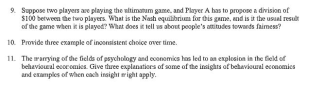 9. Suppose two players are playing the ultimatum game, and Player A has to propose a division of $100 between the two players. What is the Nash equilibrium for this game, and is it the usual result of the game when it is played? What does it tell us about people's attitudes towards fairness? 10. Provide three example of inconsistent choice over time 11. The marrying of the fields of psychology and economics has led to an explosion in the...
1. List some of the various communities to which you belong (organizations, work, hobbies, fields of...
1. List some of the various communities to which you belong (organizations, work, hobbies, fields of expertise, family). Give examples of some of the behavioral and language characteristics particular to each group? For instance, do you speak to your job supervisor in the same way you speak to your child or your best friend? Why might you interact with members of different communities differently? 2.What are some of your past experiences with writing? Please explain what you like and...
Create a lesson plan from the following: CHAPTER 3 Learning and HRD 67 Learning is a...
 Create a lesson plan from the following:
CHAPTER 3 Learning and HRD 67 Learning is a vital aspect of all HRD efforts. Whether you are training a carpenter's apprentice to use a specialized power tool, conducting a workshop o teach managers how to use discipline more effectively, trying to get meat- packers to understand and follow new safety procedures, or promoting career levelopment among your employees, your goal is to change behavion, knowl- es throwgh eaming. Supervisors and HRD professionals...
Create a lesson plan from the following:
CHAPTER 3 Learning and HRD 67 Learning is a vital aspect of all HRD efforts. Whether you are training a carpenter's apprentice to use a specialized power tool, conducting a workshop o teach managers how to use discipline more effectively, trying to get meat- packers to understand and follow new safety procedures, or promoting career levelopment among your employees, your goal is to change behavion, knowl- es throwgh eaming. Supervisors and HRD professionals...
Case Study - Joey Joey is an undergraduate psychology student attending a local college. His grades...
 Case Study - Joey Joey is an undergraduate psychology student attending a local college. His grades are adequate but increasingly he has been having behavioural issues at school - he showed up intoxicated on two occasions to his class and one time to his lab. School administrators asked Joey to see a counsellor as a condition of not being expelled. He agreed to do so. To the counsellor, Joey admitted that he was a "party-animal" when he was younger, having...
Please help assist: View the attached pictures with the lecture on additional disclosures from auditors. Analyze...
 Please help assist:
View the attached pictures with the lecture on additional
disclosures from auditors.
Analyze (in fewer than 150 words) these mandatory additional
disclosures.
You can take the perspective of the investor, auditor, or the
company.
Logically argue your case.
Please Search for, and cite, information sources, and those
found in the article. Whenever you can, give real-world
examples
to support your commentary.
The federal regulator that polices accounting firms is proposing a major overhaul of how company...
Please help assist:
View the attached pictures with the lecture on additional
disclosures from auditors.
Analyze (in fewer than 150 words) these mandatory additional
disclosures.
You can take the perspective of the investor, auditor, or the
company.
Logically argue your case.
Please Search for, and cite, information sources, and those
found in the article. Whenever you can, give real-world
examples
to support your commentary.
The federal regulator that polices accounting firms is proposing a major overhaul of how company...
Case Study #1 SUPPLY CHAIN MANAGEMENT AT BOSE CORPORATION Bose Corporation, headquartered in Framingham, Massachusetts, offers...
Case Study #1 SUPPLY CHAIN MANAGEMENT AT BOSE CORPORATION Bose Corporation, headquartered in Framingham, Massachusetts, offers an excellent example of integrated supply chain management. Bose, a producer of audio premium speakers used in automobiles, high-fidelity systems, and consumer and commercial broadcasting systems, was founded in 1964 by Dr. Bose of MIT. Bose currently maintains plants in Massachusetts and Michigan as well as Canada, Mexico, and Ireland. Its purchasing organization, while decentralized, has some overlap that requires coordination between sites. It...
Case study Company Case Campbell Soup Company: Watching What You Eat You might think that a well-known, veteran consumer products company like the Campbell Soup Company has it made. After all, when pe...
Case study Company Case Campbell Soup Company: Watching What You Eat You might think that a well-known, veteran consumer products company like the Campbell Soup Company has it made. After all, when people think of soup, they think of Campbell’s. In the $5 billion U.S. soup market, Campbell dominates with a 44 percent share. Selling products under such an iconic brand name should be a snap. But if you ask Denise Morrison, CEO of Campbell, she’ll tell you a different...
Questions-Kevin Sparks of Blue Cross and Blue Shield of Kansas City had a difficult time convincing...
Questions-Kevin Sparks of Blue Cross and Blue Shield of Kansas City had a difficult time convincing his people of the need for change. What would you have suggested he do before you read the case? What about afterwards? How did your recommendations change as a result? Blue Cross and Blue Shield, and Others: Understanding the Science behind Change Kevin Sparks has been trying to get his staff to change the way it monitors and supports the data center for the...
Answer these three questions about helping clients with diabetes in details. List sources if used. Describe...
Answer these three questions about helping clients with diabetes in details. List sources if used. Describe the health behavior theory or model that you will use to ground your efforts. Provide a rationale for your choice. Identify techniques you will use to promote communication and collaboration to your clients, including ways you plan to address resistance Use the Ten Tips for Changing Health Behaviors to illustrate how you will implement the program (ten steps given below) Ten tips are: 1....
Aflac Insurance Company InformatIon: Aflac is a Fortune 500 insurance company founded in 1955 by three...
Aflac Insurance Company InformatIon: Aflac is a Fortune 500 insurance company founded in 1955 by three brothers, John, Paul and Bill Amos. Today, Aflac employs more than 4,500 people and has more than 71,000 licensed independent agents throughout the United States and Japan. The following is an excerpt from the New York Stock Exchange business summary. “Aflac Incorporated is a general business holding company and acts as a management company, overseeing the operations of its subsidiaries by providing management services...
 9. Suppose two players are playing the ultimatum game, and Player A has to propose a division of $100 between the two players. What is the Nash equilibrium for this game, and is it the usual result of the game when it is played? What does it tell us about people's attitudes towards fairness? 10. Provide three example of inconsistent choice over time 11. The marrying of the fields of psychology and economics has led to an explosion in the...
 Create a lesson plan from the following:
CHAPTER 3 Learning and HRD 67 Learning is a vital aspect of all HRD efforts. Whether you are training a carpenter's apprentice to use a specialized power tool, conducting a workshop o teach managers how to use discipline more effectively, trying to get meat- packers to understand and follow new safety procedures, or promoting career levelopment among your employees, your goal is to change behavion, knowl- es throwgh eaming. Supervisors and HRD professionals...
Create a lesson plan from the following:
CHAPTER 3 Learning and HRD 67 Learning is a vital aspect of all HRD efforts. Whether you are training a carpenter's apprentice to use a specialized power tool, conducting a workshop o teach managers how to use discipline more effectively, trying to get meat- packers to understand and follow new safety procedures, or promoting career levelopment among your employees, your goal is to change behavion, knowl- es throwgh eaming. Supervisors and HRD professionals...
 Case Study - Joey Joey is an undergraduate psychology student attending a local college. His grades are adequate but increasingly he has been having behavioural issues at school - he showed up intoxicated on two occasions to his class and one time to his lab. School administrators asked Joey to see a counsellor as a condition of not being expelled. He agreed to do so. To the counsellor, Joey admitted that he was a "party-animal" when he was younger, having...
 Please help assist:
View the attached pictures with the lecture on additional
disclosures from auditors.
Analyze (in fewer than 150 words) these mandatory additional
disclosures.
You can take the perspective of the investor, auditor, or the
company.
Logically argue your case.
Please Search for, and cite, information sources, and those
found in the article. Whenever you can, give real-world
examples
to support your commentary.
The federal regulator that polices accounting firms is proposing a major overhaul of how company...
Please help assist:
View the attached pictures with the lecture on additional
disclosures from auditors.
Analyze (in fewer than 150 words) these mandatory additional
disclosures.
You can take the perspective of the investor, auditor, or the
company.
Logically argue your case.
Please Search for, and cite, information sources, and those
found in the article. Whenever you can, give real-world
examples
to support your commentary.
The federal regulator that polices accounting firms is proposing a major overhaul of how company...
Most questions answered within 3 hours.
-
Where is the error in this code sequence?
String s1 = "Hello";
String s2 = "ello";...
asked 10 months ago -
Financial data for Joel de Paris, Inc., for last year
follow:
Joel de Paris, Inc.
Balance...
asked 10 months ago -
Consider this reaction:
Al2(SO4)3 (aq)+ BaCl3
(aq) Al2Cl6 (aq)- +
3BaSO4(s) . What is the...
asked 10 months ago -
Suppose that Savneet is considering increasing her
recent random sample from 20 car rentals to 40...
asked 10 months ago -
Trucks arrive at an unloading terminal at an average rate of 120
per hour.
Trucks arrive...
asked 10 months ago -
Why are methanol and ethanol completely soluble in water while
octanol is not very little soluble....
asked 10 months ago -
A facilities manager at a university reads in a research report
that the mean amount of...
asked 10 months ago -
When the CuSO4 is rehydrated by adding water to the anhydrous
compound, is this an endothermic...
asked 10 months ago -
A ray of sunlight is passing from diamond into crown glass; the
angle of incidence is...
asked 10 months ago -
A block of mass 0.249 kg is placed on top of a light, vertical
spring of...
asked 10 months ago -
how do the kidneys compensate in the presences of acidosis
a) trigger hyperventilate
b) reserve acid...
asked 10 months ago -
Question 501 pts
The rental rate of capital to the firm increases. Which of the
following...
asked 10 months ago