9. Suppose nominal exchange rates are 110 Japanese yen per dollar, 0.9 euro per dollar, and...
9. Suppose nominal exchange rates are 110 Japanese yen per
dollar, 0.9 euro per dollar, and 16 Mexican pesos per dollar. A
pizza costs 1,600 yen in Tokyo, Japan, 12 euro in Munich, Germany,
180 pesos in Mexico City and 12 dollars in Raleigh, North Carolina.
Which of the following statements is (are) correct?
(x) Pizza is more expensive in Tokyo than Mexico City but less
expensive than in Munich.
(y) Pizza is less expensive in Raleigh than Munich but more
expensive than in Mexico City.
(z) Pizza is less expensive in Munich than Tokyo but more expensive
than in Raleigh.
A. (x), (y) and (z)
B. (x) and (y) only
C. (x) and (z) only
D. (y) and (z) only
E. (z) only
10. Other things the same, if the U.S. dollar depreciates relative
to the Mexican peso, then the nominal exchange rate
A. rises and it will cost fewer Mexican peso to travel in the
U.S.
B. rises and it will cost more Mexican peso to travel in the
U.S.
C. falls and it will cost fewer Mexican peso to travel in the
U.S.
D. falls and it will cost Mexican peso to travel in the U.S.
E. is unchanged and it will cost the same Mexican peso to travel in
the U.S.
11. Which of the following statements is (are) correct?
(x) The real exchange rate is the rate at which domestic goods are
traded for foreign goods.
(y) An appreciation of the U.S. real exchange rate induces U.S.
consumers to purchase more domestic goods and fewer foreign
goods.
(z) Suppose the nominal exchange rate is 10 Mexican pesos per one
U.S. dollar. If a hat costs 100 pesos in Mexico and 10 dollars in
Texas then the real exchange rate is specified as one Mexican hat
equals one American hat.
A. (x), (y) and (z)
B. (x) and (y) only
C. (x) and (z) only
D. (y) and (z) only
E. (x) only
Homework Answers
9.
Nominal exchange rates of different countries in terms of dollars are as follows:
110 Japanese Yen = 1 Dollar
0.9 Euro =1 Dollar
16 Mexican Pesos =1 Dollar
Prices of pizza in different countries are as follows
| Place | price of pizza | Nominal exchange rate | prices in terms of dollars |
|
Tokyo |
1600 Yen | 110 | 1600/110=$14.54 |
| Munich | 12 Euro | 0.9 | 12/0.9=$13.33 |
| Mexico city | 180Mexican Pesos | 16 | 180/16=$11.25 |
| Raleigh | 12 Dollars | - | $12 |
Lets analyse each alternative
(x) Pizza is more expensive in Tokyo than Mexico City but less expensive than in Munich.
False
Pizza is more expensive in Tokyo i.e. 14.54>11.25 but the other part is incorrect pizza is expensive Tokyo compared to Munich also
(y) Pizza is less expensive in Raleigh than Munich but more expensive than in Mexico City.
True
Pizza is less expensive in Raliegh than Munich i.e. 12<13.33,more expensive than Mexico city i.e. 12>11.25
(z) Pizza is less expensive in Munich than Tokyo but more expensive than in Raleigh.
True
Pizza is less expensive in Munich compared to Tokyo i.e. 13.33<14.54,more expensive than Raleigh i.e. 13.33>12
Hence correct answer is D . (y) and (z) only
10.
If Other things the same, if the U.S. dollar depreciates relative to the Mexican peso, then the nominal exchange rate
A. rises and it will cost fewer Mexican peso to travel in the
U.S.
False .As USD depriciates,exchange rate falls as it will cost less Mexican peso for each dollar
B. rises and it will cost more Mexican peso to travel in the
U.S.
As USD depriciates,exchange rate falls as it will cost less Mexican peso for each dollar
C. falls and it will cost fewer Mexican peso to travel in the
U.S.
True .as USD depriciates ,nominal exchange rate falls,and it will cost less Mexican pesos to travel to US as the purchasing power of Mexican Pesos increases.
D. falls and it will cost Mexican peso to travel in the U.S.
False .
E. is unchanged and it will cost the same Mexican peso to travel in
the U.S.
False. As the prices of dollar changes so does the nominal exchange rate so it is totally wrong to say that it will remain unchanged.
Hence correct answer is (c)
11.
(x) The real exchange rate is the rate at which domestic goods are traded for foreign goods.
True. The real exchange rate measures the price of foreign goods in terms of domestic goods.
(y) An appreciation of the U.S. real exchange rate induces U.S.
consumers to purchase more domestic goods and fewer foreign
goods.
False. because increase in US exchange rate will increase purchasing power of USD which will make foreign goods cheaper. above sentence is not valid
(z) Suppose the nominal exchange rate is 10 Mexican pesos per one
U.S. dollar. If a hat costs 100 pesos in Mexico and 10 dollars in
Texas then the real exchange rate is specified as one Mexican hat
equals one American hat.
True.
10 Mexican pesos per one U.S. dollar
hat price = 100 Pesos =10dollars
Hat costs 10dollars in mexico and same price in Texas
hence we can say that one Mexican hat equals one American hat
correct answer is c. (x) and (z).
Add Answer to:
9. Suppose nominal exchange rates are 110 Japanese yen per
dollar, 0.9 euro per dollar, and...
Exchange Rates The chart below shows the exchange rate between the U.S. dollar and the Mexican...
 Exchange Rates
The chart below shows the exchange rate between the U.S. dollar
and the Mexican peso in 2015 and 2016. In these questions we’ll
focus on changes in 2015. Note that the chart
shows the exchange rate in terms of pesos per
dollar.
Suppose a meal at a restaurant in Mexico City cost 90
pesos in 2015. Read approximate figures from
the chart for the exchange rate in January 2015 and January 2016,
and use those figures to answer the following...
Exchange Rates
The chart below shows the exchange rate between the U.S. dollar
and the Mexican peso in 2015 and 2016. In these questions we’ll
focus on changes in 2015. Note that the chart
shows the exchange rate in terms of pesos per
dollar.
Suppose a meal at a restaurant in Mexico City cost 90
pesos in 2015. Read approximate figures from
the chart for the exchange rate in January 2015 and January 2016,
and use those figures to answer the following...
Please clearly label the graph and answer the question. Thank you:) 2. Determining the exchange rate...
 Please clearly label
the graph and answer the question. Thank you:)
2. Determining the exchange rate The following question focuses on the exchange rate between U.S. dollars and Mexican pesos, defined as the number of U.S. dollars you must pay for one peso. Suppose that preferences for goods made in Mexico change in the United States, causing U.S. consumers to purchase more goods and services made in Mexico. Drag the appropriate curve(s) on the following graph to illustrate how this...
Please clearly label
the graph and answer the question. Thank you:)
2. Determining the exchange rate The following question focuses on the exchange rate between U.S. dollars and Mexican pesos, defined as the number of U.S. dollars you must pay for one peso. Suppose that preferences for goods made in Mexico change in the United States, causing U.S. consumers to purchase more goods and services made in Mexico. Drag the appropriate curve(s) on the following graph to illustrate how this...
Consider the data in the table below: Nominal Exchange Rates for the U.S. Dollar Country Foreign...
Consider the data in the table below: Nominal Exchange Rates for the U.S. Dollar Country Foreign currency/U.S. dollar U.S. dollars/foreign currency United Kingdom (pound) 0.641 1.559 Canada (Canadian dollar) 1.008 0.992 Mexico (peso) 12.39 0.081 Japan (yen) 83.338 0.012 European Union (euro) 0.756 1.322 a. Calculate the nominal exchange rate between the Mexican peso and the Japanese yen. Express in two ways. Instructions: Enter your responses rounded to three decimal places. One peso = ___ yen One yen = ___...
a. Gold Is $350 per ounce In the United States and 2.800 pesos per ounce In Mexico. The nominal exchange rate between U.S. dollar and Mexican pesos that is Implled by the PPP theory Is: pesos. b. Mex...
 a. Gold Is $350 per ounce In the United States and 2.800 pesos per ounce In Mexico. The nominal exchange rate between U.S. dollar and Mexican pesos that is Implled by the PPP theory Is: pesos. b. Mexico experiences Inflation so that the price of gold rises to 4,200 pesos per ounce, whlle the price of gold remalns $350 per ounce In the United States. The nominal exchange rate between U.S. dollars and Mexican pesos that is Implied by the...
If the nominal exchange rate is 12 Mexican pesos per $1 Question 9 (1 point) If...
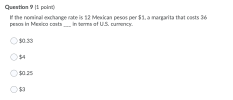 If the nominal exchange rate is 12 Mexican pesos per $1
Question 9 (1 point) If the nominal exchange rate is 12 Mexican pesos per $1, a margarita that costs 36 pesos in Mexico costs --- in terms of U.S. currency. 0 $0.33 O $4 O $0.25 O $3
If the nominal exchange rate is 12 Mexican pesos per $1
Question 9 (1 point) If the nominal exchange rate is 12 Mexican pesos per $1, a margarita that costs 36 pesos in Mexico costs --- in terms of U.S. currency. 0 $0.33 O $4 O $0.25 O $3
5. According to the textbook, which of the following statements is (are) correct? (x) From 1960...
5. According to the textbook, which of the following statements is (are) correct? (x) From 1960 to about 1975 in the United States, net capital outflow was small and sometimes negative and sometimes positive. (y) Most of the change from 1991 to 2000 in U.S. net capital outflow as a percent of GDP was due to a decrease in U.S. investment (z) In the U.S. from 2000 to 2006, net capital outflow as a percent of GDP became a larger...
The Mexican peso spot exchange rate is 12.75 peso per dollar. The nominal annual interest rate...
The Mexican peso spot exchange rate is 12.75 peso per dollar. The nominal annual interest rate in Mexico is 6% and the nominal annual interest in the US is 1%. What is the approximate 5-year forward premium/discount of the peso? A. 27.3% premium B. 27.3% discount C. 21.5% premium D. 21.5% discount E. 5.0% premium
"Traveling in Mexico is much cheaper now than it was ten years ago," says a friend....
 "Traveling in Mexico is much cheaper now than it was ten years ago," says a friend. "Ten years ago, a dollar bought 10 pesos; this year, a dollar buys 15 pesos." Given that total inflation over this period was 25 percent in Canada and 100 percent in Mexico, has it become more or less expensive to travel in Mexico? Consider the following example that compares the price of a Canadian hot dog to a Mexican taco. Answer all three questions...
15) When the nominal exchange rate in terms of dollars per yen rises, A) the dollar...
 15) When the nominal exchange rate in terms of dollars per yen rises, A) the dollar buys more yen and the dollar has depreciated. B) the dollar buys fewer yen and the dollar has depreciated. C) the dollar buys more yen and the dollar has appreciated. D) the dollar buys fewer yen and the dollar has appreciated.
Due Tuesday Problem Set 7 Econ 2301 Feb 18 Name 1. If the exchange rate between...
 Due Tuesday Problem Set 7 Econ 2301 Feb 18 Name 1. If the exchange rate between the US and Mexico let's look at price of one dollar in Mexican pesos) changes from 12 pesos = $1 to 18 pesos = $1 (as happened between about 2013 and spring 2016), a. the dollar has appreciated in value b. the peso has depreciated in value c. the dollar has depreciated in value d. the peso has appreciated in value e. a and...
 Exchange Rates
The chart below shows the exchange rate between the U.S. dollar
and the Mexican peso in 2015 and 2016. In these questions we’ll
focus on changes in 2015. Note that the chart
shows the exchange rate in terms of pesos per
dollar.
Suppose a meal at a restaurant in Mexico City cost 90
pesos in 2015. Read approximate figures from
the chart for the exchange rate in January 2015 and January 2016,
and use those figures to answer the following...
Exchange Rates
The chart below shows the exchange rate between the U.S. dollar
and the Mexican peso in 2015 and 2016. In these questions we’ll
focus on changes in 2015. Note that the chart
shows the exchange rate in terms of pesos per
dollar.
Suppose a meal at a restaurant in Mexico City cost 90
pesos in 2015. Read approximate figures from
the chart for the exchange rate in January 2015 and January 2016,
and use those figures to answer the following...
 Please clearly label
the graph and answer the question. Thank you:)
2. Determining the exchange rate The following question focuses on the exchange rate between U.S. dollars and Mexican pesos, defined as the number of U.S. dollars you must pay for one peso. Suppose that preferences for goods made in Mexico change in the United States, causing U.S. consumers to purchase more goods and services made in Mexico. Drag the appropriate curve(s) on the following graph to illustrate how this...
Please clearly label
the graph and answer the question. Thank you:)
2. Determining the exchange rate The following question focuses on the exchange rate between U.S. dollars and Mexican pesos, defined as the number of U.S. dollars you must pay for one peso. Suppose that preferences for goods made in Mexico change in the United States, causing U.S. consumers to purchase more goods and services made in Mexico. Drag the appropriate curve(s) on the following graph to illustrate how this...
 a. Gold Is $350 per ounce In the United States and 2.800 pesos per ounce In Mexico. The nominal exchange rate between U.S. dollar and Mexican pesos that is Implled by the PPP theory Is: pesos. b. Mexico experiences Inflation so that the price of gold rises to 4,200 pesos per ounce, whlle the price of gold remalns $350 per ounce In the United States. The nominal exchange rate between U.S. dollars and Mexican pesos that is Implied by the...
 If the nominal exchange rate is 12 Mexican pesos per $1
Question 9 (1 point) If the nominal exchange rate is 12 Mexican pesos per $1, a margarita that costs 36 pesos in Mexico costs --- in terms of U.S. currency. 0 $0.33 O $4 O $0.25 O $3
If the nominal exchange rate is 12 Mexican pesos per $1
Question 9 (1 point) If the nominal exchange rate is 12 Mexican pesos per $1, a margarita that costs 36 pesos in Mexico costs --- in terms of U.S. currency. 0 $0.33 O $4 O $0.25 O $3
 "Traveling in Mexico is much cheaper now than it was ten years ago," says a friend. "Ten years ago, a dollar bought 10 pesos; this year, a dollar buys 15 pesos." Given that total inflation over this period was 25 percent in Canada and 100 percent in Mexico, has it become more or less expensive to travel in Mexico? Consider the following example that compares the price of a Canadian hot dog to a Mexican taco. Answer all three questions...
 15) When the nominal exchange rate in terms of dollars per yen rises, A) the dollar buys more yen and the dollar has depreciated. B) the dollar buys fewer yen and the dollar has depreciated. C) the dollar buys more yen and the dollar has appreciated. D) the dollar buys fewer yen and the dollar has appreciated.
 Due Tuesday Problem Set 7 Econ 2301 Feb 18 Name 1. If the exchange rate between the US and Mexico let's look at price of one dollar in Mexican pesos) changes from 12 pesos = $1 to 18 pesos = $1 (as happened between about 2013 and spring 2016), a. the dollar has appreciated in value b. the peso has depreciated in value c. the dollar has depreciated in value d. the peso has appreciated in value e. a and...
Most questions answered within 3 hours.
-
Where is the error in this code sequence?
String s1 = "Hello";
String s2 = "ello";...
asked 11 months ago -
Financial data for Joel de Paris, Inc., for last year
follow:
Joel de Paris, Inc.
Balance...
asked 11 months ago -
Consider this reaction:
Al2(SO4)3 (aq)+ BaCl3
(aq) Al2Cl6 (aq)- +
3BaSO4(s) . What is the...
asked 11 months ago -
Suppose that Savneet is considering increasing her
recent random sample from 20 car rentals to 40...
asked 11 months ago -
Trucks arrive at an unloading terminal at an average rate of 120
per hour.
Trucks arrive...
asked 11 months ago -
Why are methanol and ethanol completely soluble in water while
octanol is not very little soluble....
asked 11 months ago -
A facilities manager at a university reads in a research report
that the mean amount of...
asked 11 months ago -
When the CuSO4 is rehydrated by adding water to the anhydrous
compound, is this an endothermic...
asked 11 months ago -
A ray of sunlight is passing from diamond into crown glass; the
angle of incidence is...
asked 11 months ago -
A block of mass 0.249 kg is placed on top of a light, vertical
spring of...
asked 11 months ago -
how do the kidneys compensate in the presences of acidosis
a) trigger hyperventilate
b) reserve acid...
asked 11 months ago -
Question 501 pts
The rental rate of capital to the firm increases. Which of the
following...
asked 11 months ago