
Homework Answers
In this question, we need to compute the NPV as shown below
The NPV is computed as follows:
= Initial investment + Present value of future cash flows
Present value is computed as follows:
= Future value / (1 + r)n
NPV of option A is computed as follows:
= - $ 5,000 + $ 2,000 / 1.0611 + $ 2,000 / 1.0612 + $ 2,000 / 1.0613 + $ 2,000 / 1.0614 + $ 2,000 / 1.0615
= $ 3,401.86 Approximately
NPV of option B is computed as follows:
= - $ 6,000 + $ 2,500 / 1.0741 + $ 2,500 / 1.0742 + $ 2,500 / 1.0743 + $ 2,500 / 1.0744 + $ 2,500 / 1.0745
= $ 4,141.64 Approximately
NPV of option C is computed as follows:
= - $ 7,000 + $ 3,000 / 1.0781 + $ 3,000 / 1.0782 + $ 3,000 / 1.0783 + $ 3,000 / 1.0784 + $ 3,000 / 1.0785
= $ 5,041.54 Approximately
NPV of option D is computed as follows:
= - $ 8,000 + $ 3,200 / 1.0951 + $ 3,200 / 1.0952 + $ 3,200 / 1.0953 + $ 3,200 / 1.0954 + $ 3,200 / 1.0955
= $ 4,287.07 Approximately
So, the firm shall select option C, since it has the highest NPV.
Feel free to ask in case of any query relating to this question
Add Answer to:
The cash flows for four projects are shown below, along with the cost of capital for...
show the steps how to do please 3. DMC company is evaluating two projects Land S....
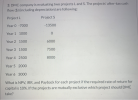 show the steps how to do please
3. DMC company is evaluating two projects Land S. The projects' after-tax cash flow ($) (including depreciation) are following: Project L Projects Year 0 -7000 - 13500 Year 1 1000 0 Year 2 1500 6000 Year 3 1500 7500 Year 4 2500 8000 Year 5 2000 Year 6 3000 What is NPV, IRR, and Payback for each project if the required rate of return for capital is 10%. If the projects are mutually...
show the steps how to do please
3. DMC company is evaluating two projects Land S. The projects' after-tax cash flow ($) (including depreciation) are following: Project L Projects Year 0 -7000 - 13500 Year 1 1000 0 Year 2 1500 6000 Year 3 1500 7500 Year 4 2500 8000 Year 5 2000 Year 6 3000 What is NPV, IRR, and Payback for each project if the required rate of return for capital is 10%. If the projects are mutually...
9) Investment A: Year: 0 Cash flow: $14,000 1 2 3 $6000 $6000 $6000 4 $6000...
 9) Investment A: Year: 0 Cash flow: $14,000 1 2 3 $6000 $6000 $6000 4 $6000 5 $6000 Investment B: Year: 0 Cash flow: $15,000 1 2 3 4 5 $7000 $7000 $7000 $7000 $7000 Investment C: 0 Cash flow: $18,000 Year: 1 $12,000 2 $2000 3 $2000 4 $2000 5 $2000 The cash flows for three projects are shown above. The cost of capital is 9.5%. If an investor decided to take projects with a payback period two years...
Your boss hands you the following information for a pair of mutually exclusive projects and asks...
 Your boss hands you the following information for a pair of mutually exclusive projects and asks for your recommendation. What should you do? Project Cost of Capital 13% 13% IRR 18% 28% Year 0 - $10,000 - $10,000 Cash Flows Year 1 Year 2 $7000 $4000 $2500 $7000 Year 3 $2000 $8000 The NPV of project A is $ , and the NPV of project B is $ (Round to two decimal places as needed.) . Using the NPV rule,...
(Numbers in parentheses are negative cash flows) These two projects are independent. Year Cash Flow of...
 (Numbers in parentheses are negative cash flows) These two projects are independent. Year Cash Flow of A Cash Flow of B 0 ($5000) ($2000) 1 $1000 $1000 2 $2000 $1000 3 $2000 $2000 4 $2000 $1000 5 $1000 ($1000) What is the approximate NPV of project A if the required rate of return is 9.5%? $390 $572 $581 $1131 $3000
1) please include the formulas used 2)i know the answer but having trouble remember how i calculated IRR and intercep...
 1) please include the formulas used
2)i know the answer but having trouble remember how i
calculated IRR and interception points
Investment A: Year: Cash flow: -514,000 $5,500 $5,500 $5,500 55,500 Investment B: Year: Cash flow: -$15,000 $6,000 $6,000 $6,000 $6,000 $6,000 Investment C: Year: Cash flow: -518,000 $12,000 $2,000 The cash fows for three projects are shown above. The cost of capital is 7.5%. If an investor decided to take projects with a payback period two years or less,...
1) please include the formulas used
2)i know the answer but having trouble remember how i
calculated IRR and interception points
Investment A: Year: Cash flow: -514,000 $5,500 $5,500 $5,500 55,500 Investment B: Year: Cash flow: -$15,000 $6,000 $6,000 $6,000 $6,000 $6,000 Investment C: Year: Cash flow: -518,000 $12,000 $2,000 The cash fows for three projects are shown above. The cost of capital is 7.5%. If an investor decided to take projects with a payback period two years or less,...
Question 6 5 pts (Numbers in parentheses are negative) These two projects are independent. Year Cash...
 Question 6 5 pts (Numbers in parentheses are negative) These two projects are independent. Year Cash Flow of A Cash Flow of B 0 ($5000) ($2000) 1 $1000 $1000 2 $2000 $1000 3 $2000 $2000 4. $2000 $1000 5 $1000 ($1000) What is the approximate crossover point between the two projects if the required rate of return is 9.5%? 12.39% O 7.24% There is no crossover point in this case. 0 7.57% O 6.12% Question 7 5 pts (Numbers in...
(Numbers in parentheses are negative cash flows) These two projects are independent. Year Cash Flow of...
 (Numbers in parentheses are negative cash flows) These two projects are independent. Year Cash Flow of A Cash Flow of B 0 ($5000) ($2000) $1000 $1000 2 $2000 $1000 3 $2000 $2000 4 $2000 $1000 5 $1000 ($1000) 1 What is the approximate IRR of project A if the required rate of return is 9.5%? 40.97% O 17.74% 15.84% O 14.85% O 15.34%
Suppose your firm is considering two mutually exclusive, required projects with the cash flows shown below....
 Suppose your firm is considering two mutually exclusive, required projects with the cash flows shown below. The required rate of return on projects of both of their risk class is 11 percent, and that the maximum allowable payback and discounted payback statistic for the projects are 2 and 3 years, respectively. 0 3 8000 1 28.000 2 48.000 19.000 Time: Project A Cash Flow Project B Cash Flow -48,000 28,000 2,000 68,000 Use the payback decision rule to evaluate these...
A company is analyzing two mutually exclusive projects, S and L, whose cash flows are shown...
A company is analyzing two mutually exclusive projects, S and L, whose cash flows are shown below: Year Cash Flow E Cash Flow F 0 -$1,100 -$1,100 1 1,000 0 2 350 300 3 50 1500 The company's cost of capital is 12 percent, and it can get an unlimited amount of capital at that cost. What is the IRR of the better project? 12.00% 15.53% 18.62% 19.08% 20.46%
(Numbers in parentheses are negative) These two projects are independent. Year Cash Flow of A Cash...
 (Numbers in parentheses are negative) These two projects are independent. Year Cash Flow of A Cash Flow of B 0 ($5000) ($2000) 1 $1000 $1000 2 $2000 $1000 3 $2000 $2000 4 $2000 $1000 5 $1000 ($1000) Based on the firms' NPV profiles which project should be taken if the required rate of return is 9.5%? Project B because it will raise the value of the firm by the greatest amount based on NPV. Both projects should be taken because...
 show the steps how to do please
3. DMC company is evaluating two projects Land S. The projects' after-tax cash flow ($) (including depreciation) are following: Project L Projects Year 0 -7000 - 13500 Year 1 1000 0 Year 2 1500 6000 Year 3 1500 7500 Year 4 2500 8000 Year 5 2000 Year 6 3000 What is NPV, IRR, and Payback for each project if the required rate of return for capital is 10%. If the projects are mutually...
show the steps how to do please
3. DMC company is evaluating two projects Land S. The projects' after-tax cash flow ($) (including depreciation) are following: Project L Projects Year 0 -7000 - 13500 Year 1 1000 0 Year 2 1500 6000 Year 3 1500 7500 Year 4 2500 8000 Year 5 2000 Year 6 3000 What is NPV, IRR, and Payback for each project if the required rate of return for capital is 10%. If the projects are mutually...
 9) Investment A: Year: 0 Cash flow: $14,000 1 2 3 $6000 $6000 $6000 4 $6000 5 $6000 Investment B: Year: 0 Cash flow: $15,000 1 2 3 4 5 $7000 $7000 $7000 $7000 $7000 Investment C: 0 Cash flow: $18,000 Year: 1 $12,000 2 $2000 3 $2000 4 $2000 5 $2000 The cash flows for three projects are shown above. The cost of capital is 9.5%. If an investor decided to take projects with a payback period two years...
 Your boss hands you the following information for a pair of mutually exclusive projects and asks for your recommendation. What should you do? Project Cost of Capital 13% 13% IRR 18% 28% Year 0 - $10,000 - $10,000 Cash Flows Year 1 Year 2 $7000 $4000 $2500 $7000 Year 3 $2000 $8000 The NPV of project A is $ , and the NPV of project B is $ (Round to two decimal places as needed.) . Using the NPV rule,...
 (Numbers in parentheses are negative cash flows) These two projects are independent. Year Cash Flow of A Cash Flow of B 0 ($5000) ($2000) 1 $1000 $1000 2 $2000 $1000 3 $2000 $2000 4 $2000 $1000 5 $1000 ($1000) What is the approximate NPV of project A if the required rate of return is 9.5%? $390 $572 $581 $1131 $3000
 1) please include the formulas used
2)i know the answer but having trouble remember how i
calculated IRR and interception points
Investment A: Year: Cash flow: -514,000 $5,500 $5,500 $5,500 55,500 Investment B: Year: Cash flow: -$15,000 $6,000 $6,000 $6,000 $6,000 $6,000 Investment C: Year: Cash flow: -518,000 $12,000 $2,000 The cash fows for three projects are shown above. The cost of capital is 7.5%. If an investor decided to take projects with a payback period two years or less,...
1) please include the formulas used
2)i know the answer but having trouble remember how i
calculated IRR and interception points
Investment A: Year: Cash flow: -514,000 $5,500 $5,500 $5,500 55,500 Investment B: Year: Cash flow: -$15,000 $6,000 $6,000 $6,000 $6,000 $6,000 Investment C: Year: Cash flow: -518,000 $12,000 $2,000 The cash fows for three projects are shown above. The cost of capital is 7.5%. If an investor decided to take projects with a payback period two years or less,...
 Question 6 5 pts (Numbers in parentheses are negative) These two projects are independent. Year Cash Flow of A Cash Flow of B 0 ($5000) ($2000) 1 $1000 $1000 2 $2000 $1000 3 $2000 $2000 4. $2000 $1000 5 $1000 ($1000) What is the approximate crossover point between the two projects if the required rate of return is 9.5%? 12.39% O 7.24% There is no crossover point in this case. 0 7.57% O 6.12% Question 7 5 pts (Numbers in...
 (Numbers in parentheses are negative cash flows) These two projects are independent. Year Cash Flow of A Cash Flow of B 0 ($5000) ($2000) $1000 $1000 2 $2000 $1000 3 $2000 $2000 4 $2000 $1000 5 $1000 ($1000) 1 What is the approximate IRR of project A if the required rate of return is 9.5%? 40.97% O 17.74% 15.84% O 14.85% O 15.34%
 Suppose your firm is considering two mutually exclusive, required projects with the cash flows shown below. The required rate of return on projects of both of their risk class is 11 percent, and that the maximum allowable payback and discounted payback statistic for the projects are 2 and 3 years, respectively. 0 3 8000 1 28.000 2 48.000 19.000 Time: Project A Cash Flow Project B Cash Flow -48,000 28,000 2,000 68,000 Use the payback decision rule to evaluate these...
 (Numbers in parentheses are negative) These two projects are independent. Year Cash Flow of A Cash Flow of B 0 ($5000) ($2000) 1 $1000 $1000 2 $2000 $1000 3 $2000 $2000 4 $2000 $1000 5 $1000 ($1000) Based on the firms' NPV profiles which project should be taken if the required rate of return is 9.5%? Project B because it will raise the value of the firm by the greatest amount based on NPV. Both projects should be taken because...
Most questions answered within 3 hours.
-
Where is the error in this code sequence?
String s1 = "Hello";
String s2 = "ello";...
asked 10 months ago -
Financial data for Joel de Paris, Inc., for last year
follow:
Joel de Paris, Inc.
Balance...
asked 10 months ago -
Consider this reaction:
Al2(SO4)3 (aq)+ BaCl3
(aq) Al2Cl6 (aq)- +
3BaSO4(s) . What is the...
asked 10 months ago -
Suppose that Savneet is considering increasing her
recent random sample from 20 car rentals to 40...
asked 10 months ago -
Trucks arrive at an unloading terminal at an average rate of 120
per hour.
Trucks arrive...
asked 10 months ago -
Why are methanol and ethanol completely soluble in water while
octanol is not very little soluble....
asked 10 months ago -
A facilities manager at a university reads in a research report
that the mean amount of...
asked 10 months ago -
When the CuSO4 is rehydrated by adding water to the anhydrous
compound, is this an endothermic...
asked 10 months ago -
A ray of sunlight is passing from diamond into crown glass; the
angle of incidence is...
asked 10 months ago -
A block of mass 0.249 kg is placed on top of a light, vertical
spring of...
asked 10 months ago -
how do the kidneys compensate in the presences of acidosis
a) trigger hyperventilate
b) reserve acid...
asked 10 months ago -
Question 501 pts
The rental rate of capital to the firm increases. Which of the
following...
asked 10 months ago