
Homework Answers
Modified Duration = Macaulay Duration / (1 + YTM) = 4.49 / (1 + 0.0281) = 4.37
Dollar Change in Price = [-Duration * Change in Yield * Current Bond Price] + [Convexity * (Change in Yield)2 * Current Bond Price]
= [-4.37 * (0.0207 - 0.0281) * $6,000] + [56.88 * (0.0207 - 0.0281)2 * $6,000]
= $193.91 + $18.69 = $212.60
Add Answer to:
Question 1 3 pts A bond with face value = 6,000 currently trades at par. Its...
Question 1 3 pts A bond with face value = 9,000 currently trades at par. Its...
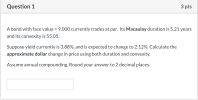 Question 1 3 pts A bond with face value = 9,000 currently trades at par. Its Macaulay duration is 5.21 years and its convexity is 55.05. Suppose yield currently is 3.88%, and is expected to change to 2.12%. Calculate the approximate dollar change in price using both duration and convexity. Assume annual compounding. Round your answer to 2 decimal places.
A bond with face value = 9,000 currently trades at par. Its Macaulay duration is 5.32...
A bond with face value = 9,000 currently trades at par. Its Macaulay duration is 5.32 years and its convexity is 56.02. Suppose yield currently is 2.74%, and is expected to change to 2.01%. Calculate the approximate dollar change in price using both duration and convexity. Assume annual compounding. Round your answer to 2 decimal places.
1. An investor purchases an annual coupon bond with a 6% coupon rate and exactly 20...
1. An investor purchases an annual coupon bond with a 6% coupon rate and exactly 20 years remaining until maturity at a price equal to par value. The investor’s investment horizon is eight years. The approximate modified duration of the bond is 11.470 years. What is the duration gap at the time of purchase? (Hint: use approximate Macaulay duration to calculate the duration gap) 2. An investor plans to retire in 10 years. As part of the retirement portfolio, the...
A) You are considering the purchase of a $1,000 par value bond with a coupon rate...
A) You are considering the purchase of a $1,000 par value bond with a coupon rate of 5% (with interest paid semiannually) that matures in 12 years. If the bond is priced to yield 9%, what is the bond's current price? The bond's current price is $__ B) Compute the current yield of a(n) 8.5%, 25-year bond that is currently priced in the market at $1,200. Use annual compounding to find the promised yield on this bond. Repeat the promised...
A T-bond with semi-annual coupons has a coupon rate of 3%, face value of $1,000, and...
A T-bond with semi-annual coupons has a coupon rate of 3%, face value of $1,000, and 2 years to maturity. If its yield to maturity is 4%, what is its Macaulay Duration? Answer in years, rounded to three decimal places
You just purchased a $1000 par value bond maturing on 30th June 2025. Suppose today’s date...
You just purchased a $1000 par value bond maturing on 30th June 2025. Suppose today’s date (settlement date) is 30th June 2019 and the yield to maturity is 6%. Given all these inputs, do the following. a) Assume the bond is a zero coupon bond (with annual compounding). Compute the bond’s Macaulay duration (using the DURATION function) and modified duration (using the MDURATION function). b) Holding everything else constant, now assume the bond pays coupons semi-annually. Compute the bond’s Macaulay...
An Apple annual coupon bond has a coupon rate of 4.6%, face value of $1,000, and...
An Apple annual coupon bond has a coupon rate of 4.6%, face value of $1,000, and 4 years to maturity. If its yield to maturity is 4.6%, what is its Macaulay Duration? Answer in years, rounded to three decimal places.
An Apple annual coupon bond has a coupon rate of 5.1% face value of $1000, and...
An Apple annual coupon bond has a coupon rate of 5.1% face value of $1000, and 4 years to maturity. If its yield to maturity is 5.1%, what is its Macaulay duration? answer in years, rounded to three decimal places
An Apple annual coupon bond has a coupon rate of 5.1%, face value of $1,000, and...
An Apple annual coupon bond has a coupon rate of 5.1%, face value of $1,000, and 4 years to maturity. If its yield to maturity is 5.1%, what is its Macaulay Duration? Answer in years, rounded to three decimal places.
Consider a 11-year, 6% annual coupon $1000 par bond currently trading at par. Suppose that the bond is callable in 2 yea...
Consider a 11-year, 6% annual coupon $1000 par bond currently trading at par. Suppose that the bond is callable in 2 years at 102% par. What is the bond's yield to call? Assume annual compounding. Round your answer to 4 decimal places.
 Question 1 3 pts A bond with face value = 9,000 currently trades at par. Its Macaulay duration is 5.21 years and its convexity is 55.05. Suppose yield currently is 3.88%, and is expected to change to 2.12%. Calculate the approximate dollar change in price using both duration and convexity. Assume annual compounding. Round your answer to 2 decimal places.
Most questions answered within 3 hours.
-
Where is the error in this code sequence?
String s1 = "Hello";
String s2 = "ello";...
asked 10 months ago -
Financial data for Joel de Paris, Inc., for last year
follow:
Joel de Paris, Inc.
Balance...
asked 10 months ago -
Consider this reaction:
Al2(SO4)3 (aq)+ BaCl3
(aq) Al2Cl6 (aq)- +
3BaSO4(s) . What is the...
asked 10 months ago -
Suppose that Savneet is considering increasing her
recent random sample from 20 car rentals to 40...
asked 10 months ago -
Trucks arrive at an unloading terminal at an average rate of 120
per hour.
Trucks arrive...
asked 10 months ago -
Why are methanol and ethanol completely soluble in water while
octanol is not very little soluble....
asked 10 months ago -
A facilities manager at a university reads in a research report
that the mean amount of...
asked 10 months ago -
When the CuSO4 is rehydrated by adding water to the anhydrous
compound, is this an endothermic...
asked 10 months ago -
A ray of sunlight is passing from diamond into crown glass; the
angle of incidence is...
asked 10 months ago -
A block of mass 0.249 kg is placed on top of a light, vertical
spring of...
asked 10 months ago -
how do the kidneys compensate in the presences of acidosis
a) trigger hyperventilate
b) reserve acid...
asked 10 months ago -
Question 501 pts
The rental rate of capital to the firm increases. Which of the
following...
asked 10 months ago