e) What types of borrowers would generally not want to buy points on a fixed-rate mortgage?...
e) What types of borrowers would generally not want to buy points on a fixed-rate mortgage? And are prepayment penalties common for this type of loan? Explain.
Homework Answers
Prepayment Penalty
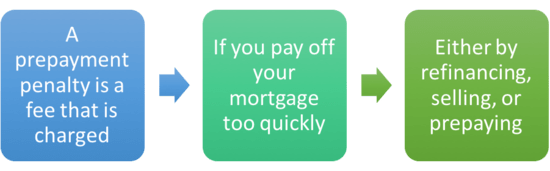
There Are Two Types of Prepayment Penalties
- There are soft prepays and hard prepays
- A soft prepay allows for the sale of the home without penalty
- But penalizes you if you refinance the mortgage
- A hard prepay penalizes you for a home sale or a refinance
A prepayment penalty, also known as a “prepay” in the industry, is an agreement between a borrower and a bank or mortgage lender that regulates what the borrower is allowed to pay off and when. Most mortgage lenders allow borrowers to pay off up to 20 percent of the loan balance each year.
A soft prepayment penalty allows a borrower to sell their home at anytime without penalty, but if they choose to refinance the mortgage, they will be subject to the prepayment penalty.
A hard prepayment penalty, on the other hand, sticks the borrower with a penalty if they sell their home OR refinance their mortgage. Obviously, this is the tougher of the two, and basically gives a borrower no option of jumping ship if they need to sell their home quickly after obtaining a mortgage.
Most prepays only last 1-3 years, but in the event that you need to refinance or sell your home unexpectedly, the prepayment penalty can be quite severe.
prepayment penalty cost
- It can vary by lender
- But it might be 80% of six months interest
- Meaning six months of interest-only mortgage payments
- Multiplied by 80%, which can be very expensive depending on the loan amount and interest rate
The prepayment penalty fee is often 80% of six months interest. It can vary, but in our example it is 80% because the lender allows the borrower to pay off 20% of the loan balance each year, so the penalty only hits the borrower for 80%.
The six months interest is the interest-only portion of the mortgage payment the borrower secured when they took out the mortgage.
So if a borrower has a mortgage rate of 6.5% on a $500,000 loan amount, their interest-only payment comes out to $2708.33 per month. Multiply that by six months, take 80% of the total, and you end up with a hefty prepayment penalty of $13,000.
An example of a prepayment penalty:
$500,000 loan amount
Interest rate of 6.5%
Monthly mortgage payment of $2,708.33
6 monthly payments = $16,249.99
80% of those 6 monthly payments = $13,000.00
Needs of the prepay,
- Prepayment penalties protect the lender/investor who purchases the loan
- From early prepayment associated with a refinance or home sale
- Since they won’t make as much money on the loan
- Assuming it isn’t kept until maturity, or worse, paid off almost immediately
- But this also means the interest rate might be lower for the borrower
Prepayment penalties were devised to protect lenders and investors that rely on years and years of lucrative interest payments to make money.
When mortgage loans are paid off quickly, regardless of whether by refinance or a home sale, less money than originally anticipated will be made. It’s a simple concept.
The mortgage is extended with the belief that a certain amount of interest will be collected. If in reality, much less is realized, the holders of these mortgages won’t profit as they originally expected. So it’s clearly less desirable for those who hold the loan.
This is essentially a way for those with an interest in your mortgage to ensure they get something back, regardless of how long the mortgage is kept before being paid off.
The good news, if you’re a borrower, is that a mortgage with a prepayment penalty attached should come with a slightly lower interest rate, all things being equal.
After all, it’s more restrictive in nature, so the price should be lower as a result.
This is similar to how an ARM prices lower than a fixed-rate mortgage, since you’re taking a risk of a rate reset with the former.
Prepayment Penalties
- While they are far less common these days
- They still exist on certain home loans
- Such as non-QM loans and other portfolio loans
- So always check your paperwork!
Be careful when considering a mortgage with a prepayment penalty. While not as common today as they were in the early 2000s, they may still be tacked onto mortgages offered by portfolio lenders, who set their own rules.
Although a mortgage with a prepayment penalty may come with a much lower interest rate, it can come back to haunt you if you need to refinance earlier than planned, if mortgage rates drop significantly, or if you decide to sell your home earlier than you anticipated.
Add Answer to:
e) What types of borrowers would generally not want to
buy points on a fixed-rate mortgage?...
A. What would be your monthly mortgage payment if you pay for a $250,000
4. A. What would be your monthly mortgage payment if you pay for a $250,000 home by making a 20% down payment and then take out a 3.74% thirty year fixed rate mortgage loan where interest is compounded monthly to cover the remaining balance. All work must be shown justifying the following answers. Mortgage payment = B. How much total interest would you have to pay over the entire life of the loan. Total interest paid = C. Suppose you inherit some money and...
Your local lender offers you a fixed-rate mortgage with the following terms: $220,000 at 4.75% for...
Your local lender offers you a fixed-rate mortgage with the following terms: $220,000 at 4.75% for 30 years, monthly payments. The lender will charge you two discount points and the loan has a 3% prepayment penalty. A. (1 pt) What is the annual percentage rate (APR) of the loan? Answer: _______ B. (1 pt) How many points are required to yield an APR of 5.25%? Answer: _______ Suppose you take a fixed-rate mortgage for $200,000 at 5.00% for 30 years,...
Two mortgage options are available: a 20-year fixed-rate loan for 6.5% with no discount points, and...
Two mortgage options are available: a 20-year fixed-rate loan for 6.5% with no discount points, and one with discount points for 6.25%. You will be living in the house for 10 years. How much are you willing to pay in points for the 6.25% loan? Assume a $100,000 mortgage. please type your answer
You want to buy a house and take out a mortgage for $250,000. The only mortgage...
You want to buy a house and take out a mortgage for $250,000. The only mortgage that you can afford is a 30 year ARM that has a fixed rate of 3% annual compounded monthly for the first 3 years and then can adjust every year after that. Against the advice of a wise EMIS professor that you once had, you decided to take the mortgage. a) What is the monthly payment for his home mortgage for the first 3...
You need a 15-year, fixed-rate mortgage to buy a new home for $250,000. Your mortgage bank...
You need a 15-year, fixed-rate mortgage to buy a new home for $250,000. Your mortgage bank will lend you the money at a 8.6 percent APR for this 180-month loan. However, you can afford monthly payments of only $850, so you offer to pay off any remaining loan balance at the end of the loan in the form of a single balloon payment. Required: How large will this balloon payment have to be for you to keep your monthly payments...
You need a 25-year, fixed-rate mortgage to buy a new home for $190,000. Your mortgage bank...
 You need a 25-year, fixed-rate mortgage to buy a new home for $190,000. Your mortgage bank will lend you the money at a 7.6 percent APR for this 300-month loan. However, you can afford monthly payments of only $1,000, so you offer to pay off any remaining loan balance at the end of the loan in the form of a single balloon payment. How large will this balloon payment have to be for you to keep your monthly payments at...
7. You need a 25-year, fixed-rate mortgage to buy a new home for $210,000. Your mortgage...
7. You need a 25-year, fixed-rate mortgage to buy a new home for $210,000. Your mortgage bank will lend you the money at a 8.1 percent APR for this 300-month loan. However, you can afford monthly payments of only $900, so you offer to pay off any remaining loan balance at the end of the loan in the form of a single balloon payment. Required: How large will this balloon payment have to be for you to keep your monthly...
You need a 30-year, fixed-rate mortgage to buy a new home for $220,000. Your mortgage bank...
You need a 30-year, fixed-rate mortgage to buy a new home for $220,000. Your mortgage bank will lend you the money at a 8.6 percent APR for this 360-month loan. However, you can afford monthly payments of only $900, so you offer to pay off any remaining loan balance at the end of the loan in the form of a single balloon payment. How large will this balloon payment have to be for you to keep your monthly payments at...
You need a 20-year, fixed-rate mortgage to buy a new home for $240,000. Your mortgage bank...
 You need a 20-year, fixed-rate mortgage to buy a new home for $240,000. Your mortgage bank will lend you the money at a 6.1 percent APR for this 240-month loan. However, you can afford monthly payments of only $800, so you offer to pay off any remaining loan balance at the end of the loan in the form of a single balloon payment. How large will this balloon payment have to be for you to keep your monthly payments at...
You want to buy a house and will need to borrow $235,000. The interest rate on...
You want to buy a house and will need to borrow $235,000. The interest rate on your loan is 5.65 percent compounded monthly and the loan is for 20 years. What are your monthly mortgage payments?
 You need a 25-year, fixed-rate mortgage to buy a new home for $190,000. Your mortgage bank will lend you the money at a 7.6 percent APR for this 300-month loan. However, you can afford monthly payments of only $1,000, so you offer to pay off any remaining loan balance at the end of the loan in the form of a single balloon payment. How large will this balloon payment have to be for you to keep your monthly payments at...
 You need a 20-year, fixed-rate mortgage to buy a new home for $240,000. Your mortgage bank will lend you the money at a 6.1 percent APR for this 240-month loan. However, you can afford monthly payments of only $800, so you offer to pay off any remaining loan balance at the end of the loan in the form of a single balloon payment. How large will this balloon payment have to be for you to keep your monthly payments at...
Most questions answered within 3 hours.
-
Where is the error in this code sequence?
String s1 = "Hello";
String s2 = "ello";...
asked 10 months ago -
Financial data for Joel de Paris, Inc., for last year
follow:
Joel de Paris, Inc.
Balance...
asked 10 months ago -
Consider this reaction:
Al2(SO4)3 (aq)+ BaCl3
(aq) Al2Cl6 (aq)- +
3BaSO4(s) . What is the...
asked 10 months ago -
Suppose that Savneet is considering increasing her
recent random sample from 20 car rentals to 40...
asked 10 months ago -
Trucks arrive at an unloading terminal at an average rate of 120
per hour.
Trucks arrive...
asked 10 months ago -
Why are methanol and ethanol completely soluble in water while
octanol is not very little soluble....
asked 10 months ago -
A facilities manager at a university reads in a research report
that the mean amount of...
asked 10 months ago -
When the CuSO4 is rehydrated by adding water to the anhydrous
compound, is this an endothermic...
asked 10 months ago -
A ray of sunlight is passing from diamond into crown glass; the
angle of incidence is...
asked 10 months ago -
A block of mass 0.249 kg is placed on top of a light, vertical
spring of...
asked 10 months ago -
how do the kidneys compensate in the presences of acidosis
a) trigger hyperventilate
b) reserve acid...
asked 10 months ago -
Question 501 pts
The rental rate of capital to the firm increases. Which of the
following...
asked 10 months ago