A food cart costs $4,500 and is expected to return $1,750 a year for three years...
A food cart costs $4,500 and is expected to return $1,750 a year for three years and then be worthless. What is the payback period for this cart?
Select one:
A. 1.57 years
B. 3.14 years
C. 2.78 years
D. 2.57 years
E. 2.83 years
Homework Answers

Add Answer to:
A food cart costs $4,500 and is expected to return $1,750 a year
for three years...
It will cost $9,600 to acquire an ice cream cart that is expected to produce cash inflows of $3,600 a year for three ye...
It will cost $9,600 to acquire an ice cream cart that is expected to produce cash inflows of $3,600 a year for three years. After the three years, the cart is expected to be worthless. What is the payback period?
It will cost $2,600 to acquire an ice cream cart. Cart sales are expected to be...
 It will cost $2,600 to acquire an ice cream cart. Cart sales are expected to be $1,700 a year for three years. After the three years, the cart is expected to be worthless as the expected life of the refrigeration unit is only three years. What is the payback period? O 1.53 years 0.53 years 1.35 years 2.53 years 0 2.35 years
it will cost $3,900 to aquire a small ice cream cart. Net cash flow is expected...
it will cost $3,900 to aquire a small ice cream cart. Net cash flow is expected to be $3,100 a year for five years. After the five years, the cart is expected to be worthless as that is the expected remaining life of the cooling system. What is the payback period of the ice cream cart?
Using the information provided below, calculate the expected standard deviation. Outcome Probability Return Recession 20% -25%...
 Using the information provided below, calculate the expected standard deviation. Outcome Probability Return Recession 20% -25% Expansion 35% 15% Boom 45% 60% Select one: a. 32.88% b. 1058.69% c. 32.54% d. 957.38% Gamma Electronics is considering the purchase of testing equipment that will cost $335 000 to replace old equipment. Assume the new machine will generate after-tax savings of $105 000 per year over the next five years. What is the payback period for this investment? Select one: a. 2.80...
If a project costs $100,000 and is expected to return $20,000 annually, how long does it...
 If a project costs $100,000 and is expected to return $20,000 annually, how long does it take to recover the initial investment? What would be the discounted payback period at i = 15%? Assume that the cash flows occur continuously throughout the year. The payback period is 5 years. (Round to one decimal place.) The discounted payback period at i = 15% would be years. (Round to one decimal place.)
A specialized automatic machine costs $280,000 and is expected to save $104,378.53 per year while in...
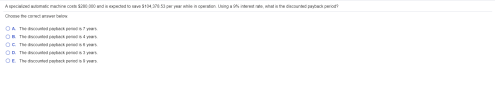 A specialized automatic machine costs $280,000 and is expected to save $104,378.53 per year while in operation. Using a 9% interest rate, what is the discounted payback period? Choose the correct answer below. O A. The discounted payback period is 7 years. OB. The discounted payback period is 4 years. O C. The discounted payback period is 6 years. OD. The discounted payback period is 3 years. O E. The discounted payback period is 9 years.
Project S costs $15,000, and its expected cash flows would be $4,500 per year for 5...
Project S costs $15,000, and its expected cash flows would be $4,500 per year for 5 years. Mutually exclusive Project L costs $37,500, and its expected cash flows would be $11,100 per year for 5 years. If both projects have a WACC of 14%, which project(s) would be accepted? A) Neither Project S or Project L would be accepted. B) Project S and Project L would be both accepted. C) Project L would be accepted. D) Project S would be...
Answer each independent question, (a) through (e), below. a. Project A costs $5,000 and will generate...
 Answer each independent question, (a) through (e), below. a. Project A costs $5,000 and will generate annual after-tax net cash inflows of $1,800 for 5 years. What is the payback period for this investment under the assumption that the cash inflows occur evenly throughout the year? (Round your answer to 2 decimal places.) b. Project B costs $5,000 and will generate after-tax cash inflows of $500 in year 1; $1,200 in year 2; $2,000 in year 3, $2,500 in year...
Answer each independent question, (a) through (e) below. a. Project A costs $6,000 and will generate annual after-t...
 Answer each independent question, (a) through (e) below. a. Project A costs $6,000 and will generate annual after-tax net cash inflows of $2,650 for 5 years. What is the payback period for this investment under the assumption that the cash inflows occur evenly throughout the year? (Round your answer to 2 decimal places.) b. Project B costs $6,000 and will generate after-tax cash inflows of $850 in year 1, $1,450 in year 2, $2,500 in year 3, $2,750 in year...
Here are the expected cash flows for three projects: Project Year: IU 0 - 5,700 -...
 Here are the expected cash flows for three projects: Project Year: IU 0 - 5,700 - 1,700 - 5,700 Cash Flows (dollars) 1 2 3 + 1,175 + 1,175 + 3,350 0 + 1,700 + 2,350 + 1,175 + 1,175 + 3,350 4 0 + 3,350 + 5,350 a. What is the payback period on each of the projects? b. If you use the payback rule with a cutoff period of 2 years, which projects will you accept? c. If...
 It will cost $2,600 to acquire an ice cream cart. Cart sales are expected to be $1,700 a year for three years. After the three years, the cart is expected to be worthless as the expected life of the refrigeration unit is only three years. What is the payback period? O 1.53 years 0.53 years 1.35 years 2.53 years 0 2.35 years
 Using the information provided below, calculate the expected standard deviation. Outcome Probability Return Recession 20% -25% Expansion 35% 15% Boom 45% 60% Select one: a. 32.88% b. 1058.69% c. 32.54% d. 957.38% Gamma Electronics is considering the purchase of testing equipment that will cost $335 000 to replace old equipment. Assume the new machine will generate after-tax savings of $105 000 per year over the next five years. What is the payback period for this investment? Select one: a. 2.80...
 If a project costs $100,000 and is expected to return $20,000 annually, how long does it take to recover the initial investment? What would be the discounted payback period at i = 15%? Assume that the cash flows occur continuously throughout the year. The payback period is 5 years. (Round to one decimal place.) The discounted payback period at i = 15% would be years. (Round to one decimal place.)
 A specialized automatic machine costs $280,000 and is expected to save $104,378.53 per year while in operation. Using a 9% interest rate, what is the discounted payback period? Choose the correct answer below. O A. The discounted payback period is 7 years. OB. The discounted payback period is 4 years. O C. The discounted payback period is 6 years. OD. The discounted payback period is 3 years. O E. The discounted payback period is 9 years.
 Answer each independent question, (a) through (e), below. a. Project A costs $5,000 and will generate annual after-tax net cash inflows of $1,800 for 5 years. What is the payback period for this investment under the assumption that the cash inflows occur evenly throughout the year? (Round your answer to 2 decimal places.) b. Project B costs $5,000 and will generate after-tax cash inflows of $500 in year 1; $1,200 in year 2; $2,000 in year 3, $2,500 in year...
 Answer each independent question, (a) through (e) below. a. Project A costs $6,000 and will generate annual after-tax net cash inflows of $2,650 for 5 years. What is the payback period for this investment under the assumption that the cash inflows occur evenly throughout the year? (Round your answer to 2 decimal places.) b. Project B costs $6,000 and will generate after-tax cash inflows of $850 in year 1, $1,450 in year 2, $2,500 in year 3, $2,750 in year...
 Here are the expected cash flows for three projects: Project Year: IU 0 - 5,700 - 1,700 - 5,700 Cash Flows (dollars) 1 2 3 + 1,175 + 1,175 + 3,350 0 + 1,700 + 2,350 + 1,175 + 1,175 + 3,350 4 0 + 3,350 + 5,350 a. What is the payback period on each of the projects? b. If you use the payback rule with a cutoff period of 2 years, which projects will you accept? c. If...
Most questions answered within 3 hours.
-
Where is the error in this code sequence?
String s1 = "Hello";
String s2 = "ello";...
asked 11 months ago -
Financial data for Joel de Paris, Inc., for last year
follow:
Joel de Paris, Inc.
Balance...
asked 11 months ago -
Consider this reaction:
Al2(SO4)3 (aq)+ BaCl3
(aq) Al2Cl6 (aq)- +
3BaSO4(s) . What is the...
asked 11 months ago -
Suppose that Savneet is considering increasing her
recent random sample from 20 car rentals to 40...
asked 11 months ago -
Trucks arrive at an unloading terminal at an average rate of 120
per hour.
Trucks arrive...
asked 11 months ago -
Why are methanol and ethanol completely soluble in water while
octanol is not very little soluble....
asked 11 months ago -
A facilities manager at a university reads in a research report
that the mean amount of...
asked 11 months ago -
When the CuSO4 is rehydrated by adding water to the anhydrous
compound, is this an endothermic...
asked 11 months ago -
A ray of sunlight is passing from diamond into crown glass; the
angle of incidence is...
asked 11 months ago -
A block of mass 0.249 kg is placed on top of a light, vertical
spring of...
asked 11 months ago -
how do the kidneys compensate in the presences of acidosis
a) trigger hyperventilate
b) reserve acid...
asked 11 months ago -
Question 501 pts
The rental rate of capital to the firm increases. Which of the
following...
asked 11 months ago