
Homework Answers
Number of quarters = 7 x 4 = 28
Quarterly (nominal) interest rate = 16%/4 = 4%
Let Quarterly coupon interest be C. Then
Bond price ($) = PC of quarterly coupon interest payments + PC of face value
750.08 = C x P/A(4%, 28) + 1,000 x P/F(4%, 28)
750.08 = C x 16.6631 + 1,000 x 0.33348
750.08 = C x 16.6631 + 333.48
C x 16.6631 = 416.6
C = $25
Annual bond coupon interest = C x 4 = $25 x 4 = $100
Annual bond interest rate = $100 / $1,000 = 0.1 = 10%
Add Answer to:
03.03-PR003 You wish to purchase a $1,000 bond from a friend who needs the money. There...
You wish to purchase a $1,100 bond from a friend who needs the money. There are...
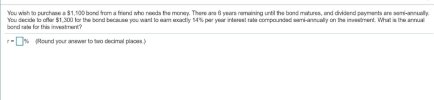 You wish to purchase a $1,100 bond from a friend who needs the money. There are 6 years remaining until the bond matures, and dividend payments are semi-annually. You decide o o er $1 300 or he bond because you want o earn exactly 14% per year interest rate compounded sem annually on en es ment. What she annual bond rate for this investment? -1-196 (Round your answer to two decimal places.)
5(b) A bond with a face value of $500,000 pays quarterly interest of 1.5% per each...
 5(b) A bond with a face value of $500,000 pays quarterly interest of 1.5% per each period. be willing to pay for this bond today if the next interest payment is due now and you want earn 8% compounded quarterly on your money? Twenty interest payments remain before the bond matures. How much would you
9. Assume that you wish to purchase a 20-year bond that has a maturity value of...
9. Assume that you wish to purchase a 20-year bond that has a maturity value of $1,000 and makes semiannual interest payments of $40. If you require a 10 percent effective annual return on your investment, what is the maximum price you should be willing to pay for the bond? (pick the closest number) answer 846 how to get that
Assume that you wish to purchase a 13-year bond that has a maturity value of $1,000...
Assume that you wish to purchase a 13-year bond that has a maturity value of $1,000 and a coupon interest rate of 4%, paid semiannually. If you require a 8.91% rate of return on this investment (YTM), what is the maximum price that you should be willing to pay for this bond? That is, solve for PV.
3. How much money will you need to have in an account today if you wish...
 3. How much money will you need to have in an account today if you wish to withdrawal $1,000 at the end of each quarter for the first 5 years and then $1,500 at the end of each quarter for another ten years. Assume that you can earn interest at 7% compounded quarterly throughout
Bond Valuation Assume that you are considering the purchase of a 20-year, non- callable bond with...
 Bond Valuation Assume that you are considering the purchase of a 20-year, non- callable bond with an annual coupon rate of 9.5%. The bond has a face value of $1,000, and it makes semiannual interest payments. If you require an 8.4% nominal yield to maturity on this investment, what is the maximum price you should be willing to pay for the bond? Yield to Maturity Radoski Corporation's bonds make an annual coupon interest payment of 7.35%. The bonds have a...
You can earn 6% p.a. interest on your money (compounded monthly). You wish to purchase a...
You can earn 6% p.a. interest on your money (compounded monthly). You wish to purchase a house in exactly 5 years, which you expect would then cost $240,000. You need to save up 50% of this amount as you can borrow the rest. What monthly amount would need to be saved to enable you to achieve your objective? Your first monthly deposit will be made one month from now, and your last deposit will be made on the day you...
The U.S. Treasury offers to sell you a bond for $715.00. No payments will be made...
The U.S. Treasury offers to sell you a bond for $715.00. No payments will be made until the bond matures 15 years from now, at which time it will be redeemed for $1,000. What interest rate would you earn if you bought this bond at the offer price? Show your inputs
Assume that you inherited some money. A friend of yours is working as an unpaid intern...
Assume that you inherited some money. A friend of yours is working as an unpaid intern at a local brokerage firm, and her boss is selling securities that call for 4 payments of $50 (1 payment at the end of each of the next 4 years) plus an extra payment of $1,000 at the end of Year 4. Your friend says she can get you some of these securities at a cost of $900 each. Your money is now invested...
You are considering the purchase of a coupon bond with a face value of $1,000, which...
You are considering the purchase of a coupon bond with a face value of $1,000, which matures in 23 years, and pays 5.15% (annual) coupons. If you require a return of 4.75% on this instrument, how much would you offer to pay for it today? [Present the answer rounded to two decimal places, e.g. 1045.16]
 You wish to purchase a $1,100 bond from a friend who needs the money. There are 6 years remaining until the bond matures, and dividend payments are semi-annually. You decide o o er $1 300 or he bond because you want o earn exactly 14% per year interest rate compounded sem annually on en es ment. What she annual bond rate for this investment? -1-196 (Round your answer to two decimal places.)
 5(b) A bond with a face value of $500,000 pays quarterly interest of 1.5% per each period. be willing to pay for this bond today if the next interest payment is due now and you want earn 8% compounded quarterly on your money? Twenty interest payments remain before the bond matures. How much would you
 3. How much money will you need to have in an account today if you wish to withdrawal $1,000 at the end of each quarter for the first 5 years and then $1,500 at the end of each quarter for another ten years. Assume that you can earn interest at 7% compounded quarterly throughout
 Bond Valuation Assume that you are considering the purchase of a 20-year, non- callable bond with an annual coupon rate of 9.5%. The bond has a face value of $1,000, and it makes semiannual interest payments. If you require an 8.4% nominal yield to maturity on this investment, what is the maximum price you should be willing to pay for the bond? Yield to Maturity Radoski Corporation's bonds make an annual coupon interest payment of 7.35%. The bonds have a...
Most questions answered within 3 hours.
-
Where is the error in this code sequence?
String s1 = "Hello";
String s2 = "ello";...
asked 11 months ago -
Financial data for Joel de Paris, Inc., for last year
follow:
Joel de Paris, Inc.
Balance...
asked 11 months ago -
Consider this reaction:
Al2(SO4)3 (aq)+ BaCl3
(aq) Al2Cl6 (aq)- +
3BaSO4(s) . What is the...
asked 11 months ago -
Suppose that Savneet is considering increasing her
recent random sample from 20 car rentals to 40...
asked 11 months ago -
Trucks arrive at an unloading terminal at an average rate of 120
per hour.
Trucks arrive...
asked 11 months ago -
Why are methanol and ethanol completely soluble in water while
octanol is not very little soluble....
asked 11 months ago -
A facilities manager at a university reads in a research report
that the mean amount of...
asked 11 months ago -
When the CuSO4 is rehydrated by adding water to the anhydrous
compound, is this an endothermic...
asked 11 months ago -
A ray of sunlight is passing from diamond into crown glass; the
angle of incidence is...
asked 11 months ago -
A block of mass 0.249 kg is placed on top of a light, vertical
spring of...
asked 11 months ago -
how do the kidneys compensate in the presences of acidosis
a) trigger hyperventilate
b) reserve acid...
asked 11 months ago -
Question 501 pts
The rental rate of capital to the firm increases. Which of the
following...
asked 11 months ago