
Homework Answers
The aswer is EGF
The loss that arise due to market inefficiency due to supply and demand disequilibrium.
Deadweight loss is created by Price floors, Price cieling and taxation.
Here taxation has increased the selling price on the product, with G was the equilibrium point the tax shifted the supply curve leftward. The new price shifted from G to F. Therefore EGF represent deadweight loss
Add Answer to:
Question 2 1 pts (Figure: Effects of Excise Tax) Based on the graph, after the excise...
(Figure: Tax Incidence) Use Figure: Tax Incidence. Based on the figure, the deadweight loss of an excise tax is likely...
 (Figure: Tax Incidence) Use Figure: Tax Incidence. Based on the
figure, the deadweight loss of an excise tax is likely to be
greater in panel _____ than in panel _____.
C; A
C; D
B; A
D; A
Figure: Tax Incidence Pand A Price (per unit) Price (per unit) Pe Q2 Q3 Quantity (per period) Q2Q Quantity (per period) Panel Panel D Price (per unit) Price (per unit) Si QQ, Quantity (per period) 0,, Quantity (per period)
(Figure: Tax Incidence) Use Figure: Tax Incidence. Based on the
figure, the deadweight loss of an excise tax is likely to be
greater in panel _____ than in panel _____.
C; A
C; D
B; A
D; A
Figure: Tax Incidence Pand A Price (per unit) Price (per unit) Pe Q2 Q3 Quantity (per period) Q2Q Quantity (per period) Panel Panel D Price (per unit) Price (per unit) Si QQ, Quantity (per period) 0,, Quantity (per period)
8. (Figure: Effects of Monopolies on Markets) Based on the graph, which area represents the deadweight...
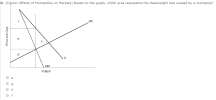 8. (Figure: Effects of Monopolies on Markets) Based on the graph, which area represents the deadweight loss caused by a monopoly? MC MR
Question 40 1 pts Refer to Figure 4-2. What is the Deadweight Loss of this tax? Figure 4-2 The equations represent the...
 Question 40 1 pts Refer to Figure 4-2. What is the Deadweight Loss of this tax? Figure 4-2 The equations represent the demand and supply for silver pendants. The government is considering imposing a $4 per unit tax on buyers of silver pendants. QD = 50,000 - 2000P QS = -10,000 + 2000P QD (with tax) = 50,000 - 2000(P+T) $4,000 $6,000 $8,000 There is not enough information to calculate Deadweight Loss
Question 5 1 pts Assuming that a $500 excise tax is imposed in a market. The...
 Question 5 1 pts Assuming that a $500 excise tax is imposed in a market. The consumer share of the actual tax incidence turns out to be $100, while the producers' share of the tax burden turns out to be $400. O This implies that supply is relatively more elastic than demand This implies that demand is relatively more elastic than supply O Tax Burden and elasticity are unrelated concepts.
Open questions 1. With the help of a graph, illustrate how the effects of a specific...
 Open questions 1. With the help of a graph, illustrate how the effects of a specific tax on one good can be decomposed into an income and a substitution effect and analyse the deadweight loss of the tax. 2. Discuss the effects of an earned income tax credit on individual labour supply. 3. Using the concept of user cost of capital illustrate in which cases a corporation tax will not affect firm investment decisions
Open questions 1. With the help...
Open questions 1. With the help of a graph, illustrate how the effects of a specific tax on one good can be decomposed into an income and a substitution effect and analyse the deadweight loss of the tax. 2. Discuss the effects of an earned income tax credit on individual labour supply. 3. Using the concept of user cost of capital illustrate in which cases a corporation tax will not affect firm investment decisions
Open questions 1. With the help...
Question 44 2 pts The net cost to society from the imposition of a tax is...
 Question 44 2 pts The net cost to society from the imposition of a tax is also known as O producer surplus. O tax revenue. O consumer surplus. O social welfare. O deadweight loss. Question 45 2 pts
Please chose the right answer and explain why. Thank you so much! Question 5 1 pts...
 Please chose the right answer and explain why. Thank you so
much!
Question 5 1 pts Suppose that the government mandates a minimum wage, as shown in the graph below. How many unemployed workers will there be in this market with the minimum wage? (in millions) Wage Rate ($/hour) Labor Market Supply of Labor Minimum wage 2- > 131 X Demand for Labor 1.7 2 2.4 Quantity (Number of Workers, Millions) Question 6 1 pts The graph below illustrates a...
Please chose the right answer and explain why. Thank you so
much!
Question 5 1 pts Suppose that the government mandates a minimum wage, as shown in the graph below. How many unemployed workers will there be in this market with the minimum wage? (in millions) Wage Rate ($/hour) Labor Market Supply of Labor Minimum wage 2- > 131 X Demand for Labor 1.7 2 2.4 Quantity (Number of Workers, Millions) Question 6 1 pts The graph below illustrates a...
Question 3 1 pts Figure 8-1 1 Price Supply KI | Lly Demand Quantity Refer to...
 Question 3 1 pts Figure 8-1 1 Price Supply KI | Lly Demand Quantity Refer to Figure 8-1. Suppose the government imposes a tax of P'P. The area measured by I+Y represents the deadweight loss due to the tax. loss in consumer surplus due to the tax. loss in producer surplus due to the tax. total surplus before the tax.
FIGURE #3 *101 ------- Quantity 12. {Refer to Figure 3 above). In the market shown, S'...
 FIGURE #3 *101 ------- Quantity 12. {Refer to Figure 3 above). In the market shown, S' represents the market supply curve after an excise tax is levied. The portion of the excise tax paid by producers is: A. $7 B. $2 C. $5 D. $3 FIGURE #4 Price Astax Wegdle" 40 60 too Quantity 13. {Refer to Figure 4 above). In the market shown, consumers pay ___ of the excise tax. A. $4 B. $2 C. $1 D. $7 14....
2. Tax Incidence: (8 points) Oil Market with Tax Supply w Tax 5.50 Supply Price ($...
 2. Tax Incidence: (8 points) Oil Market with Tax Supply w Tax 5.50 Supply Price ($ per gallon) Demand 0.00 O 0.5 1 1.5 6.5 7 7.5 8 2 2.5 3 3.5 4 4.5 5 5.5 6 Quantity (Gallons of oil, millions) a. What is the competitive equilibrium price and quantity without government intervention? b. What is the consumer surplus (measured in dollars) in this market when there is no government intervention? c. What is the producer surplus (measured in...
 (Figure: Tax Incidence) Use Figure: Tax Incidence. Based on the
figure, the deadweight loss of an excise tax is likely to be
greater in panel _____ than in panel _____.
C; A
C; D
B; A
D; A
Figure: Tax Incidence Pand A Price (per unit) Price (per unit) Pe Q2 Q3 Quantity (per period) Q2Q Quantity (per period) Panel Panel D Price (per unit) Price (per unit) Si QQ, Quantity (per period) 0,, Quantity (per period)
(Figure: Tax Incidence) Use Figure: Tax Incidence. Based on the
figure, the deadweight loss of an excise tax is likely to be
greater in panel _____ than in panel _____.
C; A
C; D
B; A
D; A
Figure: Tax Incidence Pand A Price (per unit) Price (per unit) Pe Q2 Q3 Quantity (per period) Q2Q Quantity (per period) Panel Panel D Price (per unit) Price (per unit) Si QQ, Quantity (per period) 0,, Quantity (per period)
 8. (Figure: Effects of Monopolies on Markets) Based on the graph, which area represents the deadweight loss caused by a monopoly? MC MR
 Question 40 1 pts Refer to Figure 4-2. What is the Deadweight Loss of this tax? Figure 4-2 The equations represent the demand and supply for silver pendants. The government is considering imposing a $4 per unit tax on buyers of silver pendants. QD = 50,000 - 2000P QS = -10,000 + 2000P QD (with tax) = 50,000 - 2000(P+T) $4,000 $6,000 $8,000 There is not enough information to calculate Deadweight Loss
 Question 5 1 pts Assuming that a $500 excise tax is imposed in a market. The consumer share of the actual tax incidence turns out to be $100, while the producers' share of the tax burden turns out to be $400. O This implies that supply is relatively more elastic than demand This implies that demand is relatively more elastic than supply O Tax Burden and elasticity are unrelated concepts.
 Open questions 1. With the help of a graph, illustrate how the effects of a specific tax on one good can be decomposed into an income and a substitution effect and analyse the deadweight loss of the tax. 2. Discuss the effects of an earned income tax credit on individual labour supply. 3. Using the concept of user cost of capital illustrate in which cases a corporation tax will not affect firm investment decisions
Open questions 1. With the help...
Open questions 1. With the help of a graph, illustrate how the effects of a specific tax on one good can be decomposed into an income and a substitution effect and analyse the deadweight loss of the tax. 2. Discuss the effects of an earned income tax credit on individual labour supply. 3. Using the concept of user cost of capital illustrate in which cases a corporation tax will not affect firm investment decisions
Open questions 1. With the help...
 Question 44 2 pts The net cost to society from the imposition of a tax is also known as O producer surplus. O tax revenue. O consumer surplus. O social welfare. O deadweight loss. Question 45 2 pts
 Please chose the right answer and explain why. Thank you so
much!
Question 5 1 pts Suppose that the government mandates a minimum wage, as shown in the graph below. How many unemployed workers will there be in this market with the minimum wage? (in millions) Wage Rate ($/hour) Labor Market Supply of Labor Minimum wage 2- > 131 X Demand for Labor 1.7 2 2.4 Quantity (Number of Workers, Millions) Question 6 1 pts The graph below illustrates a...
Please chose the right answer and explain why. Thank you so
much!
Question 5 1 pts Suppose that the government mandates a minimum wage, as shown in the graph below. How many unemployed workers will there be in this market with the minimum wage? (in millions) Wage Rate ($/hour) Labor Market Supply of Labor Minimum wage 2- > 131 X Demand for Labor 1.7 2 2.4 Quantity (Number of Workers, Millions) Question 6 1 pts The graph below illustrates a...
 Question 3 1 pts Figure 8-1 1 Price Supply KI | Lly Demand Quantity Refer to Figure 8-1. Suppose the government imposes a tax of P'P. The area measured by I+Y represents the deadweight loss due to the tax. loss in consumer surplus due to the tax. loss in producer surplus due to the tax. total surplus before the tax.
 FIGURE #3 *101 ------- Quantity 12. {Refer to Figure 3 above). In the market shown, S' represents the market supply curve after an excise tax is levied. The portion of the excise tax paid by producers is: A. $7 B. $2 C. $5 D. $3 FIGURE #4 Price Astax Wegdle" 40 60 too Quantity 13. {Refer to Figure 4 above). In the market shown, consumers pay ___ of the excise tax. A. $4 B. $2 C. $1 D. $7 14....
 2. Tax Incidence: (8 points) Oil Market with Tax Supply w Tax 5.50 Supply Price ($ per gallon) Demand 0.00 O 0.5 1 1.5 6.5 7 7.5 8 2 2.5 3 3.5 4 4.5 5 5.5 6 Quantity (Gallons of oil, millions) a. What is the competitive equilibrium price and quantity without government intervention? b. What is the consumer surplus (measured in dollars) in this market when there is no government intervention? c. What is the producer surplus (measured in...
Most questions answered within 3 hours.
-
Where is the error in this code sequence?
String s1 = "Hello";
String s2 = "ello";...
asked 10 months ago -
Financial data for Joel de Paris, Inc., for last year
follow:
Joel de Paris, Inc.
Balance...
asked 10 months ago -
Consider this reaction:
Al2(SO4)3 (aq)+ BaCl3
(aq) Al2Cl6 (aq)- +
3BaSO4(s) . What is the...
asked 10 months ago -
Suppose that Savneet is considering increasing her
recent random sample from 20 car rentals to 40...
asked 10 months ago -
Trucks arrive at an unloading terminal at an average rate of 120
per hour.
Trucks arrive...
asked 10 months ago -
Why are methanol and ethanol completely soluble in water while
octanol is not very little soluble....
asked 10 months ago -
A facilities manager at a university reads in a research report
that the mean amount of...
asked 10 months ago -
When the CuSO4 is rehydrated by adding water to the anhydrous
compound, is this an endothermic...
asked 10 months ago -
A ray of sunlight is passing from diamond into crown glass; the
angle of incidence is...
asked 10 months ago -
A block of mass 0.249 kg is placed on top of a light, vertical
spring of...
asked 10 months ago -
how do the kidneys compensate in the presences of acidosis
a) trigger hyperventilate
b) reserve acid...
asked 10 months ago -
Question 501 pts
The rental rate of capital to the firm increases. Which of the
following...
asked 10 months ago