![uiing lavieu valués of the chi-square distribution The distance in feet by which a parachutist misses a target is D = Vxi + x3, where X and X2 are independent with X~N(0, 25). Find P[D < 12.25 feet].](http://img.homeworklib.com/questions/2fd03f50-78c6-11ea-b170-59933e1dd588.png?x-oss-process=image/resize,w_560)
Homework Answers

Add Answer to:
uiing lavieu valués of the chi-square distribution The distance in feet by which a parachutist misses...
Problem 4 (20 points). Show how to use the chi-square distribution to calculate P(a < S2...
 Problem 4 (20 points). Show how to use the chi-square distribution to calculate P(a < S2 < b), where S,: nii Σί! from N(μ, σ2) (Xi - X)2 is the sample variance of a random sample Xi,.. . ,Xn
10) Suppose that X follows a chi-square distribution with m degrees of freedom and S=X+Y. Given...
 10) Suppose that X follows a chi-square distribution with m degrees of freedom and S=X+Y. Given that S follows a chi-square distribution with m+n degrees of freedom, and X and Y are independent, show that y follows a chi-square distribution with n degrees of freedom.
2. The chi-square distribution plays a significant role in performing inference on the as- sociation between...
 2. The chi-square distribution plays a significant role in performing inference on the as- sociation between categorical random variables (e.g., car injury severity and seat belt usage). If Z ~ N(0,1), then W = Z2 ~ xỉ – that is, W has a chi-square distribution with 1 degree of freedom. Furthermore if Z1, Z2, ..., Zn N(0,1), then W = Z+Z2+...+22 has a chi-square distribution with n degrees of freedom. Here are some helpful facts. Let t > 0 •...
Consider the observed frequency distribution for the set of random variables. a. Perform a chi-square test...
Consider the observed frequency distribution for the set of random variables. a. Perform a chi-square test using alpha=0.05 to determine if the observed frequencies follow the binomial probability distribution when p=0.50 and n=4. b. Determine the p-value and interpret its meaning. Random Variable, X Frequency, Fo 0 29 1 96 2 151 3 96 4 28 Total 400 The chi-square test statistic is chi squared, χ2=______ p-value=______
1. Suppose t hat Xhas t he chi-square distribution on p1∈(0, ∞) degrees of f reedom...
1. Suppose t hat Xhas t he chi-square distribution on p1∈(0, ∞) degrees of f reedom and that, i ndependently, Y has t he chi-square distribution on p2∈(0, p1) degrees of f ree-dom. a. Use moment generating functions to find the distribution of X + Y . b. A naive guess might be that the distribution of X − Y is chi-square on p1− p2 degrees of freedom. Prove that such a guess is wrong by demonstrating that P (X...
1. Suppose t hat Xhas t he chi-square distribution on p1∈(0, ∞) degrees of f reedom...
1. Suppose t hat Xhas t he chi-square distribution on p1∈(0, ∞) degrees of f reedom and that, i ndependently, Y has t he chi-square distribution on p2∈(0, p1) degrees of f ree-dom. a. Use moment generating functions to find the distribution of X + Y . b. A naive guess might be that the distribution of X − Y is chi-square on p1− p2 degrees of freedom. Prove that such a guess is wrong by demonstrating that P (X...
proof for distribution of (n-1)S^2/sigma^2 is the chi square distribution with n-1 degrees of freedom. I...
 proof for distribution of (n-1)S^2/sigma^2 is the chi square
distribution with n-1 degrees of freedom.
I don't understand the expansion of the square, specifically how
certain terms disappeared and how a sqrt(n) appeared. Also towards
the end, why does V have a degree of freedom of 1? x A detailed
explanation of what happened from step 2 to step 3 would be very
helpful!
THEOREM B The distribution of (n − 1)S2/02 is the chi-square distribution with n – 1...
proof for distribution of (n-1)S^2/sigma^2 is the chi square
distribution with n-1 degrees of freedom.
I don't understand the expansion of the square, specifically how
certain terms disappeared and how a sqrt(n) appeared. Also towards
the end, why does V have a degree of freedom of 1? x A detailed
explanation of what happened from step 2 to step 3 would be very
helpful!
THEOREM B The distribution of (n − 1)S2/02 is the chi-square distribution with n – 1...
Let Zn BE X2(n) (Chi-square) and let Wn = Zn/n2. Find the limiting distribution of Wn...
Let Zn BE X2(n) (Chi-square) and let Wn = Zn/n2. Find the limiting distribution of Wn using the Weak Law of Large Numbers
Find the following chi-square distribution values from Table 11.1 (to 3 decimals). a. X2 os with...
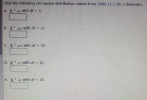 Find the following chi-square distribution values from Table 11.1 (to 3 decimals). a. X2 os with öf- 5 b. X 2 025 with df- 15 c. χ 2 .975 with d-20 d, χ 2 .01 with df-10 e, χ 2 .95 with df-18
Having troubles with question 2. Please help 2. If X has a Gamma distribution with parameters...
 Having troubles with question 2. Please help
2. If X has a Gamma distribution with parameters a and B, then its mgf is given by (a) Obtain expressions for the moment-genérating functions of an exponential random variable and of a chi-square random variable by recognizing that these are special cases of a Gamma distribution and using the mgf given above. (b) Suppose that X1 is a Gamma variable with parameters α1 and β, X2 is a Gamma variable with parameters...
Having troubles with question 2. Please help
2. If X has a Gamma distribution with parameters a and B, then its mgf is given by (a) Obtain expressions for the moment-genérating functions of an exponential random variable and of a chi-square random variable by recognizing that these are special cases of a Gamma distribution and using the mgf given above. (b) Suppose that X1 is a Gamma variable with parameters α1 and β, X2 is a Gamma variable with parameters...
 Problem 4 (20 points). Show how to use the chi-square distribution to calculate P(a < S2 < b), where S,: nii Σί! from N(μ, σ2) (Xi - X)2 is the sample variance of a random sample Xi,.. . ,Xn
 10) Suppose that X follows a chi-square distribution with m degrees of freedom and S=X+Y. Given that S follows a chi-square distribution with m+n degrees of freedom, and X and Y are independent, show that y follows a chi-square distribution with n degrees of freedom.
 2. The chi-square distribution plays a significant role in performing inference on the as- sociation between categorical random variables (e.g., car injury severity and seat belt usage). If Z ~ N(0,1), then W = Z2 ~ xỉ – that is, W has a chi-square distribution with 1 degree of freedom. Furthermore if Z1, Z2, ..., Zn N(0,1), then W = Z+Z2+...+22 has a chi-square distribution with n degrees of freedom. Here are some helpful facts. Let t > 0 •...
 proof for distribution of (n-1)S^2/sigma^2 is the chi square
distribution with n-1 degrees of freedom.
I don't understand the expansion of the square, specifically how
certain terms disappeared and how a sqrt(n) appeared. Also towards
the end, why does V have a degree of freedom of 1? x A detailed
explanation of what happened from step 2 to step 3 would be very
helpful!
THEOREM B The distribution of (n − 1)S2/02 is the chi-square distribution with n – 1...
proof for distribution of (n-1)S^2/sigma^2 is the chi square
distribution with n-1 degrees of freedom.
I don't understand the expansion of the square, specifically how
certain terms disappeared and how a sqrt(n) appeared. Also towards
the end, why does V have a degree of freedom of 1? x A detailed
explanation of what happened from step 2 to step 3 would be very
helpful!
THEOREM B The distribution of (n − 1)S2/02 is the chi-square distribution with n – 1...
 Find the following chi-square distribution values from Table 11.1 (to 3 decimals). a. X2 os with öf- 5 b. X 2 025 with df- 15 c. χ 2 .975 with d-20 d, χ 2 .01 with df-10 e, χ 2 .95 with df-18
 Having troubles with question 2. Please help
2. If X has a Gamma distribution with parameters a and B, then its mgf is given by (a) Obtain expressions for the moment-genérating functions of an exponential random variable and of a chi-square random variable by recognizing that these are special cases of a Gamma distribution and using the mgf given above. (b) Suppose that X1 is a Gamma variable with parameters α1 and β, X2 is a Gamma variable with parameters...
Having troubles with question 2. Please help
2. If X has a Gamma distribution with parameters a and B, then its mgf is given by (a) Obtain expressions for the moment-genérating functions of an exponential random variable and of a chi-square random variable by recognizing that these are special cases of a Gamma distribution and using the mgf given above. (b) Suppose that X1 is a Gamma variable with parameters α1 and β, X2 is a Gamma variable with parameters...
Most questions answered within 3 hours.
-
Where is the error in this code sequence?
String s1 = "Hello";
String s2 = "ello";...
asked 10 months ago -
Financial data for Joel de Paris, Inc., for last year
follow:
Joel de Paris, Inc.
Balance...
asked 10 months ago -
Consider this reaction:
Al2(SO4)3 (aq)+ BaCl3
(aq) Al2Cl6 (aq)- +
3BaSO4(s) . What is the...
asked 10 months ago -
Suppose that Savneet is considering increasing her
recent random sample from 20 car rentals to 40...
asked 10 months ago -
Trucks arrive at an unloading terminal at an average rate of 120
per hour.
Trucks arrive...
asked 10 months ago -
Why are methanol and ethanol completely soluble in water while
octanol is not very little soluble....
asked 10 months ago -
A facilities manager at a university reads in a research report
that the mean amount of...
asked 10 months ago -
When the CuSO4 is rehydrated by adding water to the anhydrous
compound, is this an endothermic...
asked 10 months ago -
A ray of sunlight is passing from diamond into crown glass; the
angle of incidence is...
asked 10 months ago -
A block of mass 0.249 kg is placed on top of a light, vertical
spring of...
asked 10 months ago -
how do the kidneys compensate in the presences of acidosis
a) trigger hyperventilate
b) reserve acid...
asked 10 months ago -
Question 501 pts
The rental rate of capital to the firm increases. Which of the
following...
asked 10 months ago