Make Sure you're answer is correct
Homework Answers

Add Answer to:
Make Sure you're answer is correct
A urn contains one red marble, one green marble and...
A urn contains one red marble, one green marble and one blue marble. An experiment consists...
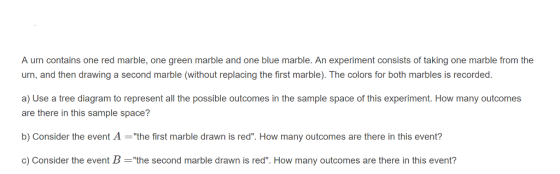
 A urn contains one red marble, one green marble and one blue marble. An experiment consists of taking one marble from the urn and then drawing a second marble (without replacing the first marble). The colors for both marbles is recorded. a) Use a tree diagram to represent all the possible outcomes in the sample space of this experiment. How many outcomes are there in this sample space? b) Consider the event A "the first marble drawn is red". How...
a) A urn contains one red marble, one green marble and one blue marble. An experiment...
 a) A urn contains one red marble, one green marble and one blue marble. An experiment consists of taking one marble from the urn, then returning it and drawing a second marble. What is the probability that exactly one red marble is selected? b) What is the probability that exactly one red marble is selected if the experiment is without replacement (marble is not returned)?
1. A box contains 3 marbles: 1 red, 1 green, and 1 blue. Consider an experiment...
1. A box contains 3 marbles: 1 red, 1 green, and 1 blue. Consider an experiment that consists of taking 1 marble from the box and then replacing it in the box and drawing a second marble from the box. Describe the sample space. Repeat when the second marble is drawn without replacing the first marble.
discrete math 1) a. A box contains 4 marbles: 1 red, 1 blue, 1 green, 1...
 discrete math
1) a. A box contains 4 marbles: 1 red, 1 blue, 1 green, 1 yellow. Consider an experiment that consists of taking 1 marble from the box, replacing it and then drawing a second marble. Describe the sample space. How does the sample space differ if the first marble was not replaced before the second marble was drawn? (2 marks) a. A bag contains 5 red balls and 8 blue balls. Each time a ball is selected, its...
discrete math
1) a. A box contains 4 marbles: 1 red, 1 blue, 1 green, 1 yellow. Consider an experiment that consists of taking 1 marble from the box, replacing it and then drawing a second marble. Describe the sample space. How does the sample space differ if the first marble was not replaced before the second marble was drawn? (2 marks) a. A bag contains 5 red balls and 8 blue balls. Each time a ball is selected, its...
An urn contains 15 different colored marbles, 7 are red, 5 are blue, and 3 are...
 An urn contains 15 different colored marbles, 7 are red, 5 are blue, and 3 are green. Part 1. If two balls are randomly picked from the urn without replacement a) b) Determine the sample space What is the probability of grabbing a red marble on the first pick and then a green marble on the second pick? Did you use the classical or empirical approach to calculate the probability in part b? Are these events independent or dependent? Disjoint...
Round all answers to 4 decimal places. a. A bag contains 6 green marbles, 10 red...
 Round all answers to 4 decimal places. a. A bag contains 6 green marbles, 10 red marbles, and 3 blue marbles. If a marble is drawn from the bag. replaced and another marble is drawn, what is the probability of drawing first a green marble and then a blue marble? 0.8421 * b. A bag contains 10 white marbles, 3 blue marbles, and 6 red marbles. If two different marbles are drawn from the bag. What is the probability of...
An urn contains three red marbles and five blue marbles. A marble is picked at random...
An urn contains three red marbles and five blue marbles. A marble is picked at random and is not replaced. A second marble is then picked from the urn. Determine the following: (a) P(both marbles are red) (b) P(both marbles are blue) (c)P(both marbles are the same color)
A bag contains 17 yellow marbles, 2 red marbles, green marbles. If one marble is drawn...
 A bag contains 17 yellow marbles, 2 red marbles, green marbles. If one marble is drawn from the bag and then replaced, what is the probability of drawing a yellow marble and then drawing a green marble? Round your answer to 4 decimal places.
An urn contains 14 red marbles, 29 blue marbles, and 43 yellow marbles. One marble is...
An urn contains 14 red marbles, 29 blue marbles, and 43 yellow marbles. One marble is to be chosen from the urn without looking. What is the probability of choosing a red marble?
An urn contains 21 red marbles, 19 blue marbles, and 40 yellow marbles. One marble is...
 An urn contains 21 red marbles, 19 blue marbles, and 40 yellow marbles. One marble is to be chosen from the urn without looking. What is the probability of choosing a red or a blue marble? Your answer should be rounded to 4 decimal places.
 A urn contains one red marble, one green marble and one blue marble. An experiment consists of taking one marble from the urn and then drawing a second marble (without replacing the first marble). The colors for both marbles is recorded. a) Use a tree diagram to represent all the possible outcomes in the sample space of this experiment. How many outcomes are there in this sample space? b) Consider the event A "the first marble drawn is red". How...
 a) A urn contains one red marble, one green marble and one blue marble. An experiment consists of taking one marble from the urn, then returning it and drawing a second marble. What is the probability that exactly one red marble is selected? b) What is the probability that exactly one red marble is selected if the experiment is without replacement (marble is not returned)?
 discrete math
1) a. A box contains 4 marbles: 1 red, 1 blue, 1 green, 1 yellow. Consider an experiment that consists of taking 1 marble from the box, replacing it and then drawing a second marble. Describe the sample space. How does the sample space differ if the first marble was not replaced before the second marble was drawn? (2 marks) a. A bag contains 5 red balls and 8 blue balls. Each time a ball is selected, its...
discrete math
1) a. A box contains 4 marbles: 1 red, 1 blue, 1 green, 1 yellow. Consider an experiment that consists of taking 1 marble from the box, replacing it and then drawing a second marble. Describe the sample space. How does the sample space differ if the first marble was not replaced before the second marble was drawn? (2 marks) a. A bag contains 5 red balls and 8 blue balls. Each time a ball is selected, its...
 An urn contains 15 different colored marbles, 7 are red, 5 are blue, and 3 are green. Part 1. If two balls are randomly picked from the urn without replacement a) b) Determine the sample space What is the probability of grabbing a red marble on the first pick and then a green marble on the second pick? Did you use the classical or empirical approach to calculate the probability in part b? Are these events independent or dependent? Disjoint...
 Round all answers to 4 decimal places. a. A bag contains 6 green marbles, 10 red marbles, and 3 blue marbles. If a marble is drawn from the bag. replaced and another marble is drawn, what is the probability of drawing first a green marble and then a blue marble? 0.8421 * b. A bag contains 10 white marbles, 3 blue marbles, and 6 red marbles. If two different marbles are drawn from the bag. What is the probability of...
 A bag contains 17 yellow marbles, 2 red marbles, green marbles. If one marble is drawn from the bag and then replaced, what is the probability of drawing a yellow marble and then drawing a green marble? Round your answer to 4 decimal places.
 An urn contains 21 red marbles, 19 blue marbles, and 40 yellow marbles. One marble is to be chosen from the urn without looking. What is the probability of choosing a red or a blue marble? Your answer should be rounded to 4 decimal places.
Most questions answered within 3 hours.
-
Where is the error in this code sequence?
String s1 = "Hello";
String s2 = "ello";...
asked 10 months ago -
Financial data for Joel de Paris, Inc., for last year
follow:
Joel de Paris, Inc.
Balance...
asked 10 months ago -
Consider this reaction:
Al2(SO4)3 (aq)+ BaCl3
(aq) Al2Cl6 (aq)- +
3BaSO4(s) . What is the...
asked 10 months ago -
Suppose that Savneet is considering increasing her
recent random sample from 20 car rentals to 40...
asked 10 months ago -
Trucks arrive at an unloading terminal at an average rate of 120
per hour.
Trucks arrive...
asked 10 months ago -
Why are methanol and ethanol completely soluble in water while
octanol is not very little soluble....
asked 10 months ago -
A facilities manager at a university reads in a research report
that the mean amount of...
asked 10 months ago -
When the CuSO4 is rehydrated by adding water to the anhydrous
compound, is this an endothermic...
asked 10 months ago -
A ray of sunlight is passing from diamond into crown glass; the
angle of incidence is...
asked 10 months ago -
A block of mass 0.249 kg is placed on top of a light, vertical
spring of...
asked 10 months ago -
how do the kidneys compensate in the presences of acidosis
a) trigger hyperventilate
b) reserve acid...
asked 10 months ago -
Question 501 pts
The rental rate of capital to the firm increases. Which of the
following...
asked 10 months ago