
Homework Answers
Add Answer to:
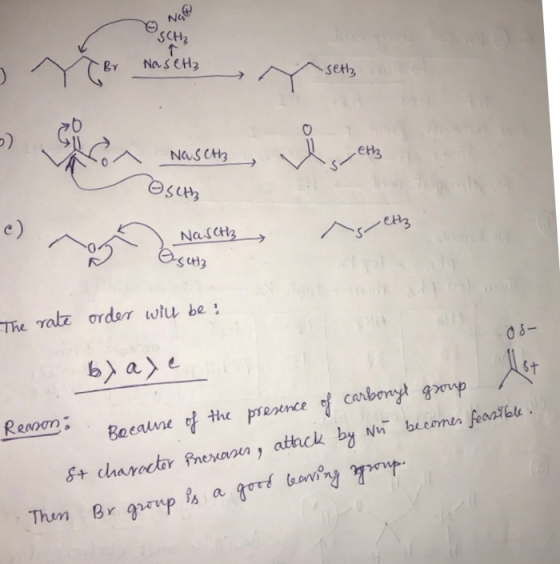
5) a) Draw the products of the following reaction. (3 marks) b) Rank the reactions from...
Rank these reaction conditions for the rate of formation of elimination products from 2-Chloro-3- 5. methylbutane....
 Rank these reaction conditions for the rate of formation of elimination products from 2-Chloro-3- 5. methylbutane. i. NaOH/H,O at 50 "C ii. H,O at 50 'C iii. H,O at 25 °C fastest ii > ii > i slowest a. fastest iii > i > i slowest b. c. fastest ii > ii > i slowest d. fastest i> i > ii slowest fastest i> i > ii slowest e. 6. For the two reactions below, which would give the largest...
Based on the activation energies and frequency factors, rank the following reactions from fastest to slowest...
 Based on the activation energies and frequency factors, rank the
following reactions from fastest to slowest reaction rate, assuming
they are all at the same temperature and that each starts with the
same initial concentration.
Rank from fastest to slowest reaction rate. To rank items as
equivalent, overlap them.
Fraction of molecules
The exponential term in the Arrhenius equation is equal to the
fraction of molecules, f, with kinetic energy greater than or equal
to the activation energy:
f=e−Ea/(R⋅T)
Most...
Based on the activation energies and frequency factors, rank the
following reactions from fastest to slowest reaction rate, assuming
they are all at the same temperature and that each starts with the
same initial concentration.
Rank from fastest to slowest reaction rate. To rank items as
equivalent, overlap them.
Fraction of molecules
The exponential term in the Arrhenius equation is equal to the
fraction of molecules, f, with kinetic energy greater than or equal
to the activation energy:
f=e−Ea/(R⋅T)
Most...
che 1. Rank from fastest (1) to slowest (5) the rates of the SN2 reaction of...
 che
1. Rank from fastest (1) to slowest (5) the rates of the SN2 reaction of the compounds shown. Br Br CH3-C-CH3 CH3 CHaCHs CH2 CH-CH21 CH-CH,он CH3CH2Br 2. Rank from fastest (1) to slowest (5) the rates of the solvolysis reaction in HOAC/HOH of the compounds shown. Br Br CH3-с-CHз CH3CH2OH CH2-CH-CH21 CH3-C-CH3 CH3 CH3CH2Br B. Circle the number corresponding to the correct answer. Answer 5. a) What is the principal determinant of reaction order? i. structure of substrate...
che
1. Rank from fastest (1) to slowest (5) the rates of the SN2 reaction of the compounds shown. Br Br CH3-C-CH3 CH3 CHaCHs CH2 CH-CH21 CH-CH,он CH3CH2Br 2. Rank from fastest (1) to slowest (5) the rates of the solvolysis reaction in HOAC/HOH of the compounds shown. Br Br CH3-с-CHз CH3CH2OH CH2-CH-CH21 CH3-C-CH3 CH3 CH3CH2Br B. Circle the number corresponding to the correct answer. Answer 5. a) What is the principal determinant of reaction order? i. structure of substrate...
5. Rank the reactivity of the following alkyl halides (A-E) for an SN2 reaction from the...
 5. Rank the reactivity of the following alkyl halides (A-E) for an SN2 reaction from the fastest (1) to the slowest (5) and explain your ranking. (10 pts) H3C-Br Br Ci
5. (8 marks) Which reaction, 1, 2, or 3 in each group, will be either faster...
 5. (8 marks) Which reaction, 1, 2, or 3 in each group, will be
either faster or more likely to succeed in forming significant
amounts of desired product. Give a brief, but clear and very
concise explanation for all your choices
5. (8 marks) Which reaction, 1, 2, or 3 in each group, will be either faster or more likely to succeed in forming significant amounts of desired product. Give a brief, but clear and very concise explanation for all...
5. (8 marks) Which reaction, 1, 2, or 3 in each group, will be
either faster or more likely to succeed in forming significant
amounts of desired product. Give a brief, but clear and very
concise explanation for all your choices
5. (8 marks) Which reaction, 1, 2, or 3 in each group, will be either faster or more likely to succeed in forming significant amounts of desired product. Give a brief, but clear and very concise explanation for all...
5. (8 marks) Which reaction, 1, 2, or 3 in each group, will be either faster...
 5. (8 marks) Which reaction, 1, 2, or 3 in each group, will be either faster or more likely to succeed in forming significant amounts of desired product. Give a brief, but clear and very concise explanation for all your choices. (6) Reaction 1 CH3COONa+ acetone CH30 Na Reaction 2 acetone CH3COONa+ Reaction 3 acetone Fastest or most likely Why? Slowest or least likely
5. 8 marks) Which reaction, 1, 2, or 3 in each group, will be either faster...
 5. 8 marks) Which reaction, 1, 2, or 3 in each group, will be either faster or more likely to succeed in forming significant amounts of desired product. Give a brief, but clear and Y concise explanation for all your choices Reaction 1 Br NACN DMSO NaCN Reaction 2 сн,снон NaCN CH,CH,OH Reaction 3 Fastest or most likely or least likely Why? Reaction 1 CH3COONa* acetone CHO Na acetone Reaction 2 Reaction 3 ~ CH,COONa+ Br acetone Fastest or most...
(8 marks) Which reaction, I, 2, or 3 in each group, will be either faster or...
 (8 marks) Which reaction, I, 2, or 3 in each group, will be either faster or more likely to succeed in forming significant amounts of desired product. Give a brief, but clear and very concise explanation for all your choices. 5. (b) CH&COO Na Reaction 1 acetone CH20 Na Br Reaction 2 acetone CH3COO Na Reaction 3 Br acetone Slowest or least likely Fastest or most likely Why?
Rank reactivity of following carboxylic acid derivatives as an electrophile from slowest (1) to fastest (5)...
 Rank reactivity of following carboxylic acid derivatives as an
electrophile from slowest (1) to fastest (5)
8. Rank reactivity of following carboxylic acid derivatives as an electrophile from slowest (1) to fastest (5) za zane ry rog za
Rank reactivity of following carboxylic acid derivatives as an
electrophile from slowest (1) to fastest (5)
8. Rank reactivity of following carboxylic acid derivatives as an electrophile from slowest (1) to fastest (5) za zane ry rog za
6. (a) Rank the reactivity of the following alkyl halides (A-E) for an Syl reaction from...
 6. (a) Rank the reactivity of the following alkyl halides (A-E) for an Syl reaction from the slowest (1) to the fastest(5) (b) Explain your ranking, (10 Pts Total) Cl CH3-Cl CH3 H,C
 Rank these reaction conditions for the rate of formation of elimination products from 2-Chloro-3- 5. methylbutane. i. NaOH/H,O at 50 "C ii. H,O at 50 'C iii. H,O at 25 °C fastest ii > ii > i slowest a. fastest iii > i > i slowest b. c. fastest ii > ii > i slowest d. fastest i> i > ii slowest fastest i> i > ii slowest e. 6. For the two reactions below, which would give the largest...
 Based on the activation energies and frequency factors, rank the
following reactions from fastest to slowest reaction rate, assuming
they are all at the same temperature and that each starts with the
same initial concentration.
Rank from fastest to slowest reaction rate. To rank items as
equivalent, overlap them.
Fraction of molecules
The exponential term in the Arrhenius equation is equal to the
fraction of molecules, f, with kinetic energy greater than or equal
to the activation energy:
f=e−Ea/(R⋅T)
Most...
Based on the activation energies and frequency factors, rank the
following reactions from fastest to slowest reaction rate, assuming
they are all at the same temperature and that each starts with the
same initial concentration.
Rank from fastest to slowest reaction rate. To rank items as
equivalent, overlap them.
Fraction of molecules
The exponential term in the Arrhenius equation is equal to the
fraction of molecules, f, with kinetic energy greater than or equal
to the activation energy:
f=e−Ea/(R⋅T)
Most...
 che
1. Rank from fastest (1) to slowest (5) the rates of the SN2 reaction of the compounds shown. Br Br CH3-C-CH3 CH3 CHaCHs CH2 CH-CH21 CH-CH,он CH3CH2Br 2. Rank from fastest (1) to slowest (5) the rates of the solvolysis reaction in HOAC/HOH of the compounds shown. Br Br CH3-с-CHз CH3CH2OH CH2-CH-CH21 CH3-C-CH3 CH3 CH3CH2Br B. Circle the number corresponding to the correct answer. Answer 5. a) What is the principal determinant of reaction order? i. structure of substrate...
che
1. Rank from fastest (1) to slowest (5) the rates of the SN2 reaction of the compounds shown. Br Br CH3-C-CH3 CH3 CHaCHs CH2 CH-CH21 CH-CH,он CH3CH2Br 2. Rank from fastest (1) to slowest (5) the rates of the solvolysis reaction in HOAC/HOH of the compounds shown. Br Br CH3-с-CHз CH3CH2OH CH2-CH-CH21 CH3-C-CH3 CH3 CH3CH2Br B. Circle the number corresponding to the correct answer. Answer 5. a) What is the principal determinant of reaction order? i. structure of substrate...
 5. Rank the reactivity of the following alkyl halides (A-E) for an SN2 reaction from the fastest (1) to the slowest (5) and explain your ranking. (10 pts) H3C-Br Br Ci
 5. (8 marks) Which reaction, 1, 2, or 3 in each group, will be
either faster or more likely to succeed in forming significant
amounts of desired product. Give a brief, but clear and very
concise explanation for all your choices
5. (8 marks) Which reaction, 1, 2, or 3 in each group, will be either faster or more likely to succeed in forming significant amounts of desired product. Give a brief, but clear and very concise explanation for all...
5. (8 marks) Which reaction, 1, 2, or 3 in each group, will be
either faster or more likely to succeed in forming significant
amounts of desired product. Give a brief, but clear and very
concise explanation for all your choices
5. (8 marks) Which reaction, 1, 2, or 3 in each group, will be either faster or more likely to succeed in forming significant amounts of desired product. Give a brief, but clear and very concise explanation for all...
 5. (8 marks) Which reaction, 1, 2, or 3 in each group, will be either faster or more likely to succeed in forming significant amounts of desired product. Give a brief, but clear and very concise explanation for all your choices. (6) Reaction 1 CH3COONa+ acetone CH30 Na Reaction 2 acetone CH3COONa+ Reaction 3 acetone Fastest or most likely Why? Slowest or least likely
 5. 8 marks) Which reaction, 1, 2, or 3 in each group, will be either faster or more likely to succeed in forming significant amounts of desired product. Give a brief, but clear and Y concise explanation for all your choices Reaction 1 Br NACN DMSO NaCN Reaction 2 сн,снон NaCN CH,CH,OH Reaction 3 Fastest or most likely or least likely Why? Reaction 1 CH3COONa* acetone CHO Na acetone Reaction 2 Reaction 3 ~ CH,COONa+ Br acetone Fastest or most...
 (8 marks) Which reaction, I, 2, or 3 in each group, will be either faster or more likely to succeed in forming significant amounts of desired product. Give a brief, but clear and very concise explanation for all your choices. 5. (b) CH&COO Na Reaction 1 acetone CH20 Na Br Reaction 2 acetone CH3COO Na Reaction 3 Br acetone Slowest or least likely Fastest or most likely Why?
 Rank reactivity of following carboxylic acid derivatives as an
electrophile from slowest (1) to fastest (5)
8. Rank reactivity of following carboxylic acid derivatives as an electrophile from slowest (1) to fastest (5) za zane ry rog za
Rank reactivity of following carboxylic acid derivatives as an
electrophile from slowest (1) to fastest (5)
8. Rank reactivity of following carboxylic acid derivatives as an electrophile from slowest (1) to fastest (5) za zane ry rog za
 6. (a) Rank the reactivity of the following alkyl halides (A-E) for an Syl reaction from the slowest (1) to the fastest(5) (b) Explain your ranking, (10 Pts Total) Cl CH3-Cl CH3 H,C
Most questions answered within 3 hours.
-
Where is the error in this code sequence?
String s1 = "Hello";
String s2 = "ello";...
asked 11 months ago -
Financial data for Joel de Paris, Inc., for last year
follow:
Joel de Paris, Inc.
Balance...
asked 11 months ago -
Consider this reaction:
Al2(SO4)3 (aq)+ BaCl3
(aq) Al2Cl6 (aq)- +
3BaSO4(s) . What is the...
asked 11 months ago -
Suppose that Savneet is considering increasing her
recent random sample from 20 car rentals to 40...
asked 11 months ago -
Trucks arrive at an unloading terminal at an average rate of 120
per hour.
Trucks arrive...
asked 11 months ago -
Why are methanol and ethanol completely soluble in water while
octanol is not very little soluble....
asked 11 months ago -
A facilities manager at a university reads in a research report
that the mean amount of...
asked 11 months ago -
When the CuSO4 is rehydrated by adding water to the anhydrous
compound, is this an endothermic...
asked 11 months ago -
A ray of sunlight is passing from diamond into crown glass; the
angle of incidence is...
asked 11 months ago -
A block of mass 0.249 kg is placed on top of a light, vertical
spring of...
asked 11 months ago -
how do the kidneys compensate in the presences of acidosis
a) trigger hyperventilate
b) reserve acid...
asked 11 months ago -
Question 501 pts
The rental rate of capital to the firm increases. Which of the
following...
asked 11 months ago