
Homework Answers
In this case demand curve will shift upward as there is an price increase at every quantity demanded. Shift will be equal to the excise tax.
So, correct option is
The demand curve will shift up by the amount of excise tax
Add Answer to:
If consumers have to remit an excise tax imposed by the government: The demand curve will...
1. An excise tax (sales tax) is imposed on producers of a good. For a given...
1. An excise tax (sales tax) is imposed on producers of a good. For a given supply curve, the more price elastic the demand for the product, the greater the tax incidence on (the party that pays more portion of tax): Producers Both Consumers Neither
2. If the government imposes a $50 excise subsidy on the production of textbooks, then from...
2. If the government imposes a $50 excise subsidy on the production of textbooks, then from the perspective of consumers (students), the “effective” or after-subsidy supply curve for textbooks will shift up vertically by exactly $50. down vertically by more than $50. right horizontally by more than $50. down vertically by less than $50. down vertically by exactly $50. left horizontally by exactly $50. 3. Which of the following would decrease the quantity supplied of smartphones, ceteris paribus? An increase...
Hi please assist with the following questions regarding excise taxes, Assume that the government has imposed...
Hi please assist with the following questions regarding excise taxes, Assume that the government has imposed a tax on the production and sale of pickup trucks in America. In what cases would that tax be absorbed more by consumers than manufacturers and vice versa? Under what circumstances would you expect the total excise tax to be borne by a consumer rather than by the producer? Or by the producer? Assume that the government imposed a 100% luxury tax on new...
Question 10 (2 points) ✓ Saved If government reduces income tax rates, the aggregate demand curve...
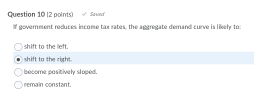 Question 10 (2 points) ✓ Saved If government reduces income tax rates, the aggregate demand curve is likely to: shift to the left. shift to the right. become positively sloped. remain constant.
Suppose the Canadian government has decided to place an excise (or sales) tax of $20 per...
 Suppose the Canadian government has decided to place an excise
(or sales) tax of $20 per tire on producers of automobile tires.
Previously, there was no excise tax on automobile tires. As a
result of the excise tax, producers of tires, such as Bridgestone
and Michelin, are going to alter their tire prices. The graph
illustrates the demand and supply curves for automobile tires
before the excise tax. 1. Please shift the appropriate curve(s) on
the graph to demonstrate the...
Suppose the Canadian government has decided to place an excise
(or sales) tax of $20 per tire on producers of automobile tires.
Previously, there was no excise tax on automobile tires. As a
result of the excise tax, producers of tires, such as Bridgestone
and Michelin, are going to alter their tire prices. The graph
illustrates the demand and supply curves for automobile tires
before the excise tax. 1. Please shift the appropriate curve(s) on
the graph to demonstrate the...
In an effort to raise revenue without hurting lower income persons, Congress imposed an excise tax...
 In an effort to raise revenue without hurting lower income
persons, Congress imposed an excise tax on luxury goods (viz.,
expensive cars, large yachts, furs, personal aircraft) manufactured
in the U.S. The excise tax imposed is represented on the diagram
below as Stax . The revenue government
anticipated it yielding is represented by the rectangle
P1abc (which is the tax per unit, distance ab, times
quantity Q1). The tax, however, did not work as
intended. After awhile domestic producers of...
In an effort to raise revenue without hurting lower income
persons, Congress imposed an excise tax on luxury goods (viz.,
expensive cars, large yachts, furs, personal aircraft) manufactured
in the U.S. The excise tax imposed is represented on the diagram
below as Stax . The revenue government
anticipated it yielding is represented by the rectangle
P1abc (which is the tax per unit, distance ab, times
quantity Q1). The tax, however, did not work as
intended. After awhile domestic producers of...
We understand that an excise tax will result in a difference between the price the consumers...
We understand that an excise tax will result in a difference between the price the consumers pay and the (net) price the firm keeps for each unit. Often, this results in a “disruption” in the market as equilibrium output decreased. For this example, suppose we look at the market for land and let’s assume that the supply of land is fixed (I realize that some countries have “reclaimed land from the sea,” but lets ignore those) and the supply curve...
We understand that an excise tax will result in a difference between the price the consumers...
We understand that an excise tax will result in a difference between the price the consumers pay and the (net) price the firm keeps for each unit. Often, this results in a “disruption” in the market as equilibrium output decreased. For this example, suppose we look at the market for land and let’s assume that the supply of land is fixed (I realize that some countries have “reclaimed land from the sea,” but lets ignore those) and the supply curve...
We understand that an excise tax will result in a difference between the price the consumers...
We understand that an excise tax will result in a difference between the price the consumers pay and the (net) price the firm keeps for each unit. Often, this results in a "disruption" in the market as equilibrium output decreased. For this example, suppose we look at the market for land and let's assume that the supply of land is fixed (I realize that some countries have "reclaimed land from the sea," but lets ignore those) and the supply curve...
We understand that an excise tax will result in a difference between the price the consumers...
We understand that an excise tax will result in a difference between the price the consumers pay and the (net) price the firm keeps for each unit. Often, this results in a “disruption” in the market as equilibrium output decreased. For this example, suppose we look at the market for land and let’s assume that the supply of land is fixed (I realize that some countries have “reclaimed land from the sea,” but lets ignore those) and the supply curve...
 Question 10 (2 points) ✓ Saved If government reduces income tax rates, the aggregate demand curve is likely to: shift to the left. shift to the right. become positively sloped. remain constant.
 Suppose the Canadian government has decided to place an excise
(or sales) tax of $20 per tire on producers of automobile tires.
Previously, there was no excise tax on automobile tires. As a
result of the excise tax, producers of tires, such as Bridgestone
and Michelin, are going to alter their tire prices. The graph
illustrates the demand and supply curves for automobile tires
before the excise tax. 1. Please shift the appropriate curve(s) on
the graph to demonstrate the...
Suppose the Canadian government has decided to place an excise
(or sales) tax of $20 per tire on producers of automobile tires.
Previously, there was no excise tax on automobile tires. As a
result of the excise tax, producers of tires, such as Bridgestone
and Michelin, are going to alter their tire prices. The graph
illustrates the demand and supply curves for automobile tires
before the excise tax. 1. Please shift the appropriate curve(s) on
the graph to demonstrate the...
 In an effort to raise revenue without hurting lower income
persons, Congress imposed an excise tax on luxury goods (viz.,
expensive cars, large yachts, furs, personal aircraft) manufactured
in the U.S. The excise tax imposed is represented on the diagram
below as Stax . The revenue government
anticipated it yielding is represented by the rectangle
P1abc (which is the tax per unit, distance ab, times
quantity Q1). The tax, however, did not work as
intended. After awhile domestic producers of...
In an effort to raise revenue without hurting lower income
persons, Congress imposed an excise tax on luxury goods (viz.,
expensive cars, large yachts, furs, personal aircraft) manufactured
in the U.S. The excise tax imposed is represented on the diagram
below as Stax . The revenue government
anticipated it yielding is represented by the rectangle
P1abc (which is the tax per unit, distance ab, times
quantity Q1). The tax, however, did not work as
intended. After awhile domestic producers of...
Most questions answered within 3 hours.
-
Where is the error in this code sequence?
String s1 = "Hello";
String s2 = "ello";...
asked 10 months ago -
Financial data for Joel de Paris, Inc., for last year
follow:
Joel de Paris, Inc.
Balance...
asked 10 months ago -
Consider this reaction:
Al2(SO4)3 (aq)+ BaCl3
(aq) Al2Cl6 (aq)- +
3BaSO4(s) . What is the...
asked 10 months ago -
Suppose that Savneet is considering increasing her
recent random sample from 20 car rentals to 40...
asked 10 months ago -
Trucks arrive at an unloading terminal at an average rate of 120
per hour.
Trucks arrive...
asked 10 months ago -
Why are methanol and ethanol completely soluble in water while
octanol is not very little soluble....
asked 10 months ago -
A facilities manager at a university reads in a research report
that the mean amount of...
asked 10 months ago -
When the CuSO4 is rehydrated by adding water to the anhydrous
compound, is this an endothermic...
asked 10 months ago -
A ray of sunlight is passing from diamond into crown glass; the
angle of incidence is...
asked 10 months ago -
A block of mass 0.249 kg is placed on top of a light, vertical
spring of...
asked 10 months ago -
how do the kidneys compensate in the presences of acidosis
a) trigger hyperventilate
b) reserve acid...
asked 10 months ago -
Question 501 pts
The rental rate of capital to the firm increases. Which of the
following...
asked 10 months ago