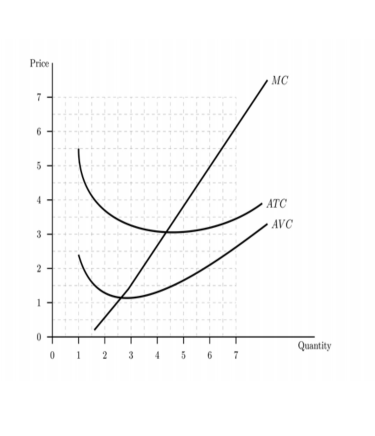
2a [5 marks] Click on the link and open the pdf. (if you zoom in, you can see the gridlines). If the market price is $4.50, calculate the firm’s economic profits or losses in the short-run.
2b [5 marks] You learn that in the market at this price the total quantity transacted is equal to 7,040. How many firms are operating in the market? What are the industry profits/losses?
2c [5 marks] If the firm in the graph is representative for all other firms in the industry, what will be the market price in the long run? Describe briefly how the market moves from the short-run to the long-run.
Homework Answers
a) P=4.5
Setting P=MC, the firm will produce Q = 5.5 units where ATC = 3
So, Profits = P-ATC*Q = (4.5-3)*5.5 = 8.25
b) A sigle firm supplies 5.5 units so total number of firms = 7040/5.5 = 1280
Industry profit = (4.5-3)*7040 = 10560
c) Market price in the long run is equal to the minimum ATC = 3 where P=ATC
In the short run, since the industry is making positive economic profits, this will attract more firms to the market and market supply will increase.When supply increases, the price decreases until it is equal to the minimum ATC where all the firms are earning zero profits so that no new firms will have any incentive to enter the market.
Add Answer to:
2a [5 marks] Click on the link and open the
pdf. (if you zoom in, you...
Q2 2a [5 marks] Look at the graph at the bottom. If the market price is...
 Q2 2a [5 marks] Look at the graph at the bottom. If the market price is $4.50, calculate the firm's economic profits or losses in the short-run. Price ATC AVC UTTTTTTTT TTT 0 1 2 3 4 5 6 7 Quantity 2b [5 marks] You learn that in the market at this price the total quantity transacted is equal to 7,040. How many firms are operating in the market? What are the industry profits/losses? 2c [5 marks] If the firm...
5 pts Question 5 In a competitive market the current price is $11, and the typical...
 5 pts Question 5 In a competitive market the current price is $11, and the typical firm in the market has ATC $11.50 and AVC $11.15 In the short run firms will shut down, and in the long run firms will leave the market. In the short run firms will continue to operate, but in the long run firms will leave the market. New firms will likely enter this market to capture any remaining economic profits O The firm will...
Suppose a firm operating in a competitive market has the following cost curves: Price MC ATC...
 Suppose a firm operating in a competitive market has the following cost curves: Price MC ATC P7 プ , AVC P3 P2 . Q1 02 03 04 05 gaantity Refer to Figure 14-5. In the short run, if the market price is P2, indavidual firms in a competitive industry will eam positive profits. zero profits. losses but will remain in business. losses and will shut down e
5. Short-run supply and long-run equilibrium Consider the competitive market for titanium. Assume that, regardless of...
 5. Short-run supply and long-run
equilibrium
Consider the competitive market for titanium. Assume that,
regardless of how many firms are in the industry, every firm in the
industry is identical and faces the marginal cost (MC), average
total cost (ATC), and average variable cost (AVC) curves shown on
the following graph.
Consider the competitive market for titanium. Assume that, regardless of how many firms are in the industry, every firm in the industry is identical and faces the marginal cost...
5. Short-run supply and long-run
equilibrium
Consider the competitive market for titanium. Assume that,
regardless of how many firms are in the industry, every firm in the
industry is identical and faces the marginal cost (MC), average
total cost (ATC), and average variable cost (AVC) curves shown on
the following graph.
Consider the competitive market for titanium. Assume that, regardless of how many firms are in the industry, every firm in the industry is identical and faces the marginal cost...
Use the following to answer questions 23-25: Figure: Determining Long-Run Adjustments ATC AVC Price and Cost...
 Use the following to answer questions 23-25: Figure: Determining Long-Run Adjustments ATC AVC Price and Cost (S) 11 ! AFC 9 12 14 Output 23. (Figure: Determining Long-Run Adjustments) The figure depicts the cost curves for a firm in a perfectly competitive industry in the long run. If the market price is $36, how many units of output should this firm produce? A) 0 B) 9 C) 12 D) 14 24. (Figure: Determining Long-Run Adjustments) If the current price is...
Short-run supply and long-run equilibrium, please and thank you Consider the competitive market for titanium. Assume...
 Short-run supply and long-run equilibrium, please and
thank you
Consider the competitive market for titanium. Assume that, regardless of how many firms are in the industry, every firm in the industry is identical and faces the marginal cost (MC), average total cost (ATC), and average variable cost (AVC) curves shown on the following graph. COSTS (Dollars per kilogram) ATC + MC O AVC ott 0 5 10 15 20 25 30 35 40 QUANTITY (Thousands of kilograms) 45 50 The...
Short-run supply and long-run equilibrium, please and
thank you
Consider the competitive market for titanium. Assume that, regardless of how many firms are in the industry, every firm in the industry is identical and faces the marginal cost (MC), average total cost (ATC), and average variable cost (AVC) curves shown on the following graph. COSTS (Dollars per kilogram) ATC + MC O AVC ott 0 5 10 15 20 25 30 35 40 QUANTITY (Thousands of kilograms) 45 50 The...
5. Short-run supply and long-run equilibrium Consider the perfectly competitive market for steel. Assume that, regardless...
 5. Short-run supply and long-run equilibrium Consider the perfectly competitive market for steel. Assume that, regardless of how many firms are in the industry, every firm in the industry is identical and faces the marginal cost (MC), average total cost (ATC), and average variable cost (AVC) curves shown on the following graph. COSTS (Dollars per ton) + MC D AVC 0 10 90 100 20 30 40 50 60 70 80 QUANTITY (Thousands of tons) The following diagram shows the...
5. Short-run supply and long-run equilibrium Consider the competitive market for titanium. Assume that, regardless of...
 5. Short-run supply and long-run equilibrium Consider the competitive market for titanium. Assume that, regardless of how many firms are in the industry, every firm in the industry is identical and faces the marginal cost (MC), average total cost (ATC), and average variable cost (AVC) curves shown on the following graph. 16, 52 COSTS (Dollars per pound) AVC + D + 0 + 3 MC D + + + + + + + 6 9 12 15 18 21 24...
8. Refer to the graph above depicting a perfectly competitive firm. When maximizing profit, the total...
 8. Refer to the graph above depicting a perfectly competitive firm. When maximizing profit, the total profit earned by the firm represented is: A. $220. B. $275. C. $330 D. $605, 26. Refer to the graph above of a monopolistically competitive firm. If the firm maximizes profit, it will earn: A. zero economic profit this year. B. $320,000 economic profit this year. C. 584,000 economic profit this year. D. $56,000 economic profit this year. ATC AVC - 01 02 03...
31 In perfectly competitive industries: A. the shont-run market supply curves are positively sloped в. long-rusniustry...
 31 In perfectly competitive industries: A. the shont-run market supply curves are positively sloped в. long-rusniustry supply curve,are positively sloped. C. the short-run D. All of the above E. Only B and C are correct market supply curves are more clastic than the long-run industry supply curvers s3. Assame a perfectly-competitive, increasing-cost industry composed of identical firms is initially in long-run equilibrium. Given a decrease in demand, in the short ran: equilbrium price decreases, equilibrium output increases, the output of...
 Q2 2a [5 marks] Look at the graph at the bottom. If the market price is $4.50, calculate the firm's economic profits or losses in the short-run. Price ATC AVC UTTTTTTTT TTT 0 1 2 3 4 5 6 7 Quantity 2b [5 marks] You learn that in the market at this price the total quantity transacted is equal to 7,040. How many firms are operating in the market? What are the industry profits/losses? 2c [5 marks] If the firm...
 5 pts Question 5 In a competitive market the current price is $11, and the typical firm in the market has ATC $11.50 and AVC $11.15 In the short run firms will shut down, and in the long run firms will leave the market. In the short run firms will continue to operate, but in the long run firms will leave the market. New firms will likely enter this market to capture any remaining economic profits O The firm will...
 Suppose a firm operating in a competitive market has the following cost curves: Price MC ATC P7 プ , AVC P3 P2 . Q1 02 03 04 05 gaantity Refer to Figure 14-5. In the short run, if the market price is P2, indavidual firms in a competitive industry will eam positive profits. zero profits. losses but will remain in business. losses and will shut down e
 5. Short-run supply and long-run
equilibrium
Consider the competitive market for titanium. Assume that,
regardless of how many firms are in the industry, every firm in the
industry is identical and faces the marginal cost (MC), average
total cost (ATC), and average variable cost (AVC) curves shown on
the following graph.
Consider the competitive market for titanium. Assume that, regardless of how many firms are in the industry, every firm in the industry is identical and faces the marginal cost...
5. Short-run supply and long-run
equilibrium
Consider the competitive market for titanium. Assume that,
regardless of how many firms are in the industry, every firm in the
industry is identical and faces the marginal cost (MC), average
total cost (ATC), and average variable cost (AVC) curves shown on
the following graph.
Consider the competitive market for titanium. Assume that, regardless of how many firms are in the industry, every firm in the industry is identical and faces the marginal cost...
 Use the following to answer questions 23-25: Figure: Determining Long-Run Adjustments ATC AVC Price and Cost (S) 11 ! AFC 9 12 14 Output 23. (Figure: Determining Long-Run Adjustments) The figure depicts the cost curves for a firm in a perfectly competitive industry in the long run. If the market price is $36, how many units of output should this firm produce? A) 0 B) 9 C) 12 D) 14 24. (Figure: Determining Long-Run Adjustments) If the current price is...
 Short-run supply and long-run equilibrium, please and
thank you
Consider the competitive market for titanium. Assume that, regardless of how many firms are in the industry, every firm in the industry is identical and faces the marginal cost (MC), average total cost (ATC), and average variable cost (AVC) curves shown on the following graph. COSTS (Dollars per kilogram) ATC + MC O AVC ott 0 5 10 15 20 25 30 35 40 QUANTITY (Thousands of kilograms) 45 50 The...
Short-run supply and long-run equilibrium, please and
thank you
Consider the competitive market for titanium. Assume that, regardless of how many firms are in the industry, every firm in the industry is identical and faces the marginal cost (MC), average total cost (ATC), and average variable cost (AVC) curves shown on the following graph. COSTS (Dollars per kilogram) ATC + MC O AVC ott 0 5 10 15 20 25 30 35 40 QUANTITY (Thousands of kilograms) 45 50 The...
 5. Short-run supply and long-run equilibrium Consider the perfectly competitive market for steel. Assume that, regardless of how many firms are in the industry, every firm in the industry is identical and faces the marginal cost (MC), average total cost (ATC), and average variable cost (AVC) curves shown on the following graph. COSTS (Dollars per ton) + MC D AVC 0 10 90 100 20 30 40 50 60 70 80 QUANTITY (Thousands of tons) The following diagram shows the...
 5. Short-run supply and long-run equilibrium Consider the competitive market for titanium. Assume that, regardless of how many firms are in the industry, every firm in the industry is identical and faces the marginal cost (MC), average total cost (ATC), and average variable cost (AVC) curves shown on the following graph. 16, 52 COSTS (Dollars per pound) AVC + D + 0 + 3 MC D + + + + + + + 6 9 12 15 18 21 24...
 8. Refer to the graph above depicting a perfectly competitive firm. When maximizing profit, the total profit earned by the firm represented is: A. $220. B. $275. C. $330 D. $605, 26. Refer to the graph above of a monopolistically competitive firm. If the firm maximizes profit, it will earn: A. zero economic profit this year. B. $320,000 economic profit this year. C. 584,000 economic profit this year. D. $56,000 economic profit this year. ATC AVC - 01 02 03...
 31 In perfectly competitive industries: A. the shont-run market supply curves are positively sloped в. long-rusniustry supply curve,are positively sloped. C. the short-run D. All of the above E. Only B and C are correct market supply curves are more clastic than the long-run industry supply curvers s3. Assame a perfectly-competitive, increasing-cost industry composed of identical firms is initially in long-run equilibrium. Given a decrease in demand, in the short ran: equilbrium price decreases, equilibrium output increases, the output of...
Most questions answered within 3 hours.
-
Where is the error in this code sequence?
String s1 = "Hello";
String s2 = "ello";...
asked 10 months ago -
Financial data for Joel de Paris, Inc., for last year
follow:
Joel de Paris, Inc.
Balance...
asked 10 months ago -
Consider this reaction:
Al2(SO4)3 (aq)+ BaCl3
(aq) Al2Cl6 (aq)- +
3BaSO4(s) . What is the...
asked 10 months ago -
Suppose that Savneet is considering increasing her
recent random sample from 20 car rentals to 40...
asked 10 months ago -
Trucks arrive at an unloading terminal at an average rate of 120
per hour.
Trucks arrive...
asked 10 months ago -
Why are methanol and ethanol completely soluble in water while
octanol is not very little soluble....
asked 10 months ago -
A facilities manager at a university reads in a research report
that the mean amount of...
asked 10 months ago -
When the CuSO4 is rehydrated by adding water to the anhydrous
compound, is this an endothermic...
asked 10 months ago -
A ray of sunlight is passing from diamond into crown glass; the
angle of incidence is...
asked 10 months ago -
A block of mass 0.249 kg is placed on top of a light, vertical
spring of...
asked 10 months ago -
how do the kidneys compensate in the presences of acidosis
a) trigger hyperventilate
b) reserve acid...
asked 10 months ago -
Question 501 pts
The rental rate of capital to the firm increases. Which of the
following...
asked 10 months ago