
Homework Answers
Add Answer to:
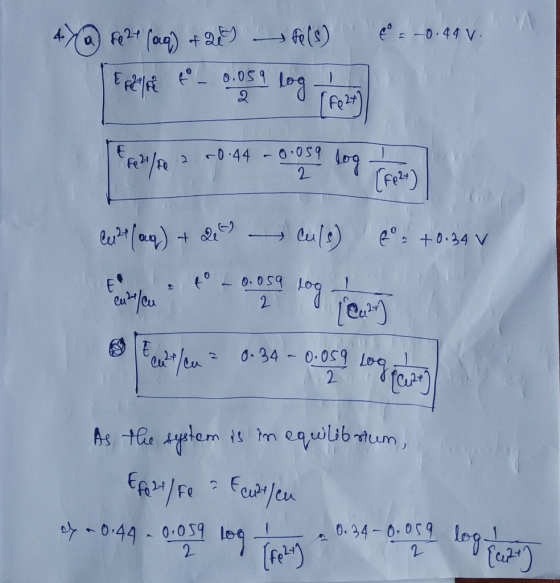
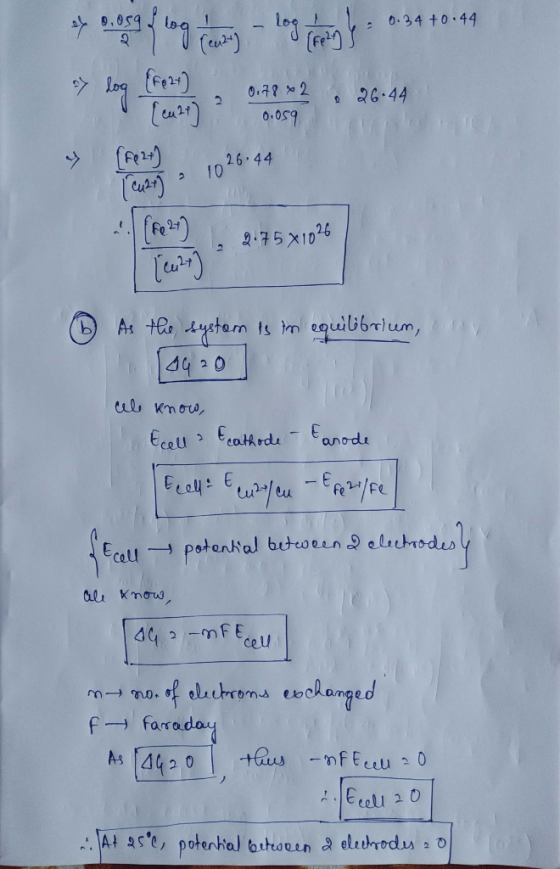
4. An excess of finely divided iron is stirred up with a solution that contains Cu²+...
Using the standard reduction potentials given below, choose the reaction than can only be achieved through...
 Using the standard reduction potentials given below, choose the reaction than can only be achieved through electrolysis. Cu2+(aq) + 2e → Cu(s) E° = 0.34 V Pb2+(aq) + 2e + Pb(s) E° = -0.13 V Fe2+(aq) + 2e Fe(s) E° = -0.44 V Zn2+(aq) + 2e + Zn(s) E° = -0.77 V Zn2+(aq) + Pb(s) → Zn(s) + Pb2+(aq) o Fe2+(aq) + Zn(s) → Fe(s) + Zn2+(aq) Pb2+(aq) + Fe(s) → Pb(s) + Fe2+(aq) Cu2+(aq) + Fe(s) → Cu(s) +...
Write the half reactions and overall reaction for each cell with calculated overall potentials as shown...
 Write the half reactions and overall reaction for each cell with calculated overall potentials as shown in Table 5-1. (Note: for the iron solutions the Nernst equation must be used) Pb(s) | Pb(NO3)2 (0.1M) || Cu(NO3)2 (0.1M) Cu(s) Zn(s) | Zn(NO3)2(0.1M) || Cu(NO3)2 (0.1M) Cu(s) Cds) | Ca(NO3)2 (0.1M) || Cu(NO3)2 (0.1M) | Cu(s) Cu() Cu(NO3)2(0.1M) Il Fe (0.1M/Fe? (0.1M graphite Pb(s) Pb(NO3)2(0.1M) Il Fe3(aq) (0.1M)/ Fe2(aq) (0.1MI graphite(s) Zns | Zn(NO3)2 (0.1M) || Pb(NO3)2 (0.1M) | Pb(s) Cdis Ca(NO3)2...
Using the table below: 19. Three combinations of metals are listed below, which combination would produce...
 Using the table below:
19. Three combinations of metals are listed below, which
combination would produce the largest voltage if they were used to
construct an electrochemical cell?
Copper (Cu) with zinc (Zn)
Lead (Pb) with zinc (Zn)
Lead (Pb) with cadmium (Cd)
Liu lur the reaction between Zn and Cu2+ ions is 1.1030 V, we can use the known value for the half-cell potential for zinc to determine the half-cell potential for copper: Zn(s) → Zn2+(aq) + 2e +...
Using the table below:
19. Three combinations of metals are listed below, which
combination would produce the largest voltage if they were used to
construct an electrochemical cell?
Copper (Cu) with zinc (Zn)
Lead (Pb) with zinc (Zn)
Lead (Pb) with cadmium (Cd)
Liu lur the reaction between Zn and Cu2+ ions is 1.1030 V, we can use the known value for the half-cell potential for zinc to determine the half-cell potential for copper: Zn(s) → Zn2+(aq) + 2e +...
Using the information in the table: Which combination of metals, if used to create an electrochemical...
 Using the information in the table:
Which combination of metals, if used to create an
electrochemical cell, would produce the largest voltage?
Liu lur the reaction between Zn and Cu2+ ions is 1.1030 V, we can use the known value for the half-cell potential for zinc to determine the half-cell potential for copper: Zn(s) → Zn2+(aq) + 2e + Cu2+(aq) + 2e → Cu(s) Zn(s) + Cu2+ (aq) → Zn2+ (aq) + Cu(s) E half-cell = 0.7628 V Eºhalf-cell =...
Using the information in the table:
Which combination of metals, if used to create an
electrochemical cell, would produce the largest voltage?
Liu lur the reaction between Zn and Cu2+ ions is 1.1030 V, we can use the known value for the half-cell potential for zinc to determine the half-cell potential for copper: Zn(s) → Zn2+(aq) + 2e + Cu2+(aq) + 2e → Cu(s) Zn(s) + Cu2+ (aq) → Zn2+ (aq) + Cu(s) E half-cell = 0.7628 V Eºhalf-cell =...
Using the Nernst equation calculate the cell voltage for: Fe(s) + Cd2+(aq) → Fe2+(aq) + Cd(s)...
Using the Nernst equation calculate the cell voltage for: Fe(s) + Cd2+(aq) → Fe2+(aq) + Cd(s) when the [Fe2+] = 0.16 M and [Cd2+] = 1.8 M. Potentially useful information: Fe2+ + 2e− → Fe(s); ε0 = -0.44 V Cd2+ + 2e− → Cd(s); ε0 = -0.40 V - - - - - - - - - - - - - - - - - - - - - - - - - - - For the hypothetical reaction: A+...
I need help with questione 1-12 and discussion question 1 and 2. The previous pictures help...
 I need help with questione 1-12 and discussion question 1 and
2. The previous pictures help determine the chart. Please Show Work
thank you so much
An oxidation half-reaction is characterized by electrons appearing on the product side. The oxidation of aluminum for instance would be represented thusly: Al(s) → Al3+ + 3e- (1) An reduction half-reaction is characterized by electrons appearing on the reactant side. The reduction of ferrous iron for instance would be represented thusly: Fe2+ + 2e...
I need help with questione 1-12 and discussion question 1 and
2. The previous pictures help determine the chart. Please Show Work
thank you so much
An oxidation half-reaction is characterized by electrons appearing on the product side. The oxidation of aluminum for instance would be represented thusly: Al(s) → Al3+ + 3e- (1) An reduction half-reaction is characterized by electrons appearing on the reactant side. The reduction of ferrous iron for instance would be represented thusly: Fe2+ + 2e...
Which of the following metal(s), if coated onto iron, would prevent the corrosion of iron? Standard...
 Which of the following metal(s), if coated onto iron, would prevent the corrosion of iron? Standard Electrode Potentials at 25°C Reduction Half-Reaction Fe2+ (aq) +2 e Zn²+(aq) +2e Pb2+ (aq) +2e A13+ (aq) + 3e E° (V) -0.45 Fe(s) → Zn (s) → Pb (s) + Al(s) 오 오오 | Check all that apply. Zn O Pb Ο ΑΙ
38. The following redox half reactions are combined in a voltaic cell. Which reaction occurs at...
 38. The following redox half reactions are combined in a voltaic cell. Which reaction occurs at the cathode and what is the Eceu? Fe2+(aq) + 2e → Fe(s) E°=-0.44 V Cu²+(aq) + 2e → Cu(s) E°= 0.34 V a) b) c) d) Cu2+(aq) + 2e → Cu(s), Ecell = 0.78 V Fe2+(aq) + 2e → Fe(s), Ecel = 0.78 V Fe2+(aq) + 2e → Fe(s), Ecell =-0.10 V Cu²+(aq) + 2e → Cu(s), Ecel = 0.10 V Cu²+ (aq) +...
Separate galvanic cells are made from the following half-cells: cell 1: H+(aq)/H2(g) and Pb2+(aq)/Pb(s) cell 2:...
 Separate galvanic cells are made from the following half-cells: cell 1: H+(aq)/H2(g) and Pb2+(aq)/Pb(s) cell 2: Fe2+(aq)/Fe(s) and Zn2+(aq)/Zn(s) Which of the following is correct for the working cells? Standard reduction potentials, 298 K, Aqueous Solution (pH = 0): Cl2(g) + 2e --> 2C1-(aq); E° = +1.36 V Fe3+(aq) + e --> Fe2+(aq); E° = +0.77 V Cu2+(aq) + 2e --> Cu(s); E° = +0.34 V 2H+(aq) + 2e --> H2(g); E° = 0.00 V Pb2+(aq) + 2e --> Pb(s);...
Find the best combination of half-cell pair from the following list, which will give the highest...
Find the best combination of half-cell pair from the following list, which will give the highest voltage. What is the voltage for that Galvanic cell? Given that Reduction Half-reaction Standard Potential (Eredo) Zn2+(aq) + 2e– → Zn(s) -0.763 (V) Fe2+(aq) + 2e– → Fe(s) -0.44 (V) Cu2+(aq) + 2e– → Cu(s) +0.34 (V) Sn2+(aq) + 2e– → Sn(s) -0.14 (V) Cu2+(aq) + e– → Cu+(aq) + 0.153 (V) Ag+(aq) + e– → Ag(s) + 0.80 (V) Cu+(aq) + e– →...
 Using the standard reduction potentials given below, choose the reaction than can only be achieved through electrolysis. Cu2+(aq) + 2e → Cu(s) E° = 0.34 V Pb2+(aq) + 2e + Pb(s) E° = -0.13 V Fe2+(aq) + 2e Fe(s) E° = -0.44 V Zn2+(aq) + 2e + Zn(s) E° = -0.77 V Zn2+(aq) + Pb(s) → Zn(s) + Pb2+(aq) o Fe2+(aq) + Zn(s) → Fe(s) + Zn2+(aq) Pb2+(aq) + Fe(s) → Pb(s) + Fe2+(aq) Cu2+(aq) + Fe(s) → Cu(s) +...
 Write the half reactions and overall reaction for each cell with calculated overall potentials as shown in Table 5-1. (Note: for the iron solutions the Nernst equation must be used) Pb(s) | Pb(NO3)2 (0.1M) || Cu(NO3)2 (0.1M) Cu(s) Zn(s) | Zn(NO3)2(0.1M) || Cu(NO3)2 (0.1M) Cu(s) Cds) | Ca(NO3)2 (0.1M) || Cu(NO3)2 (0.1M) | Cu(s) Cu() Cu(NO3)2(0.1M) Il Fe (0.1M/Fe? (0.1M graphite Pb(s) Pb(NO3)2(0.1M) Il Fe3(aq) (0.1M)/ Fe2(aq) (0.1MI graphite(s) Zns | Zn(NO3)2 (0.1M) || Pb(NO3)2 (0.1M) | Pb(s) Cdis Ca(NO3)2...
 Using the table below:
19. Three combinations of metals are listed below, which
combination would produce the largest voltage if they were used to
construct an electrochemical cell?
Copper (Cu) with zinc (Zn)
Lead (Pb) with zinc (Zn)
Lead (Pb) with cadmium (Cd)
Liu lur the reaction between Zn and Cu2+ ions is 1.1030 V, we can use the known value for the half-cell potential for zinc to determine the half-cell potential for copper: Zn(s) → Zn2+(aq) + 2e +...
Using the table below:
19. Three combinations of metals are listed below, which
combination would produce the largest voltage if they were used to
construct an electrochemical cell?
Copper (Cu) with zinc (Zn)
Lead (Pb) with zinc (Zn)
Lead (Pb) with cadmium (Cd)
Liu lur the reaction between Zn and Cu2+ ions is 1.1030 V, we can use the known value for the half-cell potential for zinc to determine the half-cell potential for copper: Zn(s) → Zn2+(aq) + 2e +...
 Using the information in the table:
Which combination of metals, if used to create an
electrochemical cell, would produce the largest voltage?
Liu lur the reaction between Zn and Cu2+ ions is 1.1030 V, we can use the known value for the half-cell potential for zinc to determine the half-cell potential for copper: Zn(s) → Zn2+(aq) + 2e + Cu2+(aq) + 2e → Cu(s) Zn(s) + Cu2+ (aq) → Zn2+ (aq) + Cu(s) E half-cell = 0.7628 V Eºhalf-cell =...
Using the information in the table:
Which combination of metals, if used to create an
electrochemical cell, would produce the largest voltage?
Liu lur the reaction between Zn and Cu2+ ions is 1.1030 V, we can use the known value for the half-cell potential for zinc to determine the half-cell potential for copper: Zn(s) → Zn2+(aq) + 2e + Cu2+(aq) + 2e → Cu(s) Zn(s) + Cu2+ (aq) → Zn2+ (aq) + Cu(s) E half-cell = 0.7628 V Eºhalf-cell =...
 I need help with questione 1-12 and discussion question 1 and
2. The previous pictures help determine the chart. Please Show Work
thank you so much
An oxidation half-reaction is characterized by electrons appearing on the product side. The oxidation of aluminum for instance would be represented thusly: Al(s) → Al3+ + 3e- (1) An reduction half-reaction is characterized by electrons appearing on the reactant side. The reduction of ferrous iron for instance would be represented thusly: Fe2+ + 2e...
I need help with questione 1-12 and discussion question 1 and
2. The previous pictures help determine the chart. Please Show Work
thank you so much
An oxidation half-reaction is characterized by electrons appearing on the product side. The oxidation of aluminum for instance would be represented thusly: Al(s) → Al3+ + 3e- (1) An reduction half-reaction is characterized by electrons appearing on the reactant side. The reduction of ferrous iron for instance would be represented thusly: Fe2+ + 2e...
 Which of the following metal(s), if coated onto iron, would prevent the corrosion of iron? Standard Electrode Potentials at 25°C Reduction Half-Reaction Fe2+ (aq) +2 e Zn²+(aq) +2e Pb2+ (aq) +2e A13+ (aq) + 3e E° (V) -0.45 Fe(s) → Zn (s) → Pb (s) + Al(s) 오 오오 | Check all that apply. Zn O Pb Ο ΑΙ
 38. The following redox half reactions are combined in a voltaic cell. Which reaction occurs at the cathode and what is the Eceu? Fe2+(aq) + 2e → Fe(s) E°=-0.44 V Cu²+(aq) + 2e → Cu(s) E°= 0.34 V a) b) c) d) Cu2+(aq) + 2e → Cu(s), Ecell = 0.78 V Fe2+(aq) + 2e → Fe(s), Ecel = 0.78 V Fe2+(aq) + 2e → Fe(s), Ecell =-0.10 V Cu²+(aq) + 2e → Cu(s), Ecel = 0.10 V Cu²+ (aq) +...
 Separate galvanic cells are made from the following half-cells: cell 1: H+(aq)/H2(g) and Pb2+(aq)/Pb(s) cell 2: Fe2+(aq)/Fe(s) and Zn2+(aq)/Zn(s) Which of the following is correct for the working cells? Standard reduction potentials, 298 K, Aqueous Solution (pH = 0): Cl2(g) + 2e --> 2C1-(aq); E° = +1.36 V Fe3+(aq) + e --> Fe2+(aq); E° = +0.77 V Cu2+(aq) + 2e --> Cu(s); E° = +0.34 V 2H+(aq) + 2e --> H2(g); E° = 0.00 V Pb2+(aq) + 2e --> Pb(s);...
Most questions answered within 3 hours.
-
Where is the error in this code sequence?
String s1 = "Hello";
String s2 = "ello";...
asked 11 months ago -
Financial data for Joel de Paris, Inc., for last year
follow:
Joel de Paris, Inc.
Balance...
asked 11 months ago -
Consider this reaction:
Al2(SO4)3 (aq)+ BaCl3
(aq) Al2Cl6 (aq)- +
3BaSO4(s) . What is the...
asked 11 months ago -
Suppose that Savneet is considering increasing her
recent random sample from 20 car rentals to 40...
asked 11 months ago -
Trucks arrive at an unloading terminal at an average rate of 120
per hour.
Trucks arrive...
asked 11 months ago -
Why are methanol and ethanol completely soluble in water while
octanol is not very little soluble....
asked 11 months ago -
A facilities manager at a university reads in a research report
that the mean amount of...
asked 11 months ago -
When the CuSO4 is rehydrated by adding water to the anhydrous
compound, is this an endothermic...
asked 11 months ago -
A ray of sunlight is passing from diamond into crown glass; the
angle of incidence is...
asked 11 months ago -
A block of mass 0.249 kg is placed on top of a light, vertical
spring of...
asked 11 months ago -
how do the kidneys compensate in the presences of acidosis
a) trigger hyperventilate
b) reserve acid...
asked 11 months ago -
Question 501 pts
The rental rate of capital to the firm increases. Which of the
following...
asked 11 months ago