The Kennedy Center is launching a membership campaign to raise funds. The 100 prospective members are of two types: 60% are ordinary, 40% are generous. Memberships can be of two types: sustainer, with ordinary benefits, and golden circle, with more generous benefits. The cost of providing benefits to each type of members, and the members’ willingness to pay are summarized in the following table (measured in dollars):

a) How much does the Kennedy Center collect by selling golden circle memberships to generous donors and sustainer memberships to ordinary donors?
b) Assume not that the Kennedy Center cannot identify the customers’ types. What happens if they follow the same pricing policy as of point A?
c) Find the membership-pricing mechanism that the Kennedy Center should follow to separate types of prospective members.
d) Assume now that the share of generous members grows to 50%. What kind of membership-pricing mechanism would ensure higher revenues to the Kennedy Center?
Homework Answers
a. According to probabilities, out of 100 customers, there are 60 ordinary and 40 generous customers.
Revenue = 60*280 + 40*600 = 40,800
b. If Kennedy Centre can identify customers, then it would able to maiximise the benefits by selling the sustainer membership to ordinary customer at 280 and golden circle membership to generous customers at 600. This would maximise the centre's revenue.
c. In order to seperate the customers, it could charge such that the amount earned over the cost is maximised. For ordinary customers, 80 (280-200) is profit above the cost for sustainer membership and 50 (350-300) is profit above the cost for golden circle membership. It is beneficical for the centre to get the ordinary customers pay for sustainer membership. For generous customers, 250 (450-200) is profit above the cost for sustainer membership and 300 (600-300) is profit above the cost for golden circle membership. It is beneficical for the centre to get the generous customers pay for golden circle membership. But if the centre charges 280 for sustainer membership, then even generous customers would want to go for sustainer membership because of higher benefit for them. If price is 280 and their willingness is 450 for sustainer, then there is a benefit of 170 over the price. So, the centre could charge 429 (600 - 170-1) for golden circle membership such that generous customers would be indifferent between two types of membership at price 430 and would chose golden circle membership for price 429. This way the centre could maximise its revenue and seperate the customers.
d. Even if the generous customers rise to 50%, the optimal startergy for the centre would be to chose the stratergy mentioned in part c.
Add Answer to:
The Kennedy Center is launching a membership campaign to raise
funds. The 100 prospective members are...
Question 4 The Kennedy Center is launching a membership campaign to raise funds. The 100 prospective...
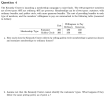 Question 4 The Kennedy Center is launching a membership campaign to raise funds. The 100 prospective members are of two types: 60% are ordinary, 40% are generous. Memberships can be of two types: sustainer, with ordinary benefits, and golden circle, with more generous benefits. The cost of providing benefits to each type of members, and the members' willingness to pay are summarized in the following table (measured in dollars): Cost Sustainer Membership Type Golden Circle Willingness to Pay Ordinary Generous...
Please read the article and answer about questions. You and the Law Business and law are...
Please read the article and answer about questions. You and the Law Business and law are inseparable. For B-Money, the two predictably merged when he was negotiat- ing a deal for his tracks. At other times, the merger is unpredictable, like when your business faces an unexpected auto accident, product recall, or government regulation change. In either type of situation, when business owners know the law, they can better protect themselves and sometimes even avoid the problems completely. This chapter...
SYNOPSIS The product manager for coffee development at Kraft Canada must decide whether to introduce the...
 SYNOPSIS The product manager for coffee development at Kraft Canada must decide whether to introduce the company's new line of single-serve coffee pods or to await results from the product's launch in the United States. Key strategic decisions include choosing the target market to focus on and determining the value proposition to emphasize. Important questions are also raised in regard to how the new product should be branded, the flavors to offer, whether Kraft should use traditional distribution channels or...
 Question 4 The Kennedy Center is launching a membership campaign to raise funds. The 100 prospective members are of two types: 60% are ordinary, 40% are generous. Memberships can be of two types: sustainer, with ordinary benefits, and golden circle, with more generous benefits. The cost of providing benefits to each type of members, and the members' willingness to pay are summarized in the following table (measured in dollars): Cost Sustainer Membership Type Golden Circle Willingness to Pay Ordinary Generous...
 SYNOPSIS The product manager for coffee development at Kraft Canada must decide whether to introduce the company's new line of single-serve coffee pods or to await results from the product's launch in the United States. Key strategic decisions include choosing the target market to focus on and determining the value proposition to emphasize. Important questions are also raised in regard to how the new product should be branded, the flavors to offer, whether Kraft should use traditional distribution channels or...
Most questions answered within 3 hours.
-
Where is the error in this code sequence?
String s1 = "Hello";
String s2 = "ello";...
asked 10 months ago -
Financial data for Joel de Paris, Inc., for last year
follow:
Joel de Paris, Inc.
Balance...
asked 10 months ago -
Consider this reaction:
Al2(SO4)3 (aq)+ BaCl3
(aq) Al2Cl6 (aq)- +
3BaSO4(s) . What is the...
asked 10 months ago -
Suppose that Savneet is considering increasing her
recent random sample from 20 car rentals to 40...
asked 10 months ago -
Trucks arrive at an unloading terminal at an average rate of 120
per hour.
Trucks arrive...
asked 10 months ago -
Why are methanol and ethanol completely soluble in water while
octanol is not very little soluble....
asked 10 months ago -
A facilities manager at a university reads in a research report
that the mean amount of...
asked 10 months ago -
When the CuSO4 is rehydrated by adding water to the anhydrous
compound, is this an endothermic...
asked 10 months ago -
A ray of sunlight is passing from diamond into crown glass; the
angle of incidence is...
asked 10 months ago -
A block of mass 0.249 kg is placed on top of a light, vertical
spring of...
asked 10 months ago -
how do the kidneys compensate in the presences of acidosis
a) trigger hyperventilate
b) reserve acid...
asked 10 months ago -
Question 501 pts
The rental rate of capital to the firm increases. Which of the
following...
asked 10 months ago