PLEASE SHOW WORKING A passenger is on a plane with one stop in Chicago. The arrival...
PLEASE SHOW WORKING
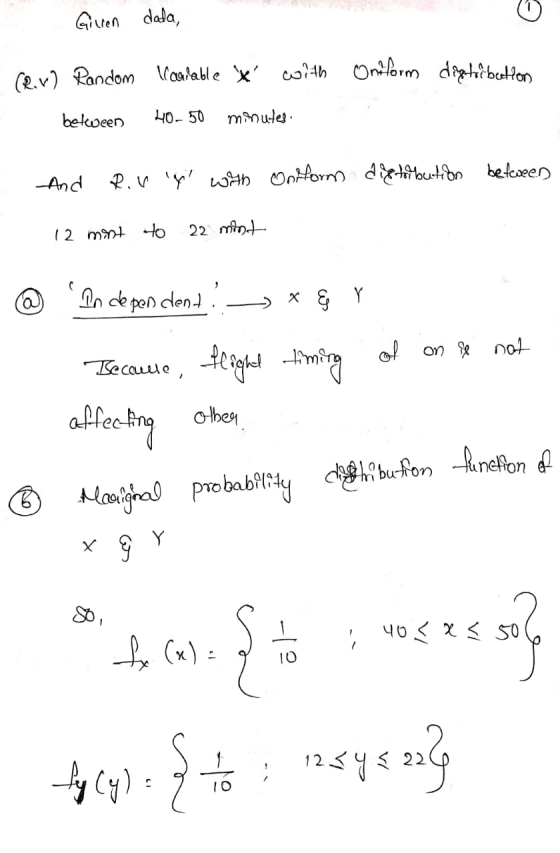
A passenger is on a plane with one stop in Chicago. The arrival time of airplane in Chicago is a random variable X with a uniform distribution between 40-50 minutes. The connecting flight will depart from Chicago in one hour. The time for the passenger to get off the plane and then run the connecting flight before its door is closed will be another random variable Y with a uniform distribution between 12 minutes to 22 minutes.DO
a) are X AND Y INDEPENDENT OR NOT AND WHY?
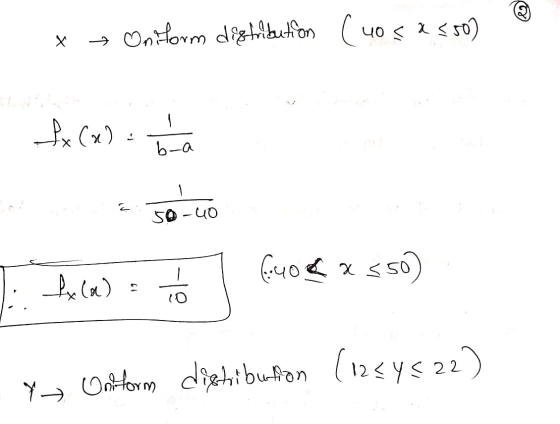
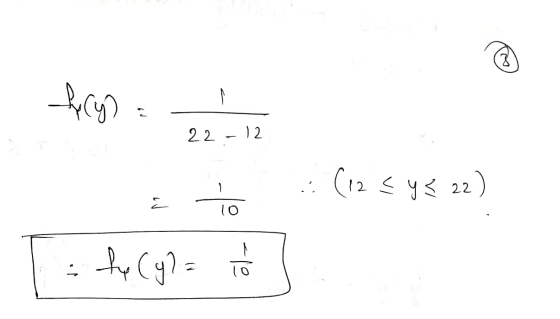
B) Find the marginal probability distribution function of X and the marginal probability distribution function of Y
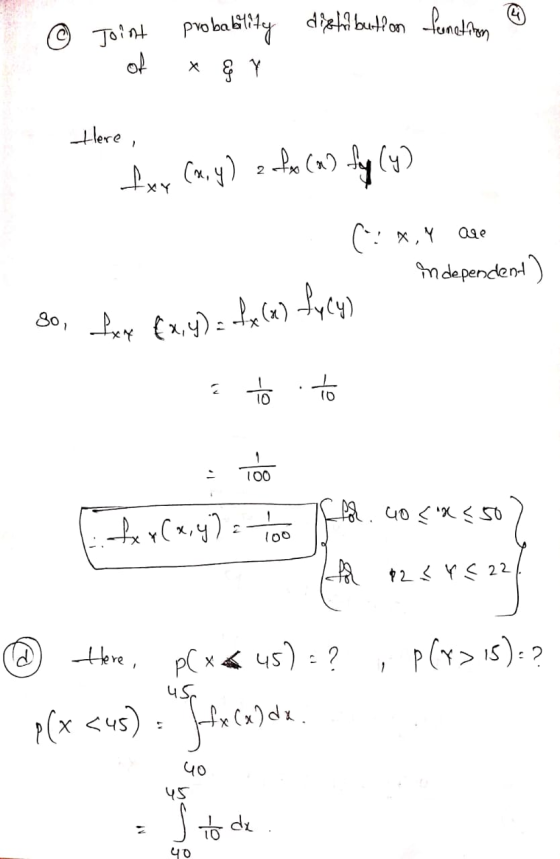
C) Give the joint probability distribution function of X and Y (HINT: since both X and Y have uniform distribution, the joint probability distribution must be constant k)
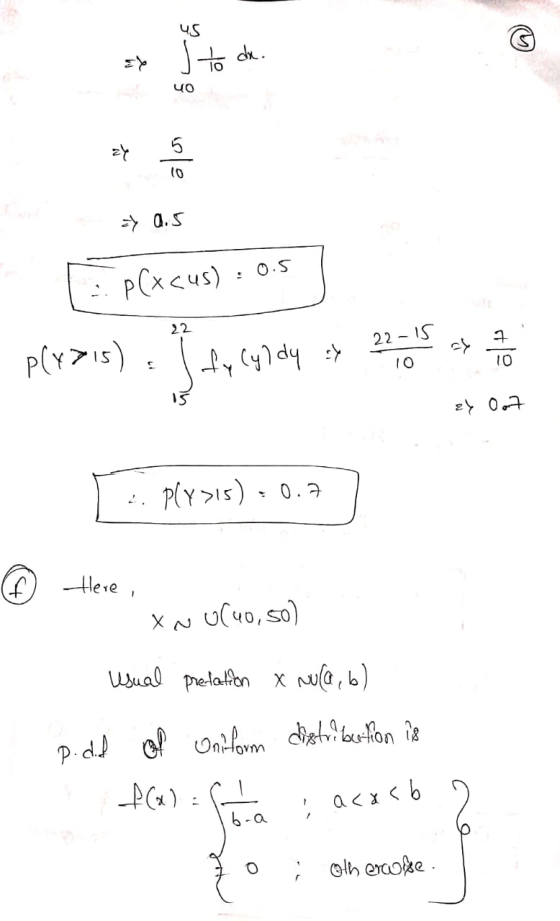
D) What the probability that the plane arrives in less than 45 minutes? What’s the probability that the passenger needs more than 15 minutes to get to the gate of the connecting flight?
E) what the probability that the passenger can catch up the connecting flight?
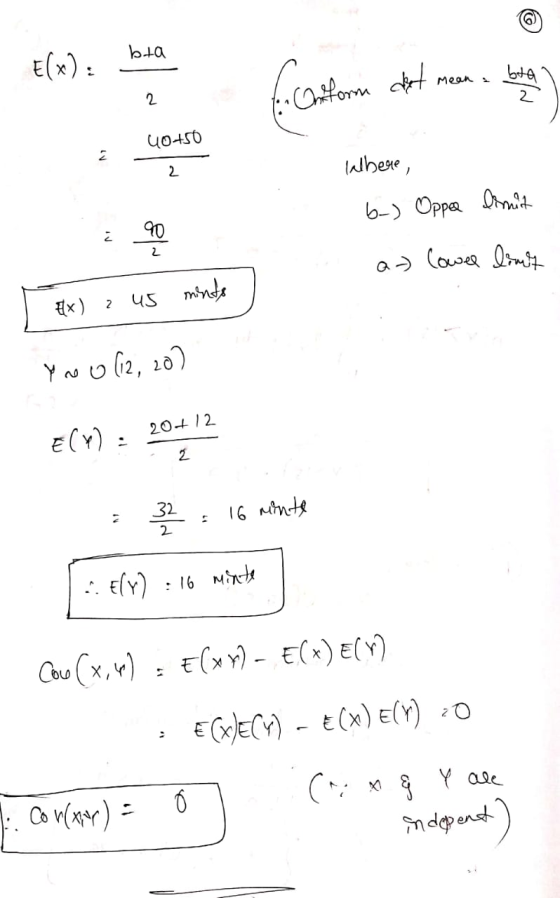
F) E(X)=? And E(Y)=?, COV(X,Y)=?
Homework Answers
Add Answer to:
PLEASE SHOW WORKING
A passenger is on a plane with one stop in Chicago. The arrival...
A bus arrives at a stop every 15 minutes exactly, in a very consistent way, very...
A bus arrives at a stop every 15 minutes exactly, in a very consistent way, very easily drawn. A passenger is not aware of the schedule, and arrives randomly at the stop. Let X represent the number of minutes they wait for the bus to arrive. What type of random variable is X, if the passenger arrives completely randomly at the stop? Circle the correct answer: Discrete Normal Uniform Sketch a picture for X based upon your answer to part...
Let the random variable X and Y have the joint probability density function. fxy(x,y) lo, 3....
 Let the random variable X and Y
have the joint probability density function.
fxy(x,y) lo, 3. Let the random variables X and Y have the joint probability density function fxy(x, y) = 0<y<1, 0<x<y otherwise (a) Compute the joint expectation E(XY). (b) Compute the marginal expectations E(X) and E(Y). (c) Compute the covariance Cov(X,Y).
Let the random variable X and Y
have the joint probability density function.
fxy(x,y) lo, 3. Let the random variables X and Y have the joint probability density function fxy(x, y) = 0<y<1, 0<x<y otherwise (a) Compute the joint expectation E(XY). (b) Compute the marginal expectations E(X) and E(Y). (c) Compute the covariance Cov(X,Y).
Please show how did you came up with the answer, show formulas and work. Also, please do Parts e to i. Thank you so much 1. Consider the following probability mass function for the discrete joint pro...
 Please show how did you came up with the answer, show formulas
and work. Also, please do Parts e to i. Thank you so much
1. Consider the following probability mass function for the discrete joint probability distribution for random variables X and Y where the possible values for X are 0, 1, 2, and 3; and the possible values for Y are 0, 1, 2, 3, and 4. p(x,y) <0 3 0 4 0.01 0 0 0.10 0.05 0.15...
Please show how did you came up with the answer, show formulas
and work. Also, please do Parts e to i. Thank you so much
1. Consider the following probability mass function for the discrete joint probability distribution for random variables X and Y where the possible values for X are 0, 1, 2, and 3; and the possible values for Y are 0, 1, 2, 3, and 4. p(x,y) <0 3 0 4 0.01 0 0 0.10 0.05 0.15...
Exercise about two-dimensional random variables, independence and covariation: Suppose, two-dimensional random variable...
 Exercise about two-dimensional random variables, independence
and covariation:
Suppose, two-dimensional random variable (X, Y) has probability density function as follows: 0y1 + f(x, y) 2xy) ,0 <x<1, otherwise 0 Find c Find marginal probability density functions of X and Y-find f(x) and f(y) and find if X and Y are independent; Find joint (X, Y) distribution function; Find covariation of X and Y find Cov(X, Y) and correlation p(X, Y). What can be concluded?
Suppose, two-dimensional random variable (X, Y)...
Exercise about two-dimensional random variables, independence
and covariation:
Suppose, two-dimensional random variable (X, Y) has probability density function as follows: 0y1 + f(x, y) 2xy) ,0 <x<1, otherwise 0 Find c Find marginal probability density functions of X and Y-find f(x) and f(y) and find if X and Y are independent; Find joint (X, Y) distribution function; Find covariation of X and Y find Cov(X, Y) and correlation p(X, Y). What can be concluded?
Suppose, two-dimensional random variable (X, Y)...
show all work Airlines often oversell their flights. Suppose that for a plane with 50 seats,...
 show all work
Airlines often oversell their flights. Suppose that for a plane with 50 seats, they sold tickets to 55 passengers. Let random variable X be the number of ticketed passengers who actually show up for the flight. Based on the historical data, the airline determines the probability mass function of X in the table below. x 45 46 47 48 49 5 5 52 53 54 55 Px() 0.05 0.1 0.12 0.14 0.25 0.17 0.06 0.05 0.03 0.02...
show all work
Airlines often oversell their flights. Suppose that for a plane with 50 seats, they sold tickets to 55 passengers. Let random variable X be the number of ticketed passengers who actually show up for the flight. Based on the historical data, the airline determines the probability mass function of X in the table below. x 45 46 47 48 49 5 5 52 53 54 55 Px() 0.05 0.1 0.12 0.14 0.25 0.17 0.06 0.05 0.03 0.02...
A step by step solution 2. Suppose X and Y are random variables with joint probability...
 A step by step solution
2. Suppose X and Y are random variables with joint probability density function of the form f(x, y) +y, for 0 S r S 1; and 0 SyS 1 and zero elsewhere. (a) Find the marginal distribution of X and Y. (b) Compute E(X), E(Y); Var(X) and Var(Y). (c) Compute Cov(X, Y). (d) Compute El(2X - Y)
A step by step solution
2. Suppose X and Y are random variables with joint probability density function of the form f(x, y) +y, for 0 S r S 1; and 0 SyS 1 and zero elsewhere. (a) Find the marginal distribution of X and Y. (b) Compute E(X), E(Y); Var(X) and Var(Y). (c) Compute Cov(X, Y). (d) Compute El(2X - Y)
Let the frequency function of the joint distribution of the random variables X and Y P(X...
 Let the frequency function of the joint distribution of the random variables X and Y P(X = 2, Y = 3) = P(X = 1, Y = 2) = P(X = -1, Y = 1) = P(X = 0, Y = -1) = P(X = -1, Y = -2) = 3 a) Determine the marginal distributions of the random variables X and Y. b) Determine Cov(X,Y) and Corr(X,Y). c) Determine the conditional distributions of the random variable Y as a...
Question 4: Let X and Y be two discrete random variables with the following joint probability...
 Question 4: Let X and Y be two discrete random variables with the following joint probability distribution (mass) function Pxy(x, y): a) Complete the following probability table: Y 2 f(x)=P(X=x) 1 3 4 0 0 0.08 0.06 0.05 0.02 0.07 0.08 0.06 0.12 0.05 0.03 0.06 0.05 0.04 0.03 0.01 0.02 0.03 0.04 2 3 foy)=P(Y=y) 0.03 b) What is P(X s 2 and YS 3)? c) Find the marginal probability distribution (mass) function of X; [f(x)]. d) Find the...
15. Problem 15. Show that if pxy (r.v) -Px ()py () for any (r,y) E x x y (independent random vari...
 15. Problem 15. Show that if pxy (r.v) -Px ()py () for any (r,y) E x x y (independent random variables) then: EIXY-EX] E[Y: factorazibility of crpectation values; b) sex.r-sx)+s(): aditinity of entropy Note that pxy (r, y) denotes the probability density function of the joint random variable (x, Y), while px (a) and py (u) are the marginal probability density functions of and Y, respectively. The Shannon eatropy (messured in units of nats) of the joint system (X. Y)...
1. Consider a discrete random variable, X, where the outcome of this random variable is determined...
1. Consider a discrete random variable, X, where the outcome of this random variable is determined by throwing a 6-sided die. X takes on integer values 1,2,…,6. The die is fair. That is, P(X=1)= P(X=2)=…= P(X=6). i. Draw the probability distribution function for this random variable. Carefully label the graph. ii. Draw the cumulative distribution function for X. iii. Calculate the following: P(X=4) P(X≠5) P(X=1 or X=6) P(X4) E(X) Var(X) sd(X) iv. Consider the random variable Y where the outcome...
 Let the random variable X and Y
have the joint probability density function.
fxy(x,y) lo, 3. Let the random variables X and Y have the joint probability density function fxy(x, y) = 0<y<1, 0<x<y otherwise (a) Compute the joint expectation E(XY). (b) Compute the marginal expectations E(X) and E(Y). (c) Compute the covariance Cov(X,Y).
Let the random variable X and Y
have the joint probability density function.
fxy(x,y) lo, 3. Let the random variables X and Y have the joint probability density function fxy(x, y) = 0<y<1, 0<x<y otherwise (a) Compute the joint expectation E(XY). (b) Compute the marginal expectations E(X) and E(Y). (c) Compute the covariance Cov(X,Y).
 Please show how did you came up with the answer, show formulas
and work. Also, please do Parts e to i. Thank you so much
1. Consider the following probability mass function for the discrete joint probability distribution for random variables X and Y where the possible values for X are 0, 1, 2, and 3; and the possible values for Y are 0, 1, 2, 3, and 4. p(x,y) <0 3 0 4 0.01 0 0 0.10 0.05 0.15...
Please show how did you came up with the answer, show formulas
and work. Also, please do Parts e to i. Thank you so much
1. Consider the following probability mass function for the discrete joint probability distribution for random variables X and Y where the possible values for X are 0, 1, 2, and 3; and the possible values for Y are 0, 1, 2, 3, and 4. p(x,y) <0 3 0 4 0.01 0 0 0.10 0.05 0.15...
 Exercise about two-dimensional random variables, independence
and covariation:
Suppose, two-dimensional random variable (X, Y) has probability density function as follows: 0y1 + f(x, y) 2xy) ,0 <x<1, otherwise 0 Find c Find marginal probability density functions of X and Y-find f(x) and f(y) and find if X and Y are independent; Find joint (X, Y) distribution function; Find covariation of X and Y find Cov(X, Y) and correlation p(X, Y). What can be concluded?
Suppose, two-dimensional random variable (X, Y)...
Exercise about two-dimensional random variables, independence
and covariation:
Suppose, two-dimensional random variable (X, Y) has probability density function as follows: 0y1 + f(x, y) 2xy) ,0 <x<1, otherwise 0 Find c Find marginal probability density functions of X and Y-find f(x) and f(y) and find if X and Y are independent; Find joint (X, Y) distribution function; Find covariation of X and Y find Cov(X, Y) and correlation p(X, Y). What can be concluded?
Suppose, two-dimensional random variable (X, Y)...
 show all work
Airlines often oversell their flights. Suppose that for a plane with 50 seats, they sold tickets to 55 passengers. Let random variable X be the number of ticketed passengers who actually show up for the flight. Based on the historical data, the airline determines the probability mass function of X in the table below. x 45 46 47 48 49 5 5 52 53 54 55 Px() 0.05 0.1 0.12 0.14 0.25 0.17 0.06 0.05 0.03 0.02...
show all work
Airlines often oversell their flights. Suppose that for a plane with 50 seats, they sold tickets to 55 passengers. Let random variable X be the number of ticketed passengers who actually show up for the flight. Based on the historical data, the airline determines the probability mass function of X in the table below. x 45 46 47 48 49 5 5 52 53 54 55 Px() 0.05 0.1 0.12 0.14 0.25 0.17 0.06 0.05 0.03 0.02...
 A step by step solution
2. Suppose X and Y are random variables with joint probability density function of the form f(x, y) +y, for 0 S r S 1; and 0 SyS 1 and zero elsewhere. (a) Find the marginal distribution of X and Y. (b) Compute E(X), E(Y); Var(X) and Var(Y). (c) Compute Cov(X, Y). (d) Compute El(2X - Y)
A step by step solution
2. Suppose X and Y are random variables with joint probability density function of the form f(x, y) +y, for 0 S r S 1; and 0 SyS 1 and zero elsewhere. (a) Find the marginal distribution of X and Y. (b) Compute E(X), E(Y); Var(X) and Var(Y). (c) Compute Cov(X, Y). (d) Compute El(2X - Y)
 Let the frequency function of the joint distribution of the random variables X and Y P(X = 2, Y = 3) = P(X = 1, Y = 2) = P(X = -1, Y = 1) = P(X = 0, Y = -1) = P(X = -1, Y = -2) = 3 a) Determine the marginal distributions of the random variables X and Y. b) Determine Cov(X,Y) and Corr(X,Y). c) Determine the conditional distributions of the random variable Y as a...
 Question 4: Let X and Y be two discrete random variables with the following joint probability distribution (mass) function Pxy(x, y): a) Complete the following probability table: Y 2 f(x)=P(X=x) 1 3 4 0 0 0.08 0.06 0.05 0.02 0.07 0.08 0.06 0.12 0.05 0.03 0.06 0.05 0.04 0.03 0.01 0.02 0.03 0.04 2 3 foy)=P(Y=y) 0.03 b) What is P(X s 2 and YS 3)? c) Find the marginal probability distribution (mass) function of X; [f(x)]. d) Find the...
 15. Problem 15. Show that if pxy (r.v) -Px ()py () for any (r,y) E x x y (independent random variables) then: EIXY-EX] E[Y: factorazibility of crpectation values; b) sex.r-sx)+s(): aditinity of entropy Note that pxy (r, y) denotes the probability density function of the joint random variable (x, Y), while px (a) and py (u) are the marginal probability density functions of and Y, respectively. The Shannon eatropy (messured in units of nats) of the joint system (X. Y)...
Most questions answered within 3 hours.
-
Where is the error in this code sequence?
String s1 = "Hello";
String s2 = "ello";...
asked 10 months ago -
Financial data for Joel de Paris, Inc., for last year
follow:
Joel de Paris, Inc.
Balance...
asked 10 months ago -
Consider this reaction:
Al2(SO4)3 (aq)+ BaCl3
(aq) Al2Cl6 (aq)- +
3BaSO4(s) . What is the...
asked 10 months ago -
Suppose that Savneet is considering increasing her
recent random sample from 20 car rentals to 40...
asked 10 months ago -
Trucks arrive at an unloading terminal at an average rate of 120
per hour.
Trucks arrive...
asked 10 months ago -
Why are methanol and ethanol completely soluble in water while
octanol is not very little soluble....
asked 10 months ago -
A facilities manager at a university reads in a research report
that the mean amount of...
asked 10 months ago -
When the CuSO4 is rehydrated by adding water to the anhydrous
compound, is this an endothermic...
asked 10 months ago -
A ray of sunlight is passing from diamond into crown glass; the
angle of incidence is...
asked 10 months ago -
A block of mass 0.249 kg is placed on top of a light, vertical
spring of...
asked 10 months ago -
how do the kidneys compensate in the presences of acidosis
a) trigger hyperventilate
b) reserve acid...
asked 10 months ago -
Question 501 pts
The rental rate of capital to the firm increases. Which of the
following...
asked 10 months ago