
Homework Answers

Add Answer to:
(D) SNU29) + 12 + 2HNO3(14) + NU19) 8) Determine the overall reaction, using Hess's Law...
Hess's Law (b) Given the following thermochemical data: 2HNO3(aq) +A920(s) - H2O(1) +2AgNO3(aq) AH = -44.8...
 Hess's Law (b) Given the following thermochemical data: 2HNO3(aq) +A920(s) - H2O(1) +2AgNO3(aq) AH = -44.8 kJ Ag20(s) - 2Ag(s) + 1/2O2(9) AH = 31.0 kj H20(1) - H2(9)+1/202(9) AH = 285.8 kJ Use Hess's Law to determine AH for the reaction: Ag(s)+HNO3(aq) → 12H2(9)+AgNO3(aq) AH =
6. Hess's Law. Use the data in Table 1 to calculate AH for the reaction below:...
 6. Hess's Law. Use the data in Table 1 to calculate AH for the reaction below: Table 1. Change in Enthalpy for Reactions Reactions Change in Enthalpy (AH) AH = -393.5 kJ/mol (1) C() (2) Hz((g) + + O2(g) O2(g) → CO2(8) → H2O(l) AH2 = -285.8 kJ/mol (3) 2CH.(g) + 702(g) → 4 CO2(g)+ 6H2O(1) AH = -283.0 kJ/mol Calculate the enthalpy change for the reaction: 2 C(s) + 3H2(g) → CzH6(g) AH = kJ/mol
6. Hess's Law. Use the data in Table 1 to calculate AH for the reaction below:...
 6. Hess's Law. Use the data in Table 1 to calculate AH for the reaction below: Table 1. Change in Enthalpy for Reactions Reactions Change in Enthalpy (AH) AH = -393.5 kJ/mol (1) C() (2) Hz((g) + + O2(g) O2(g) → CO2(8) → H2O(l) AH2 = -285.8 kJ/mol (3) 2CH.(g) + 702(g) → 4 CO2(g)+ 6H2O(1) AH = -283.0 kJ/mol Calculate the enthalpy change for the reaction: 2 C(s) + 3H2(g) → CzH6(g) AH = kJ/mol
PROBLEM-SOLVING CLASS ACTIVITY 11 Use Hess's Law to calculate the enthalpy of formation of CH2OH: C(graphite)...
 PROBLEM-SOLVING CLASS ACTIVITY 11 Use Hess's Law to calculate the enthalpy of formation of CH2OH: C(graphite) + 2 H2(g) + 1026) → CH2OH(1) Given the following data: CH2OH() • 02(9) + CO2(g) + 2H2O(1) AH°: -726.4 kJ/mol C(graphite). O2(g) → CO2(9) AH' = -393.5 kJ/mol H2(g) + 40269) → H2O(1) AH = -285.8 kJ/mol
Calculate the enthalpy of the reaction 2NO(g) + O2(g)2NO2(g) Hess's law states that "the heat released or absorbed in a...
 Calculate the enthalpy of the reaction 2NO(g) + O2(g)2NO2(g) Hess's law states that "the heat released or absorbed in a chemical process is the same whether the process takes place in one or in several steps." It is important to recall the following rules: given the following reactions and enthalpies of formation: 1. ¢ N2(g) + O2(g)+NO2(g), AH; = 33.2 kJ 2. N2(g) + O2(g) NO(g), AHB = 90.2 kJ 1. When two reactions are added, their enthalpy values are...
Learning Goal: To understand how to use Hess's law to find the enthalpy of an overall...
 Learning Goal: To understand how to use Hess's law to find the enthalpy of an overall reaction. Correct The change in enthalpy, AH, is the heat absorbed or produced during any reaction at constant pressure. Hess's law states that ? H for an overall reaction is the sum of the values for the individual reactions. For example, if we wanted to know the enthalpy change for the reaction PartB What is the enthalpy for reaction 1 reversed? Express your answer...
Practice with Hess's Law and Standard Heats of Formation 1. (Example) The reaction C2H4 (g) +...
 Practice with Hess's Law and Standard Heats of Formation 1. (Example) The reaction C2H4 (g) + 6 F2 (g) → 2 CF4(g) + 4 HF (g) can be written as the sum of: C2H4 (9) ► 2 C(s) + 2 H2 (g) AH = -52.3 kJ/mol 2 C(s) + 4 F2 (9) ► 2 CF4(9) AH = -1360 kJ/mol 2 H2(g) + 2 F2 (g) → 4 HF (a) AH = -1074 kJ/mol C2H4(g) + 6 F2(g) → 2 CF4(g)...
25) Using Hess's Law, find the ΔGrxn for: 2N2(g) + 502(8)2N2Os(g) Given: H2(g)2(8)H20(0) N05(g) +...
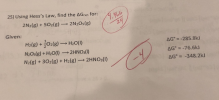 25) Using Hess's Law, find the ΔGrxn for: 2N2(g) + 502(8)2N2Os(g) Given: H2(g)2(8)H20(0) N05(g) + H2O(l) → 2HNO3(I) N2(g) +302(g) + H2(g)2HNO3(l) AG348.2k
25) Using Hess's Law, find the ΔGrxn for: 2N2(g) + 502(8)2N2Os(g) Given: H2(g)2(8)H20(0) N05(g) + H2O(l) → 2HNO3(I) N2(g) +302(g) + H2(g)2HNO3(l) AG348.2k
25) Using Hess's Law, find the ΔGrxn for: 2N2(g) + 502(8)2N2Os(g) Given: H2(g)2(8)H20(0) N05(g) + H2O(l) → 2HNO3(I) N2(g) +302(g) + H2(g)2HNO3(l) AG348.2k
Learning Goal: To understand how to use Hess's law to find the enthalpy of an overall...
Learning Goal: To understand how to use Hess's law to find the enthalpy of an overall reaction. The change in enthalpy, ΔH, is the heat absorbed or produced during any reaction at constant pressure. Hess's law states that ΔH for an overall reaction is the sum of the ΔH values for the individual reactions. For example, if we wanted to know the enthalpy change for the reaction 3Mn+3O2→3MnO2 we could calculate it using the enthalpy values for the following individual...
Using Hess's Law to calculate net reaction enthalpy Dimethycurier, a useful organic solvent, is prepared in...
 Using Hess's Law to calculate net reaction enthalpy Dimethycurier, a useful organic solvent, is prepared in two steps. In the first step, carbon dioxide and hydrogen react to form methanol and water: CO2(g) + 3H2(9) - CH2OH(1) + H2O(1) AH-131. J In the second step, methanol reacts to form dimethyl ether and water: 2 CH,OH(1) - CH,OCH,(9) + H,00 AH8. kJ Calculate the net change in enthalpy for the formation of one mole of dimethyl ether from carbon dioxide and...
 Hess's Law (b) Given the following thermochemical data: 2HNO3(aq) +A920(s) - H2O(1) +2AgNO3(aq) AH = -44.8 kJ Ag20(s) - 2Ag(s) + 1/2O2(9) AH = 31.0 kj H20(1) - H2(9)+1/202(9) AH = 285.8 kJ Use Hess's Law to determine AH for the reaction: Ag(s)+HNO3(aq) → 12H2(9)+AgNO3(aq) AH =
 6. Hess's Law. Use the data in Table 1 to calculate AH for the reaction below: Table 1. Change in Enthalpy for Reactions Reactions Change in Enthalpy (AH) AH = -393.5 kJ/mol (1) C() (2) Hz((g) + + O2(g) O2(g) → CO2(8) → H2O(l) AH2 = -285.8 kJ/mol (3) 2CH.(g) + 702(g) → 4 CO2(g)+ 6H2O(1) AH = -283.0 kJ/mol Calculate the enthalpy change for the reaction: 2 C(s) + 3H2(g) → CzH6(g) AH = kJ/mol
 6. Hess's Law. Use the data in Table 1 to calculate AH for the reaction below: Table 1. Change in Enthalpy for Reactions Reactions Change in Enthalpy (AH) AH = -393.5 kJ/mol (1) C() (2) Hz((g) + + O2(g) O2(g) → CO2(8) → H2O(l) AH2 = -285.8 kJ/mol (3) 2CH.(g) + 702(g) → 4 CO2(g)+ 6H2O(1) AH = -283.0 kJ/mol Calculate the enthalpy change for the reaction: 2 C(s) + 3H2(g) → CzH6(g) AH = kJ/mol
 PROBLEM-SOLVING CLASS ACTIVITY 11 Use Hess's Law to calculate the enthalpy of formation of CH2OH: C(graphite) + 2 H2(g) + 1026) → CH2OH(1) Given the following data: CH2OH() • 02(9) + CO2(g) + 2H2O(1) AH°: -726.4 kJ/mol C(graphite). O2(g) → CO2(9) AH' = -393.5 kJ/mol H2(g) + 40269) → H2O(1) AH = -285.8 kJ/mol
 Calculate the enthalpy of the reaction 2NO(g) + O2(g)2NO2(g) Hess's law states that "the heat released or absorbed in a chemical process is the same whether the process takes place in one or in several steps." It is important to recall the following rules: given the following reactions and enthalpies of formation: 1. ¢ N2(g) + O2(g)+NO2(g), AH; = 33.2 kJ 2. N2(g) + O2(g) NO(g), AHB = 90.2 kJ 1. When two reactions are added, their enthalpy values are...
 Learning Goal: To understand how to use Hess's law to find the enthalpy of an overall reaction. Correct The change in enthalpy, AH, is the heat absorbed or produced during any reaction at constant pressure. Hess's law states that ? H for an overall reaction is the sum of the values for the individual reactions. For example, if we wanted to know the enthalpy change for the reaction PartB What is the enthalpy for reaction 1 reversed? Express your answer...
 Practice with Hess's Law and Standard Heats of Formation 1. (Example) The reaction C2H4 (g) + 6 F2 (g) → 2 CF4(g) + 4 HF (g) can be written as the sum of: C2H4 (9) ► 2 C(s) + 2 H2 (g) AH = -52.3 kJ/mol 2 C(s) + 4 F2 (9) ► 2 CF4(9) AH = -1360 kJ/mol 2 H2(g) + 2 F2 (g) → 4 HF (a) AH = -1074 kJ/mol C2H4(g) + 6 F2(g) → 2 CF4(g)...
 25) Using Hess's Law, find the ΔGrxn for: 2N2(g) + 502(8)2N2Os(g) Given: H2(g)2(8)H20(0) N05(g) + H2O(l) → 2HNO3(I) N2(g) +302(g) + H2(g)2HNO3(l) AG348.2k
25) Using Hess's Law, find the ΔGrxn for: 2N2(g) + 502(8)2N2Os(g) Given: H2(g)2(8)H20(0) N05(g) + H2O(l) → 2HNO3(I) N2(g) +302(g) + H2(g)2HNO3(l) AG348.2k
25) Using Hess's Law, find the ΔGrxn for: 2N2(g) + 502(8)2N2Os(g) Given: H2(g)2(8)H20(0) N05(g) + H2O(l) → 2HNO3(I) N2(g) +302(g) + H2(g)2HNO3(l) AG348.2k
 Using Hess's Law to calculate net reaction enthalpy Dimethycurier, a useful organic solvent, is prepared in two steps. In the first step, carbon dioxide and hydrogen react to form methanol and water: CO2(g) + 3H2(9) - CH2OH(1) + H2O(1) AH-131. J In the second step, methanol reacts to form dimethyl ether and water: 2 CH,OH(1) - CH,OCH,(9) + H,00 AH8. kJ Calculate the net change in enthalpy for the formation of one mole of dimethyl ether from carbon dioxide and...
Most questions answered within 3 hours.
-
Where is the error in this code sequence?
String s1 = "Hello";
String s2 = "ello";...
asked 10 months ago -
Financial data for Joel de Paris, Inc., for last year
follow:
Joel de Paris, Inc.
Balance...
asked 10 months ago -
Consider this reaction:
Al2(SO4)3 (aq)+ BaCl3
(aq) Al2Cl6 (aq)- +
3BaSO4(s) . What is the...
asked 10 months ago -
Suppose that Savneet is considering increasing her
recent random sample from 20 car rentals to 40...
asked 10 months ago -
Trucks arrive at an unloading terminal at an average rate of 120
per hour.
Trucks arrive...
asked 10 months ago -
Why are methanol and ethanol completely soluble in water while
octanol is not very little soluble....
asked 10 months ago -
A facilities manager at a university reads in a research report
that the mean amount of...
asked 10 months ago -
When the CuSO4 is rehydrated by adding water to the anhydrous
compound, is this an endothermic...
asked 10 months ago -
A ray of sunlight is passing from diamond into crown glass; the
angle of incidence is...
asked 10 months ago -
A block of mass 0.249 kg is placed on top of a light, vertical
spring of...
asked 10 months ago -
how do the kidneys compensate in the presences of acidosis
a) trigger hyperventilate
b) reserve acid...
asked 10 months ago -
Question 501 pts
The rental rate of capital to the firm increases. Which of the
following...
asked 10 months ago