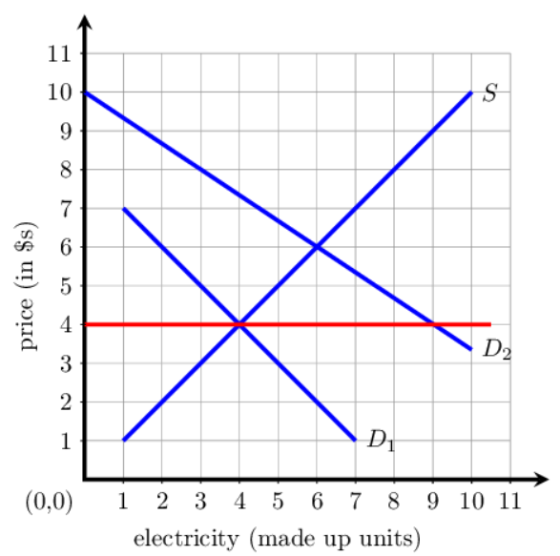
Most people are unaware of electricity rate regulation because, most of the time, those price controls don't bind. For example, suppose that Figure B represents the market for electricity in California in 2001. During a typical Spring demand is at D1, but following an unusually hot Summer demand shifts to D2. Meanwhile, a price ceiling is in place at $4 per unit. By how much does the shortage (excess demand) increase following the shift in demand?
A. 0 units
B. 2 units
C. 5 units
D. 6 units
Homework Answers
Demand curve shifts from D1 to D2.
At a price of $4, quantity supplied is 4 units and quantity demand on D2 is 9 units.
Shortage = Quantity demand - Quantity supplied
Shortage = 9 units - 4 units.
Shortage = 5 units.
Note; When Demand curve is D1, then there is no shortage at a price of$4. Shifts in demand curve from D1 to D2 leads to creates a shortage of 5 units at a price of $4.
Answer: Option (C).
Add Answer to:
Most people are unaware of electricity rate regulation because,
most of the time, those price controls...
CASE 20 Enron: Not Accounting for the Future* INTRODUCTION Once upon a time, there was a...
 CASE 20 Enron: Not Accounting for the Future* INTRODUCTION Once upon a time, there was a gleaming office tower in Houston, Texas. In front of that gleaming tower was a giant "E" slowly revolving, flashing in the hot Texas sun. But in 2001, the Enron Corporation, which once ranked among the top Fortune 500 companies, would collapse under a mountain of debt that had been concealed through a complex scheme of off-balance-sheet partnerships. Forced to declare bankruptcy, the energy firm...
 CASE 20 Enron: Not Accounting for the Future* INTRODUCTION Once upon a time, there was a gleaming office tower in Houston, Texas. In front of that gleaming tower was a giant "E" slowly revolving, flashing in the hot Texas sun. But in 2001, the Enron Corporation, which once ranked among the top Fortune 500 companies, would collapse under a mountain of debt that had been concealed through a complex scheme of off-balance-sheet partnerships. Forced to declare bankruptcy, the energy firm...
Most questions answered within 3 hours.
-
Where is the error in this code sequence?
String s1 = "Hello";
String s2 = "ello";...
asked 11 months ago -
Financial data for Joel de Paris, Inc., for last year
follow:
Joel de Paris, Inc.
Balance...
asked 11 months ago -
Consider this reaction:
Al2(SO4)3 (aq)+ BaCl3
(aq) Al2Cl6 (aq)- +
3BaSO4(s) . What is the...
asked 11 months ago -
Suppose that Savneet is considering increasing her
recent random sample from 20 car rentals to 40...
asked 11 months ago -
Trucks arrive at an unloading terminal at an average rate of 120
per hour.
Trucks arrive...
asked 11 months ago -
Why are methanol and ethanol completely soluble in water while
octanol is not very little soluble....
asked 11 months ago -
A facilities manager at a university reads in a research report
that the mean amount of...
asked 11 months ago -
When the CuSO4 is rehydrated by adding water to the anhydrous
compound, is this an endothermic...
asked 11 months ago -
A ray of sunlight is passing from diamond into crown glass; the
angle of incidence is...
asked 11 months ago -
A block of mass 0.249 kg is placed on top of a light, vertical
spring of...
asked 11 months ago -
how do the kidneys compensate in the presences of acidosis
a) trigger hyperventilate
b) reserve acid...
asked 11 months ago -
Question 501 pts
The rental rate of capital to the firm increases. Which of the
following...
asked 11 months ago