Suppose that Bridget and Erin spend their incomes on only two goods, food (F) and clothing...
- Suppose that Bridget and Erin spend their incomes on only two
goods, food (F) and clothing (C). Bridget’s preferences are
represented by the utility function U(F,C)=10FC
 , while Erin’s
preferences are represented by the utility function
UF,C=5F2C
, while Erin’s
preferences are represented by the utility function
UF,C=5F2C .
.
- With the market basket F=2 and C=5, both Bridget and Erin get 100 unit of utility. Is it correct to say that Bridget and Erin have the same preference (i.e. their indifference curves are the same)? Explain your answer.
- Would you agree that Erin enjoys clothing more than Bridget does when F<4? Apply the concept and derivation of marginal rate of substitution and provide your support to the conclusion.
Homework Answers
(a) Both have different utility functions, and
their utility curve for U=100 intersects at where F=2 and C=5. Yet
the Bridget and Erin's individual utility curves would not
intersect for different utility levels, but comparing both of their
Utility functions, they would intersect where  or
or  or
or  . We have the required graphs as below.
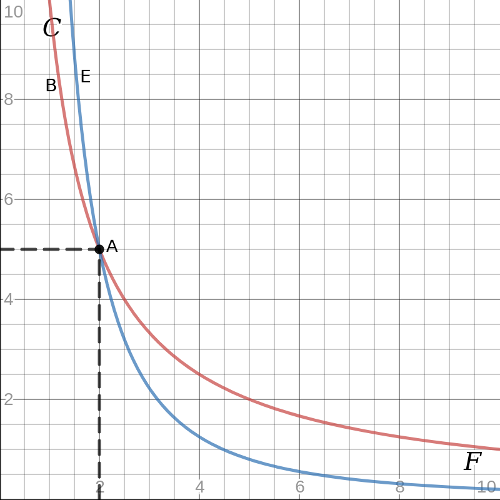
We can see that Bridget's IC (B) is different from Erin's IC (E), its just that when both are at utility level U=100, their IC's intersects at point A, where F=2 and C=5. We can even algebraically see that they have different sets of preferences for the same utility, only except at point A.
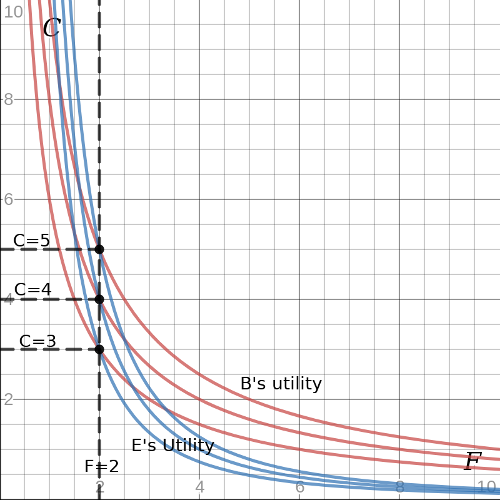
Here we can see different ICs (U = 100,80,60) of B and E, and they intersect at F=2 (as solved above), and at C = 5,4,3.
[Note that we can compare different MRS also to state that
both have different ICs. At F=2 and C=5, Bridget is willing to
forgo  units of C for adding a unit F, while Erin is willing to forgo
 units of C for adding a unit F. But MRS seems to be required in
the next part, so MRS is used in part b.]
units of C for adding a unit F. But MRS seems to be required in
the next part, so MRS is used in part b.]
(b) Bridget's MRS would be as  or
or  or
or  , ie
, ie  .
.
Erin's MRS would be as  or
or  or
or  or
or  , ie
, ie  .
.
We have  since
since  or
or  for any combination of C and F. This means that Erin is willing to
forgo more units of Cs for an additional unit F, than Bridget. This
would mean that Erin enjoys clothes less than Bridget, since Erin
can forgo more clothes than Bridget for the same amount of food, to
remain at the same utility level. Moreover, it doesn't depend on
whether F<4 or not, but is true for all possible combinations of
F and C.
for any combination of C and F. This means that Erin is willing to
forgo more units of Cs for an additional unit F, than Bridget. This
would mean that Erin enjoys clothes less than Bridget, since Erin
can forgo more clothes than Bridget for the same amount of food, to
remain at the same utility level. Moreover, it doesn't depend on
whether F<4 or not, but is true for all possible combinations of
F and C.
Add Answer to:
Suppose that Bridget and Erin spend their incomes on only two
goods, food (F) and clothing...
The utility that Julie receives by consuming food F and clothing C is given by U(F,...
The utility that Julie receives by consuming food F and clothing C is given by U(F, C) = FC. For this utility function, the marginal utilities are MUF = C and MUC = F. a) On a graph with F on the horizontal axis and C on the vertical axis, draw indifference curves for U = 12, U = 18, and U = 24. b) Do the shapes of these indifference curves suggest that Julie has a diminishing marginal rate...
3.10. The utility that Julie receives by consuming food F and clothing C is given by...
3.10. The utility that Julie receives by consuming food F and clothing C is given by U(F, C) = FC. For this utility function, the marginal utilities are MUF = C and MUC = F. a) On a graph with F on the horizontal axis and C on the vertical axis, draw indifference curves for U = 12, U = 18, and U= 24. b) Do the shapes of these indifference curves suggest that Julie has a diminishing marginal rate...
Instructions: Answer the following questions as completely as possible. Write your answer neatly and legibly. When...
Instructions: Answer the following questions as completely as possible. Write your answer neatly and legibly. When drawing a graph, make sure that you label axes and curves, and include appropriate coordinates. Always show your work. Suppose that Bridget and Erin spend their incomes on two goods, food (F) and clothing (C). Bridget’s preferences are represented by the utility function U(F,C) = 10FC, while Erin’s preferences are represented by the utility function U ( F , C ) = 0.20 F^2...
John has preferences for food F and clothing C described by a utility function U(F,C) =...
 John has preferences for food F and clothing C described by a utility function U(F,C) = min (F, 2C). Suppose that food costs $1 a unit and that clothing costs $2 a unit. John has $12 to spend on food and clothing. (10 pts.) a) On a graph, draw indifference curves corresponding to u = 6, u = 10, u = 14. Make sure to label coordinates clearly. Using the graph, find the optimal choice of food and clothing. Let...
Nora consumes only two goods (food and clothing) and her preferences for these goods can be...
Nora consumes only two goods (food and clothing) and her preferences for these goods can be represented by the following utility function UF,C=F2C where F is the quantity of food consumed and C is the amount of clothing consumed respectively. Suppose Nora’s allocated monthly income on the two goods is $M and the prices of the two goods (food and clothing) she prefers are $PF for food and $PC for clothing. Using the above information write Nora’s utility maximization problem...
Question 1: Robert and Erin are trapped on a deserted island with only two goods: Wine...
 Question 1: Robert and Erin are trapped on a deserted island with only two goods: Wine (W) and Crackers (C). Robert currently has 6 bottles of wine and 9 boxes crackers whereas Erin has 9 bottles of wine and 6 boxes of crackers. Robert's preferences are represented by his utility function UR = W0.6C0.4 and Erin's by UE = W0.400.6. Suppose instead that Robert and Erin used a market to trade and that the prices of each good are such...
Question 1: Robert and Erin are trapped on a deserted island with only two goods: Wine...
 Question 1: Robert and Erin are trapped on a deserted island with only two goods: Wine (W) and Crackers (C). Robert currently has 6 bottles of wine and 9 boxes crackers whereas Erin has 9 bottles of wine and 6 boxes of crackers. Robert's preferences are represented by his utility function UR = W0.6C0.4 and Erin's by UE = W0.400.6. (a) Calculate MRSWc for both Robert and Erin. Are they the same or different given their endowments of W and...
If the utility function (U) between food (F) and clothing (C) can be represented as U=...
If the utility function (U) between food (F) and clothing (C) can be represented as U= SQRT(F*C), the marginal rate of substitution of clothing for food will ________ if more food and less clothing are consumed. A) increase in absolute terms B) decrease in absolute terms C) remain the same D) Not enough information.
Robert and Erin are trapped on a deserted island with only two goods: Wine (W) and...
 Robert and Erin are trapped on a deserted island with only two goods: Wine (W) and Crackers (C). Robert currently has 4 bottles of wine and 16 boxes of crackers whereas Erin has 16 bottles of wine and 4 boxes of crackers. Robert's preferences are represented by his utility function UR = W0.5 C0.5 and Erin's by UE = W0.5 C0.5 . Suppose Robert and Erin use a market to trade goods and that Pw = Pc = 1 How...
2 and 3 please. A consumer purchases two goods, food (F) and clothing (C). Her utility...
 2 and 3 please.
A consumer purchases two goods, food (F) and clothing (C). Her utility function is given by U(F,C)= FC +F. The marginal utilities are MU, = C +1 and MUS = F. The price of food is Pc , the price of clothing is Pc, and the consumer's income is I. 1) What is the demand curve for clothing? 2) Is clothing a normal good in this case? Charlie consumes two goods, professional baseball games (B) and...
2 and 3 please.
A consumer purchases two goods, food (F) and clothing (C). Her utility function is given by U(F,C)= FC +F. The marginal utilities are MU, = C +1 and MUS = F. The price of food is Pc , the price of clothing is Pc, and the consumer's income is I. 1) What is the demand curve for clothing? 2) Is clothing a normal good in this case? Charlie consumes two goods, professional baseball games (B) and...
 John has preferences for food F and clothing C described by a utility function U(F,C) = min (F, 2C). Suppose that food costs $1 a unit and that clothing costs $2 a unit. John has $12 to spend on food and clothing. (10 pts.) a) On a graph, draw indifference curves corresponding to u = 6, u = 10, u = 14. Make sure to label coordinates clearly. Using the graph, find the optimal choice of food and clothing. Let...
 Question 1: Robert and Erin are trapped on a deserted island with only two goods: Wine (W) and Crackers (C). Robert currently has 6 bottles of wine and 9 boxes crackers whereas Erin has 9 bottles of wine and 6 boxes of crackers. Robert's preferences are represented by his utility function UR = W0.6C0.4 and Erin's by UE = W0.400.6. Suppose instead that Robert and Erin used a market to trade and that the prices of each good are such...
 Question 1: Robert and Erin are trapped on a deserted island with only two goods: Wine (W) and Crackers (C). Robert currently has 6 bottles of wine and 9 boxes crackers whereas Erin has 9 bottles of wine and 6 boxes of crackers. Robert's preferences are represented by his utility function UR = W0.6C0.4 and Erin's by UE = W0.400.6. (a) Calculate MRSWc for both Robert and Erin. Are they the same or different given their endowments of W and...
 Robert and Erin are trapped on a deserted island with only two goods: Wine (W) and Crackers (C). Robert currently has 4 bottles of wine and 16 boxes of crackers whereas Erin has 16 bottles of wine and 4 boxes of crackers. Robert's preferences are represented by his utility function UR = W0.5 C0.5 and Erin's by UE = W0.5 C0.5 . Suppose Robert and Erin use a market to trade goods and that Pw = Pc = 1 How...
 2 and 3 please.
A consumer purchases two goods, food (F) and clothing (C). Her utility function is given by U(F,C)= FC +F. The marginal utilities are MU, = C +1 and MUS = F. The price of food is Pc , the price of clothing is Pc, and the consumer's income is I. 1) What is the demand curve for clothing? 2) Is clothing a normal good in this case? Charlie consumes two goods, professional baseball games (B) and...
2 and 3 please.
A consumer purchases two goods, food (F) and clothing (C). Her utility function is given by U(F,C)= FC +F. The marginal utilities are MU, = C +1 and MUS = F. The price of food is Pc , the price of clothing is Pc, and the consumer's income is I. 1) What is the demand curve for clothing? 2) Is clothing a normal good in this case? Charlie consumes two goods, professional baseball games (B) and...
Most questions answered within 3 hours.
-
Where is the error in this code sequence?
String s1 = "Hello";
String s2 = "ello";...
asked 11 months ago -
Financial data for Joel de Paris, Inc., for last year
follow:
Joel de Paris, Inc.
Balance...
asked 11 months ago -
Consider this reaction:
Al2(SO4)3 (aq)+ BaCl3
(aq) Al2Cl6 (aq)- +
3BaSO4(s) . What is the...
asked 11 months ago -
Suppose that Savneet is considering increasing her
recent random sample from 20 car rentals to 40...
asked 11 months ago -
Trucks arrive at an unloading terminal at an average rate of 120
per hour.
Trucks arrive...
asked 11 months ago -
Why are methanol and ethanol completely soluble in water while
octanol is not very little soluble....
asked 11 months ago -
A facilities manager at a university reads in a research report
that the mean amount of...
asked 11 months ago -
When the CuSO4 is rehydrated by adding water to the anhydrous
compound, is this an endothermic...
asked 11 months ago -
A ray of sunlight is passing from diamond into crown glass; the
angle of incidence is...
asked 11 months ago -
A block of mass 0.249 kg is placed on top of a light, vertical
spring of...
asked 11 months ago -
how do the kidneys compensate in the presences of acidosis
a) trigger hyperventilate
b) reserve acid...
asked 11 months ago -
Question 501 pts
The rental rate of capital to the firm increases. Which of the
following...
asked 11 months ago