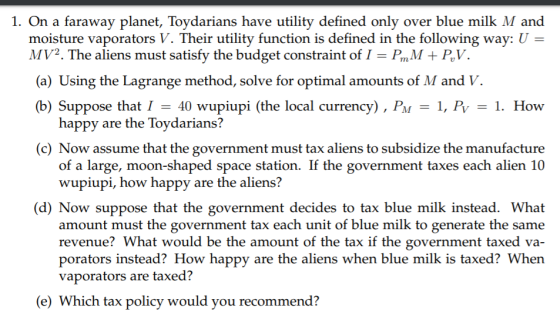
I'm having a hard time understanding the Lagrange method in
general, so any explanation is helpful. For example in part a), I
know that  =
=  ,
,  , and
, and  . But I don't know what to do after that.
Homework Answers
Solution:
a) For Lagrangian method: there is a single equation carrying the objective function (function to be maximized/minimized, eg utility function here) and all the constraints (here only one constraint: the budget constraint). Using this single Lagrangian equation, you solve for the optimizing parameters by taking partial derivatives with respect to them and Lagrangian multiplier(s), and solving for the first order conditions. After this, you reach to the three equations you have mentioned correctly as (taking Lagrangian multiplier as b, instead of lambda for ease of typing):
dL/dM = V2 - b*Pm;
dL/dV = 2MV - b*Pv; and
dL/db = I - Pm*M - Pv*V
Next, we solve for first order conditions (FOC): dL/dx = 0 (x is denoted for any optimizer and Lagrangian multiplier; here x = M, V, b)
Then, FOC gives us following equations:
V2 - b*Pm = 0 ... (i)
2MV - b*Pv = 0 ... (ii)
I - Pm*M - Pv*V = 0 ... (iii) (this is same as budget constraint; under Lagrangian multiplier, FOC corresponding to the multiplier always gives back the respective constraint (with equality))
Rewriting (i) and (ii) for multiplier value:
(i) gives b = V2/Pm, and (ii) gives 2MV/Pv
Using these two, we have V2/Pm = 2MV/Pv
**The above equation further rewritten gives us, V2/2MV = Pm/Pv. Note that this is how the optimal condition of tangency: marginal rate of substitution equal the price ratio (slope of indifference curve equals the slope of budget line) for utility maximization is derived.
So, V = 2M*Pm/Pv
Using this in (iii), we have Pm*M + Pv*(2M*Pm/Pv) = I
3Pm*M = I
M = I/(3*Pm)
Then V = 2*(I/(3*Pm))*Pm/Pv = 2*I/(3*Pv)
b) With I = 40, Pm = $1, and Pv = $1
Then, using part (a)
M = 40/3*1 = 40/3
V = 2*40/(3*1) = 80/3
Then utility level is: U = (40/3)*(80/3)2 = 256000/27 = 9481.48 (approx)
c) With tax of $10 to each alien, income of an alien = 40 - 10 = $30
With this income, new consumption levels are:
M' = 30/3*1 = 10
V' = 2*30/(3*1) = 20
And new utility level = 10*202 = 4000
Clearly, utility level or happiness level has now decreased, as with tax, aliens are able to consume less.
Add Answer to:
I'm having a hard time understanding the Lagrange method in
general, so any explanation is helpful....
1. On a faraway planet, Toydarians have utility defined only over blue milk M and moisture...
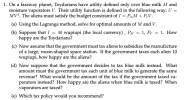 1. On a faraway planet, Toydarians have utility defined only over blue milk M and moisture vaporators V. Their utility function is defined in the following way: U MV2. The aliens must satisfy the budget constraint of I = PmM+P,V. (a) Using the Lagrange method, solve for optimal amounts of M and V. (b) Suppose that I = 40 wupiupi (the local currency), PM 1, Py = 1. How happy are the Toydarians? (c) Now assume that the government must...
 1. On a faraway planet, Toydarians have utility defined only over blue milk M and moisture vaporators V. Their utility function is defined in the following way: U MV2. The aliens must satisfy the budget constraint of I = PmM+P,V. (a) Using the Lagrange method, solve for optimal amounts of M and V. (b) Suppose that I = 40 wupiupi (the local currency), PM 1, Py = 1. How happy are the Toydarians? (c) Now assume that the government must...
Most questions answered within 3 hours.
-
Where is the error in this code sequence?
String s1 = "Hello";
String s2 = "ello";...
asked 11 months ago -
Financial data for Joel de Paris, Inc., for last year
follow:
Joel de Paris, Inc.
Balance...
asked 11 months ago -
Consider this reaction:
Al2(SO4)3 (aq)+ BaCl3
(aq) Al2Cl6 (aq)- +
3BaSO4(s) . What is the...
asked 11 months ago -
Suppose that Savneet is considering increasing her
recent random sample from 20 car rentals to 40...
asked 11 months ago -
Trucks arrive at an unloading terminal at an average rate of 120
per hour.
Trucks arrive...
asked 11 months ago -
Why are methanol and ethanol completely soluble in water while
octanol is not very little soluble....
asked 11 months ago -
A facilities manager at a university reads in a research report
that the mean amount of...
asked 11 months ago -
When the CuSO4 is rehydrated by adding water to the anhydrous
compound, is this an endothermic...
asked 11 months ago -
A ray of sunlight is passing from diamond into crown glass; the
angle of incidence is...
asked 11 months ago -
A block of mass 0.249 kg is placed on top of a light, vertical
spring of...
asked 11 months ago -
how do the kidneys compensate in the presences of acidosis
a) trigger hyperventilate
b) reserve acid...
asked 11 months ago -
Question 501 pts
The rental rate of capital to the firm increases. Which of the
following...
asked 11 months ago