
Homework Answers
We are adding iron (II) chloride to a solution of silver nitrate . The reaction that occurs between them is

The complete ionic equation that takes place can be written as

Hence,  are the spectator ions.
Hence, finally we get a solid precipitate in the form of AgCl.
To calculate the number of Fe(II) cation, since Fe2+ is a spectator ion, its initial concentration after dissolving and before reaction will be same as its final concentration after reaction.
Amount of FeCl2 added = 2.26 g
Molar mass of FeCl2 = 126.751 g/mol
Hence, number of moles of FeCl2 added =

Total volume of the solution, V = 250. mL = 0.250 L
Hence concentration of FeCl2 after dissolving is

Note that each mole of FeCl2 produces 1 mol of Fe(II) cation.
Hence, concentration of Fe(II) cation in the solution is 0.0713 M. Since it is a spectator ion in the reaction that occurs, the final molarity of Fe(II) cation in the solution is 0.0713 M. (rounded to 3 significant figures)
Add Answer to:
please answer question correctly and show your work!
Suppose 2.26 g of Iron(II) chloride is dissolved...
please ! Suppose 1.68 g of iron(II) lodide is dissolved in 250. mL of a 33.0...
 please !
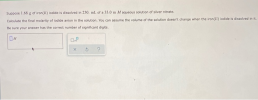
Suppose 1.68 g of iron(II) lodide is dissolved in 250. mL of a 33.0 m M aqueous solution of silver nitrate. Calculate the final molarity of lodide anion in the solution. You can assume the volume of the solution doesn't change when the iron(II) iodide is dissolved in it. Be sure your answer has the correct number of significant digits. OM x 5 ?
please !
Suppose 1.68 g of iron(II) lodide is dissolved in 250. mL of a 33.0 m M aqueous solution of silver nitrate. Calculate the final molarity of lodide anion in the solution. You can assume the volume of the solution doesn't change when the iron(II) iodide is dissolved in it. Be sure your answer has the correct number of significant digits. OM x 5 ?
plz answer and show work Suppose 0.193 g of copper(II) nitrate is dissolved in 350. mL...
 plz
answer and show work
Suppose 0.193 g of copper(II) nitrate is dissolved in 350. mL of a 17.0 m M aqueous solution of sodium chromate. Calculate the final molarity of copper(II) cation in the solution. You can assume the volume of the solution doesn't change when the copper(II) nitrate is dissolved in it. Be sure your answer has the correct number of significant digits. Ом 01
plz
answer and show work
Suppose 0.193 g of copper(II) nitrate is dissolved in 350. mL of a 17.0 m M aqueous solution of sodium chromate. Calculate the final molarity of copper(II) cation in the solution. You can assume the volume of the solution doesn't change when the copper(II) nitrate is dissolved in it. Be sure your answer has the correct number of significant digits. Ом 01
Suppose 0.153 g of iron(II) bromide is dissolved in 50. mL of a 10.0 m M...
 Suppose 0.153 g of iron(II) bromide is dissolved in 50. mL of a 10.0 m M aqueous solution of silver nitrate. Calculate the final molarity of bromide anion in the solution. You can assume the volume of the solution doesn't change when the iron(II) bromide is dissolved in it. Round your answer to 2 significant digits. ПМ x s ?
Suppose 0.509 g of nickel(II) chloride is dissolved in 100. mL of a 23.0 mM aqueous...
Suppose 0.509 g of nickel(II) chloride is dissolved in 100. mL of a 23.0 mM aqueous solution of potassium carbonate. Calculate the final molarity of nickel(II) cation in the solution. You can assume the volume of the solution doesn't change when the nickel(II) chloride is dissolved in it. Be sure your answer has the correct number of significant digits. (M)
Suppose 0.459 g of iron(II) bromide is dissolved in 150. mL of a 18.0 m Maqueous...
 Suppose 0.459 g of iron(II) bromide is dissolved in 150. mL of a 18.0 m Maqueous solution of silver nitrate. Calculate the final molarity of bromide anion in the solution. You can assume the volume of the solution doesn't change when the iron(II) bromide is dissolved in it. Round your answer to 3 significant digits. OM x 6 ?
7. Suppose 2.26 g of zinc chloride is dissolved in 150 ml. of 67.0 mM aqueous...
 7. Suppose 2.26 g of zinc chloride is dissolved in 150 ml. of 67.0 mM aqueous solution of ammonium sulfate. Calculate the final molarity of zinc cation in the solution. You can assume the volume does not change when the zinc chloride is dissolved in it. Round your answer to 3 significant digits.
Suppose 0.425g of sodium chloride is dissolved in 50.mL of a 0.50 M aqueous solution of...
Suppose 0.425g of sodium chloride is dissolved in 50.mL of a 0.50 M aqueous solution of silver nitrate. Calculate the final molarity of chloride anion in the solution. You can assume the volume of the solution doesn't change when the sodium chloride is dissolved in it. Be sure your answer has the correct number of significant digits.
Suppose 2.26 g of zinc chloride is dissolved in 150. mL of 67.0 mM aqueous solution of ammonium sulfate.
Suppose 2.26 g of zinc chloride is dissolved in 150. mL of 67.0 mM aqueous solution of ammonium sulfate. Calculate the final molarity of zinc cation in the solution. You can assume the volume does not change when the zinc chloride is dissolved in it Round your answer to 3 significant digits.
Suppose 0.107 g of potassium chloride is dissolved in 50 mL of a 42.0 mM aqueous solution of silver nitrate.
Suppose 0.107 g of potassium chloride is dissolved in 50 mL of a 42.0 mM aqueous solution of silver nitrate. Calculate the final molarity of chloride anion in the solution. You can assume the volume of the solution doesn't change when the potassium chloride is dissolved in it. Be sure your answer has the correct number of significant digits.
Suppose 0.448 of iron(II) iodide is dissolved in 150. mL of a 16.0 m Maqueous solution...
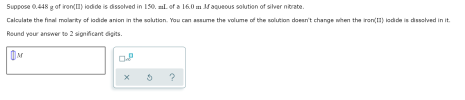 Suppose 0.448 of iron(II) iodide is dissolved in 150. mL of a 16.0 m Maqueous solution of silver nitrate. Calculate the final molarity of iodide anion in the solution. You can assume the volume of the solution doesn't change when the iron(II) iodide is dissolved in it. Round your answer to 2 significant digits. ÜM [xlo Х 5 ?
 please !
Suppose 1.68 g of iron(II) lodide is dissolved in 250. mL of a 33.0 m M aqueous solution of silver nitrate. Calculate the final molarity of lodide anion in the solution. You can assume the volume of the solution doesn't change when the iron(II) iodide is dissolved in it. Be sure your answer has the correct number of significant digits. OM x 5 ?
please !
Suppose 1.68 g of iron(II) lodide is dissolved in 250. mL of a 33.0 m M aqueous solution of silver nitrate. Calculate the final molarity of lodide anion in the solution. You can assume the volume of the solution doesn't change when the iron(II) iodide is dissolved in it. Be sure your answer has the correct number of significant digits. OM x 5 ?
 plz
answer and show work
Suppose 0.193 g of copper(II) nitrate is dissolved in 350. mL of a 17.0 m M aqueous solution of sodium chromate. Calculate the final molarity of copper(II) cation in the solution. You can assume the volume of the solution doesn't change when the copper(II) nitrate is dissolved in it. Be sure your answer has the correct number of significant digits. Ом 01
plz
answer and show work
Suppose 0.193 g of copper(II) nitrate is dissolved in 350. mL of a 17.0 m M aqueous solution of sodium chromate. Calculate the final molarity of copper(II) cation in the solution. You can assume the volume of the solution doesn't change when the copper(II) nitrate is dissolved in it. Be sure your answer has the correct number of significant digits. Ом 01
 Suppose 0.153 g of iron(II) bromide is dissolved in 50. mL of a 10.0 m M aqueous solution of silver nitrate. Calculate the final molarity of bromide anion in the solution. You can assume the volume of the solution doesn't change when the iron(II) bromide is dissolved in it. Round your answer to 2 significant digits. ПМ x s ?
 Suppose 0.459 g of iron(II) bromide is dissolved in 150. mL of a 18.0 m Maqueous solution of silver nitrate. Calculate the final molarity of bromide anion in the solution. You can assume the volume of the solution doesn't change when the iron(II) bromide is dissolved in it. Round your answer to 3 significant digits. OM x 6 ?
 7. Suppose 2.26 g of zinc chloride is dissolved in 150 ml. of 67.0 mM aqueous solution of ammonium sulfate. Calculate the final molarity of zinc cation in the solution. You can assume the volume does not change when the zinc chloride is dissolved in it. Round your answer to 3 significant digits.
 Suppose 0.448 of iron(II) iodide is dissolved in 150. mL of a 16.0 m Maqueous solution of silver nitrate. Calculate the final molarity of iodide anion in the solution. You can assume the volume of the solution doesn't change when the iron(II) iodide is dissolved in it. Round your answer to 2 significant digits. ÜM [xlo Х 5 ?
Most questions answered within 3 hours.
-
Where is the error in this code sequence?
String s1 = "Hello";
String s2 = "ello";...
asked 10 months ago -
Financial data for Joel de Paris, Inc., for last year
follow:
Joel de Paris, Inc.
Balance...
asked 10 months ago -
Consider this reaction:
Al2(SO4)3 (aq)+ BaCl3
(aq) Al2Cl6 (aq)- +
3BaSO4(s) . What is the...
asked 10 months ago -
Suppose that Savneet is considering increasing her
recent random sample from 20 car rentals to 40...
asked 10 months ago -
Trucks arrive at an unloading terminal at an average rate of 120
per hour.
Trucks arrive...
asked 10 months ago -
Why are methanol and ethanol completely soluble in water while
octanol is not very little soluble....
asked 10 months ago -
A facilities manager at a university reads in a research report
that the mean amount of...
asked 10 months ago -
When the CuSO4 is rehydrated by adding water to the anhydrous
compound, is this an endothermic...
asked 10 months ago -
A ray of sunlight is passing from diamond into crown glass; the
angle of incidence is...
asked 10 months ago -
A block of mass 0.249 kg is placed on top of a light, vertical
spring of...
asked 10 months ago -
how do the kidneys compensate in the presences of acidosis
a) trigger hyperventilate
b) reserve acid...
asked 10 months ago -
Question 501 pts
The rental rate of capital to the firm increases. Which of the
following...
asked 10 months ago