Your start-up company needs capital. Right now, you own 100 % of the firm with 9.6...
Your start-up company needs capital. Right now, you own
100 %
of the firm with
9.6
million shares. You have received two offers from venture capitalists. The first offers to invest
$ 2.93
million for
1.11
million new shares. The second offers
$ 2.07
million for
473,000
new shares.
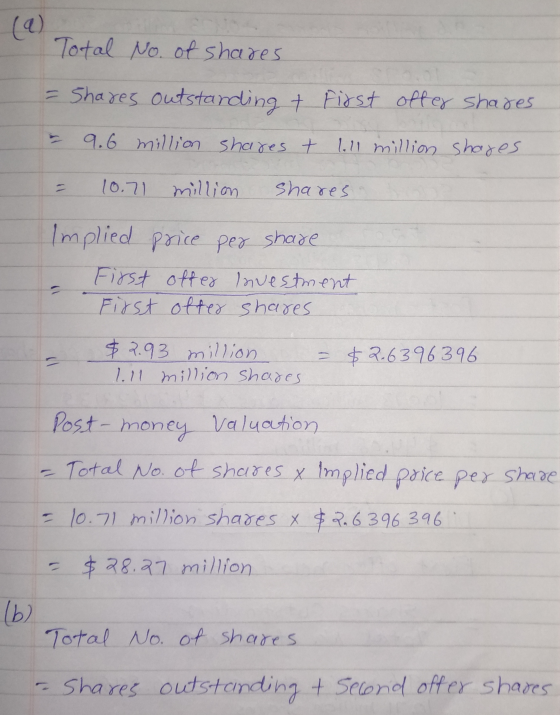
a. What is the first offer's post-money valuation of the firm?
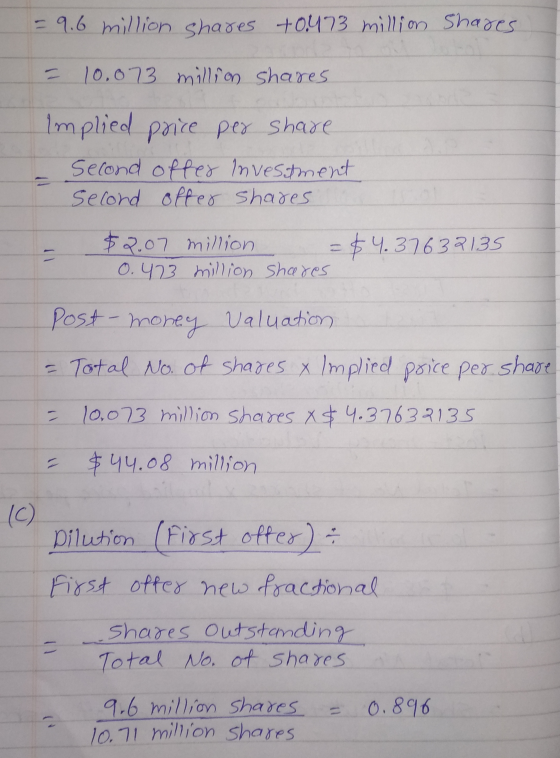
b. What is the second offer's post-money valuation of the firm?
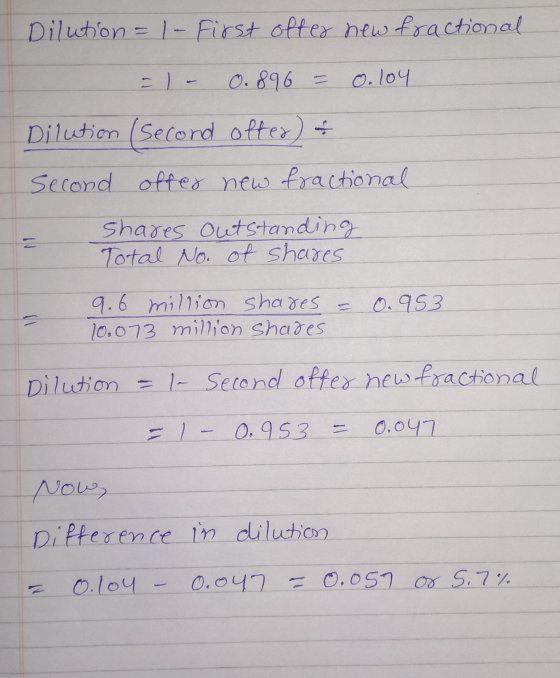
c. What is the difference in the percentage dilution caused by each offer?
Homework Answers
Given,
Shares outstanding = 9.6 million shares
First offer investment = $ 2.93 million
First offer shares = 1.11 million shares
Second offer investment = $ 2.07 million
Second offer shares = 473000 shares or 0.473 million shares
Solution :-
Add Answer to:
Your start-up company needs capital. Right now, you own
100 %
of the firm with
9.6...
Your start-up company needs capital. Right now, you own 100% of the firm with 9.6 million...
 Your start-up company needs capital. Right now, you own 100% of the firm with 9.6 million shares. You have received two offers from venture capitalists. The first offers to invest $3.08 million for 1.09 million new shares. The second offers $1.93 million for 512,000 new shares. a. What is the first offer's post-money valuation of the firm? b. What is the second offer's post-money valuation of the firm? c. What is the difference in the percentage dilution caused by each...
Your start-up company needs capital. Right now, you own 100% of the firm with 10.2 million...
 Your start-up company needs capital. Right now, you own 100% of the firm with 10.2 million shares. You have received two offers from venture capitalists. The first offers to invest $3.07 million for 1.04 million new shares. The second offers $2.03 million for 542,000 new shares. a. What is the first offer's post-money valuation of the firm? b. What is the second offer's post-money valuation of the firm? c. What is the difference in the percentage dilution caused by each...
Your start-up company needs capital. Right now, you own 100% of the firm with 10.2 million...
Your start-up company needs capital. Right now, you own 100% of the firm with 10.2 million shares. You have received two offers from venture capitalists. The first offers to invest $2.92 million for 1.04 million new shares. The second offers $2.08 million for 512,000 new shares. a. What is the first offer's post-money valuation of the firm? b. What is the second offer's post-money valuation of the firm? c. What is the difference in the percentage dilution caused by each...
You founded your own firm three years ago. You initially contributed $200,000 of your own money...
 You founded your own firm three years ago. You initially contributed $200,000 of your own money and in return you received 2 million shares of stock. Since then, you have sold an additional 1 million shares of stock to angel investors. You are now considering raising capital from a venture capital firm. This venture capital firm would invest $5 million and would receive 4 million newly issued shares in return. After the venture capitalist's investment, the post-money valuation of your...
You have started a company and are in lucklong dash—a venture capitalist has offered to invest....
You have started a company and are in lucklong dash—a venture capitalist has offered to invest. You own 100% of the company with 4.57 million shares. The VC offers $1.18 million for 800,000 new shares. a. What is the implied price per share? b. What is the post-money valuation? c. What fraction of the firm will you own after the investment? a. What is the implied price per share? The implied price per share will be $nothing per share. (Round...
You founded your own firm three years ago. You initially contributed $200,000 of your own money...
 You founded your own firm three years ago. You initially contributed $200,000 of your own money and in return you received 1 million shares of stock Since then, you have sold an additional 1 million shares of stock to angel investors. You are now considering raising capital from a venture capital firm. This venture capital firm would invest $4 million and would receive 3 million newly issued shares in retum After the venture capitalist's investment what percentage of the firm...
Example: Funding and Ownership You founded your own firm two years ago. You initially contributed $100,000...
 Example: Funding and Ownership You founded your own firm two years ago. You initially contributed $100,000 of your money and, in return received 1,500,000 shares of stock. Since then, you have sold an additional 500,000 shares to angel investors. You are now considering raising even more capital from a venture capitalist. This venture capitalist would invest $6 million and would receive 3,000,000 newly issued shares. Assuming that this is the venture capitalist's first investment in your company, what percentage of...
Starware Software was founded last year to develop software for gaming applications. The founder initially invested...
Starware Software was founded last year to develop software for gaming applications. The founder initially invested $700,000 and received 10 million shares of stock. Starware now needs to raise a second round of capital, and it has identified a venture capitalist who is interested in investing. This venture capitalist will invest $1.00 million and wants to own 13% of the company after the investment is completed. a. How many shares must the venture capitalist receive to end up with 13%...
Question 27: [Venture Capital Valuation Method] A venture capitalist firm wants to invest $1.5 million in...
Question 27: [Venture Capital Valuation Method] A venture capitalist firm wants to invest $1.5 million in your NYDeli dot.com venture that you started six months ago. You do not expect to make a profit until year four when your net income is expected to be $3 million. The common stock of BioSystems, a “comparable” firm, currently trades in the over-the-counter market at $30 per share. BioSystems’ net income for the most recent year was $300,000 and the firm has 150,000...
You have started a new business and are looking for some start-up capital. You are in...
You have started a new business and are looking for some start-up capital. You are in discussions with a venture angel, and you agree that for a $3 million investment, the VC investor will get a 20% ownership percentage of the company. What is the post-money value of the company? What is the pre-money value of the company?
 Your start-up company needs capital. Right now, you own 100% of the firm with 9.6 million shares. You have received two offers from venture capitalists. The first offers to invest $3.08 million for 1.09 million new shares. The second offers $1.93 million for 512,000 new shares. a. What is the first offer's post-money valuation of the firm? b. What is the second offer's post-money valuation of the firm? c. What is the difference in the percentage dilution caused by each...
 Your start-up company needs capital. Right now, you own 100% of the firm with 10.2 million shares. You have received two offers from venture capitalists. The first offers to invest $3.07 million for 1.04 million new shares. The second offers $2.03 million for 542,000 new shares. a. What is the first offer's post-money valuation of the firm? b. What is the second offer's post-money valuation of the firm? c. What is the difference in the percentage dilution caused by each...
 You founded your own firm three years ago. You initially contributed $200,000 of your own money and in return you received 2 million shares of stock. Since then, you have sold an additional 1 million shares of stock to angel investors. You are now considering raising capital from a venture capital firm. This venture capital firm would invest $5 million and would receive 4 million newly issued shares in return. After the venture capitalist's investment, the post-money valuation of your...
 You founded your own firm three years ago. You initially contributed $200,000 of your own money and in return you received 1 million shares of stock Since then, you have sold an additional 1 million shares of stock to angel investors. You are now considering raising capital from a venture capital firm. This venture capital firm would invest $4 million and would receive 3 million newly issued shares in retum After the venture capitalist's investment what percentage of the firm...
 Example: Funding and Ownership You founded your own firm two years ago. You initially contributed $100,000 of your money and, in return received 1,500,000 shares of stock. Since then, you have sold an additional 500,000 shares to angel investors. You are now considering raising even more capital from a venture capitalist. This venture capitalist would invest $6 million and would receive 3,000,000 newly issued shares. Assuming that this is the venture capitalist's first investment in your company, what percentage of...
Most questions answered within 3 hours.
-
Where is the error in this code sequence?
String s1 = "Hello";
String s2 = "ello";...
asked 11 months ago -
Financial data for Joel de Paris, Inc., for last year
follow:
Joel de Paris, Inc.
Balance...
asked 11 months ago -
Consider this reaction:
Al2(SO4)3 (aq)+ BaCl3
(aq) Al2Cl6 (aq)- +
3BaSO4(s) . What is the...
asked 11 months ago -
Suppose that Savneet is considering increasing her
recent random sample from 20 car rentals to 40...
asked 11 months ago -
Trucks arrive at an unloading terminal at an average rate of 120
per hour.
Trucks arrive...
asked 11 months ago -
Why are methanol and ethanol completely soluble in water while
octanol is not very little soluble....
asked 11 months ago -
A facilities manager at a university reads in a research report
that the mean amount of...
asked 11 months ago -
When the CuSO4 is rehydrated by adding water to the anhydrous
compound, is this an endothermic...
asked 11 months ago -
A ray of sunlight is passing from diamond into crown glass; the
angle of incidence is...
asked 11 months ago -
A block of mass 0.249 kg is placed on top of a light, vertical
spring of...
asked 11 months ago -
how do the kidneys compensate in the presences of acidosis
a) trigger hyperventilate
b) reserve acid...
asked 11 months ago -
Question 501 pts
The rental rate of capital to the firm increases. Which of the
following...
asked 11 months ago