

Homework Answers

Add Answer to:
- Structure of sty with lone pair in equatorial position 3-D structure with lone pair in...
Lone pair of electrons prefer axial over equatorial position in the compound with trigonal bipyramidal geometry....
 Lone pair of electrons prefer axial over equatorial position in the compound with trigonal bipyramidal geometry. a. True b. False
letter e please 3. Stability of Axial vs. Equatorial Lone-Pairs in Trigonal Bipyramidal Structures: SF. Useful...
 letter e please
3. Stability of Axial vs. Equatorial Lone-Pairs in Trigonal Bipyramidal Structures: SF. Useful conversion factors: o 1 au = 627.5096 kcal/mol = 2,625 50 kJ/mol a. Based on the Spartan data, which structure of SF. is more stable? (Circle one.) SF. w/ lone pair in axial position (SF, w/ lone pair in equitorial position How do you know which is more stable? more neseline value = more Shtle b. Energy of the axial lone-pair structure in au)?...
letter e please
3. Stability of Axial vs. Equatorial Lone-Pairs in Trigonal Bipyramidal Structures: SF. Useful conversion factors: o 1 au = 627.5096 kcal/mol = 2,625 50 kJ/mol a. Based on the Spartan data, which structure of SF. is more stable? (Circle one.) SF. w/ lone pair in axial position (SF, w/ lone pair in equitorial position How do you know which is more stable? more neseline value = more Shtle b. Energy of the axial lone-pair structure in au)?...
in sf4, does the loan electron pair occupy an axial in the molecule or an equatorial position? how does this affect the...
in sf4, does the loan electron pair occupy an axial in the molecule or an equatorial position? how does this affect the bond angles in the molecule? explain.
Select all the statements that correctly explain why lone pairs prefer to occupy equatorial positions in...
 Select all the statements that correctly explain why lone pairs prefer to occupy equatorial positions in a system with five electron domains. Check all that apply. A larger bond angle leads to more electron repulsion. Alone pair in an axial position will be too far away from the other electron pairs. There is less repulsion between electron domains in equatorial positions. Alone pair in an equatorial position has more space. Do you know the answer? Match each molecular geometry correctly...
-The lone pairs on are located all on the axial positions. all on the equatorial positions....
-The lone pairs on are located all on the axial positions. all on the equatorial positions. two on the axial and one on the equatorial position. two on the equatorial and one on the axial position. -A orbital's energy is lower than the orbital. is lower than the original s orbital. is higher than the original s orbital. depends on the atom. -If an atom has hybridization, it has four orbitals. one s and three p orbitals. three hybridized p...
3, Variations on AXs, steric number (SN) Types AX4E (seesaw), AXsE2 (T-shaped), and AX2Es (linear) In...
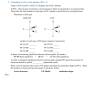 3, Variations on AXs, steric number (SN) Types AX4E (seesaw), AXsE2 (T-shaped), and AX2Es (linear) In PC14, the lone pair of electrons can be placed in either an equatorial or an axial position. Determine the total number of each type of 90° repulsive interactions for each placement. 5 Placement of lone pair equatorial axial number of each type of 90 degree repulsive interactions 90 LP-LP 90° LP-BP 90° LP-BP 90° LP-LP- 90° LP-BP 90° LP-BP In terms of increasing repulsions...
Consider the molecule AX5, where the central atom A has no lone pairs. X represents the...
Consider the molecule AX5, where the central atom A has no lone pairs. X represents the outer atoms, all identical to each other. How many of the following statements are correct? A. The central atom A utilizes its outermost ns orbital, all three of its outermost np orbitals, and two of its (n – 1)d orbitals for bonding. B. The A-X equatorial bond length is shorter than the A-X axial bond length. C. Suppose in AX5 a lone pair was...
Draw a Lewis structure of CIF,. Show the location of atoms and any lone pairs of...
 Draw a Lewis structure of CIF,. Show the location of atoms and any lone pairs of electrons. In CIF, the two lone pairs of electrons can be placed one axial and one equatorial, both equatorial, or both axial. Determine the total number of each type of 90° repulsive interac- tion for each placement. F:
1. Which position is more stable for the methyl group in methylcyclohexane: an equatorial position...
1. Which position is more stable for the methyl group in methylcyclohexane: an equatorial position or an axial position? Explain your answer. 2. Draw the Fisher projections for the pair of enantiomers of lactic acid, CH3–CH(OH)–COOH. 3. For 2,3-dibromobutane: a. How many stereoisomers are possible for the compound? Br Br | | CH3–CH–CH–CH3 b. Draw Fisher projections for each stereoisomer, label enantiomers. Label any meso 4. Determine the relationship between the following pairs of...
Each cyclic structure shown below contains a heteroatom that has lone-pair electrons. For each structure, answer the following questions: Are the lone-pair electrons delocalized? Is the structure aromatic?
 Each cyclic structure shown below contains a heteroatom that has lone-pair electrons. For each structure, answer the following questions: Are the lone-pair electrons delocalized? Is the structure aromatic?
 Lone pair of electrons prefer axial over equatorial position in the compound with trigonal bipyramidal geometry. a. True b. False
 letter e please
3. Stability of Axial vs. Equatorial Lone-Pairs in Trigonal Bipyramidal Structures: SF. Useful conversion factors: o 1 au = 627.5096 kcal/mol = 2,625 50 kJ/mol a. Based on the Spartan data, which structure of SF. is more stable? (Circle one.) SF. w/ lone pair in axial position (SF, w/ lone pair in equitorial position How do you know which is more stable? more neseline value = more Shtle b. Energy of the axial lone-pair structure in au)?...
letter e please
3. Stability of Axial vs. Equatorial Lone-Pairs in Trigonal Bipyramidal Structures: SF. Useful conversion factors: o 1 au = 627.5096 kcal/mol = 2,625 50 kJ/mol a. Based on the Spartan data, which structure of SF. is more stable? (Circle one.) SF. w/ lone pair in axial position (SF, w/ lone pair in equitorial position How do you know which is more stable? more neseline value = more Shtle b. Energy of the axial lone-pair structure in au)?...
 Select all the statements that correctly explain why lone pairs prefer to occupy equatorial positions in a system with five electron domains. Check all that apply. A larger bond angle leads to more electron repulsion. Alone pair in an axial position will be too far away from the other electron pairs. There is less repulsion between electron domains in equatorial positions. Alone pair in an equatorial position has more space. Do you know the answer? Match each molecular geometry correctly...
 3, Variations on AXs, steric number (SN) Types AX4E (seesaw), AXsE2 (T-shaped), and AX2Es (linear) In PC14, the lone pair of electrons can be placed in either an equatorial or an axial position. Determine the total number of each type of 90° repulsive interactions for each placement. 5 Placement of lone pair equatorial axial number of each type of 90 degree repulsive interactions 90 LP-LP 90° LP-BP 90° LP-BP 90° LP-LP- 90° LP-BP 90° LP-BP In terms of increasing repulsions...
 Draw a Lewis structure of CIF,. Show the location of atoms and any lone pairs of electrons. In CIF, the two lone pairs of electrons can be placed one axial and one equatorial, both equatorial, or both axial. Determine the total number of each type of 90° repulsive interac- tion for each placement. F:
Most questions answered within 3 hours.
-
Where is the error in this code sequence?
String s1 = "Hello";
String s2 = "ello";...
asked 10 months ago -
Financial data for Joel de Paris, Inc., for last year
follow:
Joel de Paris, Inc.
Balance...
asked 10 months ago -
Consider this reaction:
Al2(SO4)3 (aq)+ BaCl3
(aq) Al2Cl6 (aq)- +
3BaSO4(s) . What is the...
asked 10 months ago -
Suppose that Savneet is considering increasing her
recent random sample from 20 car rentals to 40...
asked 10 months ago -
Trucks arrive at an unloading terminal at an average rate of 120
per hour.
Trucks arrive...
asked 10 months ago -
Why are methanol and ethanol completely soluble in water while
octanol is not very little soluble....
asked 10 months ago -
A facilities manager at a university reads in a research report
that the mean amount of...
asked 10 months ago -
When the CuSO4 is rehydrated by adding water to the anhydrous
compound, is this an endothermic...
asked 10 months ago -
A ray of sunlight is passing from diamond into crown glass; the
angle of incidence is...
asked 10 months ago -
A block of mass 0.249 kg is placed on top of a light, vertical
spring of...
asked 10 months ago -
how do the kidneys compensate in the presences of acidosis
a) trigger hyperventilate
b) reserve acid...
asked 10 months ago -
Question 501 pts
The rental rate of capital to the firm increases. Which of the
following...
asked 10 months ago