
Homework Answers
Add Answer to:
< Question 4 of 15 > Suppose you are asked to determine the identity of a...
Suppose you are asked to determine the identity of a white solid. When you add water...
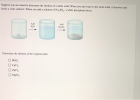 Suppose you are asked to determine the identity of a white solid. When you add water to the white solid, it dissolves and forms a clear solution. When you add a solution of Na, so , a white precipitate forms. Add HO Add Na SO Determine the identity of the original solid, OPCI, OCaCI, ZnCl2 MgCl2
Suppose you are asked to determine the identity of a white solid. When you add water...
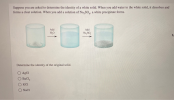 Suppose you are asked to determine the identity of a white solid. When you add water to the white solid, it dissolves and forms a clear solution. When you add a solution of Na,so, a white precipitate forms. Add Add HO Na, SO Determine the identity of the original solid. OAgCI ОBaCl, OKCI Naci
Suppose you have an unknown clear, colorless solution. In attempt to identify it, you add NaOH...
 Suppose you have an unknown clear, colorless solution. In attempt to identify it, you add NaOH dropwise and find that a white gelatinous precipitate forms, but when more NaOH was added the precipitate dissolved again. To another test tube of the same unknown solution is added AgNO3 dropwise, and a white precipitate forms. What salt most likely comprises the unknown solution? Explain your reasoning (3 points) 2. Suppose you have a different unknown solution that you know to be 50/50...
Suppose you have an unknown clear, colorless solution. In attempt to identify it, you add NaOH dropwise...
Suppose you have an unknown clear, colorless solution. In attempt to identify it, you add NaOH dropwise and find that a white gelatinous precipitate forms, but when more NaOH was added the precipitate dissolved again. To another test tube of the same unknown solution is added AgNO3 dropwise, and a white precipitate forms. What salt most likely comprises the unknown solution? Explain your reasoning.
Lab Section: 1 Prelab: Inorganic Group I Ions 1. On the report sheet, complete the flow...
 Lab Section: 1 Prelab: Inorganic Group I Ions 1. On the report sheet, complete the flow diagram for the separation and identification of the ions in Group I 2. Write balanced net ionic equations for the following reactions: The precipitation of the chloride of Pb a. in Step 1. The formation of a yellow precipitate in Step 4. b. The formation of a complex ion in Step 5. c. d. The reaction that forms a white precipitate in Step 5....
1) Suppose you are trying to determine the identity of the metal ions in your unknown...
 1) Suppose you are trying to determine the identity of the metal
ions in your unknown mixture for this lab and you find that after
step 1 you have a precipitate. You separate the precipitate from
the solution and perform step 2 (on the precipitate) and step 3 (on
the solution). Your results of step 2 do not yield a precipitate.
Your results from step 3 yield a precipitate. Which spot tests
should you run to completely determine the identities...
1) Suppose you are trying to determine the identity of the metal
ions in your unknown mixture for this lab and you find that after
step 1 you have a precipitate. You separate the precipitate from
the solution and perform step 2 (on the precipitate) and step 3 (on
the solution). Your results of step 2 do not yield a precipitate.
Your results from step 3 yield a precipitate. Which spot tests
should you run to completely determine the identities...
3. What tests would you use to identify a solution of FeCl3? 4. A flame test of a colorless solution gives a bright...
 3. What tests would you use to identify a solution of FeCl3? 4. A flame test of a colorless solution gives a bright yellow color. When reacted with AgNO, a white precipitate forms that dissolves when HNO, is added. When HCl is added to the unknown solution, bubbles form. What is the compound in the colorless solution?
Post-Lab Questions: 1. If you had a solution which contained only chloride, bromide, or iodide ion,...
 Post-Lab Questions: 1. If you had a solution which contained only chloride, bromide, or iodide ion, which of the three tests would most clearly tell you which anion was in the solution? Explain. 2.) Suppose that you were quite sure that your unknown centained only sulfate ion. Which test would most quickly 3. Consider each set of results below which were carried out on a solution containing either (1)one of the six anions studied in this experiment, or (2) none...
please complete the flow diagram (only question number 1) the role of Name Lab Section 1...
 please complete the flow diagram (only question number 1)
the role of Name Lab Section 1 2 3 4 Prelab: Inorganic Group I lons 1. On the report sheet, complete the flow diagram for the separation and identification of the ions in Group I. 2. Write balanced net ionic equations for the following reactions: a. The precipitation of the chloride of Pb in Step 1. b. The formation of a yellow precipitate in Step 4. C. The formation of a...
please complete the flow diagram (only question number 1)
the role of Name Lab Section 1 2 3 4 Prelab: Inorganic Group I lons 1. On the report sheet, complete the flow diagram for the separation and identification of the ions in Group I. 2. Write balanced net ionic equations for the following reactions: a. The precipitation of the chloride of Pb in Step 1. b. The formation of a yellow precipitate in Step 4. C. The formation of a...
Post-Lab Questions: 1. If you had a solution which contained only chloride, bromide, or iodide ion,...
 Post-Lab Questions: 1. If you had a solution which contained only chloride, bromide, or iodide ion, which of the three tests would most clearly tell you which anion was in the solution? Explain. 2.) Suppose that you were quite sure that your unknown contained only sulfate ion. Which test would most quickly (that is, in the fewest steps) confirm your hypothesis? Explain. Consider each set of results below which were carried out on a solution containing either (1)one of the...
 Suppose you are asked to determine the identity of a white solid. When you add water to the white solid, it dissolves and forms a clear solution. When you add a solution of Na, so , a white precipitate forms. Add HO Add Na SO Determine the identity of the original solid, OPCI, OCaCI, ZnCl2 MgCl2
 Suppose you are asked to determine the identity of a white solid. When you add water to the white solid, it dissolves and forms a clear solution. When you add a solution of Na,so, a white precipitate forms. Add Add HO Na, SO Determine the identity of the original solid. OAgCI ОBaCl, OKCI Naci
 Suppose you have an unknown clear, colorless solution. In attempt to identify it, you add NaOH dropwise and find that a white gelatinous precipitate forms, but when more NaOH was added the precipitate dissolved again. To another test tube of the same unknown solution is added AgNO3 dropwise, and a white precipitate forms. What salt most likely comprises the unknown solution? Explain your reasoning (3 points) 2. Suppose you have a different unknown solution that you know to be 50/50...
 Lab Section: 1 Prelab: Inorganic Group I Ions 1. On the report sheet, complete the flow diagram for the separation and identification of the ions in Group I 2. Write balanced net ionic equations for the following reactions: The precipitation of the chloride of Pb a. in Step 1. The formation of a yellow precipitate in Step 4. b. The formation of a complex ion in Step 5. c. d. The reaction that forms a white precipitate in Step 5....
 1) Suppose you are trying to determine the identity of the metal
ions in your unknown mixture for this lab and you find that after
step 1 you have a precipitate. You separate the precipitate from
the solution and perform step 2 (on the precipitate) and step 3 (on
the solution). Your results of step 2 do not yield a precipitate.
Your results from step 3 yield a precipitate. Which spot tests
should you run to completely determine the identities...
1) Suppose you are trying to determine the identity of the metal
ions in your unknown mixture for this lab and you find that after
step 1 you have a precipitate. You separate the precipitate from
the solution and perform step 2 (on the precipitate) and step 3 (on
the solution). Your results of step 2 do not yield a precipitate.
Your results from step 3 yield a precipitate. Which spot tests
should you run to completely determine the identities...
 3. What tests would you use to identify a solution of FeCl3? 4. A flame test of a colorless solution gives a bright yellow color. When reacted with AgNO, a white precipitate forms that dissolves when HNO, is added. When HCl is added to the unknown solution, bubbles form. What is the compound in the colorless solution?
 Post-Lab Questions: 1. If you had a solution which contained only chloride, bromide, or iodide ion, which of the three tests would most clearly tell you which anion was in the solution? Explain. 2.) Suppose that you were quite sure that your unknown centained only sulfate ion. Which test would most quickly 3. Consider each set of results below which were carried out on a solution containing either (1)one of the six anions studied in this experiment, or (2) none...
 please complete the flow diagram (only question number 1)
the role of Name Lab Section 1 2 3 4 Prelab: Inorganic Group I lons 1. On the report sheet, complete the flow diagram for the separation and identification of the ions in Group I. 2. Write balanced net ionic equations for the following reactions: a. The precipitation of the chloride of Pb in Step 1. b. The formation of a yellow precipitate in Step 4. C. The formation of a...
please complete the flow diagram (only question number 1)
the role of Name Lab Section 1 2 3 4 Prelab: Inorganic Group I lons 1. On the report sheet, complete the flow diagram for the separation and identification of the ions in Group I. 2. Write balanced net ionic equations for the following reactions: a. The precipitation of the chloride of Pb in Step 1. b. The formation of a yellow precipitate in Step 4. C. The formation of a...
 Post-Lab Questions: 1. If you had a solution which contained only chloride, bromide, or iodide ion, which of the three tests would most clearly tell you which anion was in the solution? Explain. 2.) Suppose that you were quite sure that your unknown contained only sulfate ion. Which test would most quickly (that is, in the fewest steps) confirm your hypothesis? Explain. Consider each set of results below which were carried out on a solution containing either (1)one of the...
Most questions answered within 3 hours.
-
Where is the error in this code sequence?
String s1 = "Hello";
String s2 = "ello";...
asked 11 months ago -
Financial data for Joel de Paris, Inc., for last year
follow:
Joel de Paris, Inc.
Balance...
asked 11 months ago -
Consider this reaction:
Al2(SO4)3 (aq)+ BaCl3
(aq) Al2Cl6 (aq)- +
3BaSO4(s) . What is the...
asked 11 months ago -
Suppose that Savneet is considering increasing her
recent random sample from 20 car rentals to 40...
asked 11 months ago -
Trucks arrive at an unloading terminal at an average rate of 120
per hour.
Trucks arrive...
asked 11 months ago -
Why are methanol and ethanol completely soluble in water while
octanol is not very little soluble....
asked 11 months ago -
A facilities manager at a university reads in a research report
that the mean amount of...
asked 11 months ago -
When the CuSO4 is rehydrated by adding water to the anhydrous
compound, is this an endothermic...
asked 11 months ago -
A ray of sunlight is passing from diamond into crown glass; the
angle of incidence is...
asked 11 months ago -
A block of mass 0.249 kg is placed on top of a light, vertical
spring of...
asked 11 months ago -
how do the kidneys compensate in the presences of acidosis
a) trigger hyperventilate
b) reserve acid...
asked 11 months ago -
Question 501 pts
The rental rate of capital to the firm increases. Which of the
following...
asked 11 months ago