
I want help to solve this question
Homework Answers
(5)
B: Event of the at least once the outcome "heads" in three independent tosses of fair coin
A : Event of obtaining "heads" three times
Knowing that we obtained at least once the outcome "heads in three independent tosses of a fair coin,
Probability that we obtained "heads" three time = P(A|B)
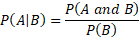
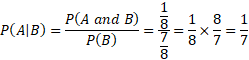
P(A and B) = P((Heads three times ) and (at least one head) ) = P(Heads three times) = (1/2)x(1/2)x(1/2) =1/8
Event (Heads three times ) and (at least one head) can only happen when event all three heads happen
P(B) = Probability of at least one head = 1 -Probability of obtaining "tails" three times = 1-(1/2x1/2x1/2) =1-1/8=7/8
Knowing that we obtained at least once the outcome "heads in
three independent tosses of a fair coin, Probability that we
obtained "heads" three time = 
Add Answer to:
I want help to solve this question
(5) Knowing that we obtained at least once the...
Suppose that a coin is tossed three times. We assume that a coin is fair, so...
Suppose that a coin is tossed three times. We assume that a coin is fair, so that the heads and tails are equally likely. Probability that two heads are obtained in three tosses given that at least one head is obtained in three tosses is ___________ Probability that that one head is obtained in three tosses given that at most one head is obtained in three tosses is ____________ at least one means one or more, at most one means...
This is discrete mathematics If you do it right, I must give praise. You must use probability spa...
 This is discrete mathematics
If you do it right, I must give praise.
You must
use probability space is a triple relative
acknowledge.
S: is a
sample sapce
E=p(s) is
the set of all events
P:
E-->R is a function.
The important thing that I need to say three times:
If you don't know how to do it, please don't do
it.
don't copy others,
especially for question (a), give sample space, probability
measure
The important thing that I need...
This is discrete mathematics
If you do it right, I must give praise.
You must
use probability space is a triple relative
acknowledge.
S: is a
sample sapce
E=p(s) is
the set of all events
P:
E-->R is a function.
The important thing that I need to say three times:
If you don't know how to do it, please don't do
it.
don't copy others,
especially for question (a), give sample space, probability
measure
The important thing that I need...
I want help to solve this question (3) A fair die is rolled twice, independently. (a)...
 I want help to solve this question
(3) A fair die is rolled twice, independently. (a) Consider the events: A = "the first number that show up is a 6"| B = "the sum of the two numbers obtained is equal to 7" C=" the sum of the two numbers obtained is equal to 7 or 11“ (i) Calculate P(BIC) (ii) Calculate P(A|B) (iii) Are A and B independent events? (b) Considering rolling two dice. Knowing that an even number...
I want help to solve this question
(3) A fair die is rolled twice, independently. (a) Consider the events: A = "the first number that show up is a 6"| B = "the sum of the two numbers obtained is equal to 7" C=" the sum of the two numbers obtained is equal to 7 or 11“ (i) Calculate P(BIC) (ii) Calculate P(A|B) (iii) Are A and B independent events? (b) Considering rolling two dice. Knowing that an even number...
Solve the following problems in R studio or R. please help with this question in writing...
 Solve the following problems in R studio or R. please help with
this question in writing codes in R.
1. Suppose you toss a fair coin 10 times, let X denote the number of heads. (a) What is the probability that X=5? (b) What is the probability that X greater or equal than 5? (c) If I want to make sure that the P(X<a) > 0.8, what is the minimum value of a? (a is an integer)
Solve the following problems in R studio or R. please help with
this question in writing codes in R.
1. Suppose you toss a fair coin 10 times, let X denote the number of heads. (a) What is the probability that X=5? (b) What is the probability that X greater or equal than 5? (c) If I want to make sure that the P(X<a) > 0.8, what is the minimum value of a? (a is an integer)
I NEED HELP ASAP. THANK YOU Consider rolling a fair die thrice and tossing a fair...
 I NEED HELP ASAP. THANK YOU
Consider rolling a fair die thrice and tossing a fair coin sixteen times. Assume that all the tosses and rolls are independent. and the chance that the total The chance that the total number of heads in all the coin tosses equals 12 is (Q3) number of spots showing in all the die rolls equals 12 is (Q4) The number of heads in all the tosses of the coin plus the total number of...
I NEED HELP ASAP. THANK YOU
Consider rolling a fair die thrice and tossing a fair coin sixteen times. Assume that all the tosses and rolls are independent. and the chance that the total The chance that the total number of heads in all the coin tosses equals 12 is (Q3) number of spots showing in all the die rolls equals 12 is (Q4) The number of heads in all the tosses of the coin plus the total number of...
Please use "permutation" method to solve the problem: Adam tosses a fair coin n + 1...
Please use "permutation" method to solve the problem: Adam tosses a fair coin n + 1 times; Andrew tosses the same coin n times. What is the probability that Adam gets more heads than Andrew?
We toss a fair coin n times. What is the probability that we get at least...
We toss a fair coin n times. What is the probability that we get at least 3 heads given that we get at least one?
I want the solution for this. Stat 352 Homework Set 2 Fall 2019: Conditional Probability and...
 I want the solution for this.
Stat 352 Homework Set 2 Fall 2019: Conditional Probability and Independence Deadline: Monday November 11, 2019 (1) In throwing two dice with the sample space Define the following events on : = {(x,y):x, y = 1,2,3,4,5,6). A = {sum less than 4) = {(x, y): x + y < 4, x, y = 1,2,3,4,5,6) B = {first number is 1) = {(x,y): x = 1, y = 1,2,3,4,5,6) C = {sum of number is...
I want the solution for this.
Stat 352 Homework Set 2 Fall 2019: Conditional Probability and Independence Deadline: Monday November 11, 2019 (1) In throwing two dice with the sample space Define the following events on : = {(x,y):x, y = 1,2,3,4,5,6). A = {sum less than 4) = {(x, y): x + y < 4, x, y = 1,2,3,4,5,6) B = {first number is 1) = {(x,y): x = 1, y = 1,2,3,4,5,6) C = {sum of number is...
8.46 Sample size for tossing a coin. Refer to Exercise 8.39 where we analyzed the 10,000...
 8.46 Sample size for tossing a coin. Refer to Exercise 8.39 where we analyzed the 10,000 coin tosses made by John Kerrich. Suppose that you want to design as a study that would test the hypothesis that a coin is fair if versus the alternative that the probability of a head is 0.05. what sample 0.51. Using a two-sided test with a = size would be needed to have 0.80 power to detect this alternative? us 8.39 Tossing a coin...
Problem 5 - Rare outcomes and data set size Here we will be concerned with a biased coin for whic...
 Problem 5 - Rare outcomes and data set size Here we will be concerned with a biased coin for which outcome 1 has a very low probability, i.e 0 < θι < 6o << 1. Assume our experiment consists of n independent tosses of this coin. 1. What is the probability po P(n1 0) that the outcome sequence contains no 1's? Write the answer as a function of θ| and n 2. What is the probability pi P(n1-1) that the...
 This is discrete mathematics
If you do it right, I must give praise.
You must
use probability space is a triple relative
acknowledge.
S: is a
sample sapce
E=p(s) is
the set of all events
P:
E-->R is a function.
The important thing that I need to say three times:
If you don't know how to do it, please don't do
it.
don't copy others,
especially for question (a), give sample space, probability
measure
The important thing that I need...
This is discrete mathematics
If you do it right, I must give praise.
You must
use probability space is a triple relative
acknowledge.
S: is a
sample sapce
E=p(s) is
the set of all events
P:
E-->R is a function.
The important thing that I need to say three times:
If you don't know how to do it, please don't do
it.
don't copy others,
especially for question (a), give sample space, probability
measure
The important thing that I need...
 I want help to solve this question
(3) A fair die is rolled twice, independently. (a) Consider the events: A = "the first number that show up is a 6"| B = "the sum of the two numbers obtained is equal to 7" C=" the sum of the two numbers obtained is equal to 7 or 11“ (i) Calculate P(BIC) (ii) Calculate P(A|B) (iii) Are A and B independent events? (b) Considering rolling two dice. Knowing that an even number...
I want help to solve this question
(3) A fair die is rolled twice, independently. (a) Consider the events: A = "the first number that show up is a 6"| B = "the sum of the two numbers obtained is equal to 7" C=" the sum of the two numbers obtained is equal to 7 or 11“ (i) Calculate P(BIC) (ii) Calculate P(A|B) (iii) Are A and B independent events? (b) Considering rolling two dice. Knowing that an even number...
 Solve the following problems in R studio or R. please help with
this question in writing codes in R.
1. Suppose you toss a fair coin 10 times, let X denote the number of heads. (a) What is the probability that X=5? (b) What is the probability that X greater or equal than 5? (c) If I want to make sure that the P(X<a) > 0.8, what is the minimum value of a? (a is an integer)
Solve the following problems in R studio or R. please help with
this question in writing codes in R.
1. Suppose you toss a fair coin 10 times, let X denote the number of heads. (a) What is the probability that X=5? (b) What is the probability that X greater or equal than 5? (c) If I want to make sure that the P(X<a) > 0.8, what is the minimum value of a? (a is an integer)
 I NEED HELP ASAP. THANK YOU
Consider rolling a fair die thrice and tossing a fair coin sixteen times. Assume that all the tosses and rolls are independent. and the chance that the total The chance that the total number of heads in all the coin tosses equals 12 is (Q3) number of spots showing in all the die rolls equals 12 is (Q4) The number of heads in all the tosses of the coin plus the total number of...
I NEED HELP ASAP. THANK YOU
Consider rolling a fair die thrice and tossing a fair coin sixteen times. Assume that all the tosses and rolls are independent. and the chance that the total The chance that the total number of heads in all the coin tosses equals 12 is (Q3) number of spots showing in all the die rolls equals 12 is (Q4) The number of heads in all the tosses of the coin plus the total number of...
 I want the solution for this.
Stat 352 Homework Set 2 Fall 2019: Conditional Probability and Independence Deadline: Monday November 11, 2019 (1) In throwing two dice with the sample space Define the following events on : = {(x,y):x, y = 1,2,3,4,5,6). A = {sum less than 4) = {(x, y): x + y < 4, x, y = 1,2,3,4,5,6) B = {first number is 1) = {(x,y): x = 1, y = 1,2,3,4,5,6) C = {sum of number is...
I want the solution for this.
Stat 352 Homework Set 2 Fall 2019: Conditional Probability and Independence Deadline: Monday November 11, 2019 (1) In throwing two dice with the sample space Define the following events on : = {(x,y):x, y = 1,2,3,4,5,6). A = {sum less than 4) = {(x, y): x + y < 4, x, y = 1,2,3,4,5,6) B = {first number is 1) = {(x,y): x = 1, y = 1,2,3,4,5,6) C = {sum of number is...
 8.46 Sample size for tossing a coin. Refer to Exercise 8.39 where we analyzed the 10,000 coin tosses made by John Kerrich. Suppose that you want to design as a study that would test the hypothesis that a coin is fair if versus the alternative that the probability of a head is 0.05. what sample 0.51. Using a two-sided test with a = size would be needed to have 0.80 power to detect this alternative? us 8.39 Tossing a coin...
 Problem 5 - Rare outcomes and data set size Here we will be concerned with a biased coin for which outcome 1 has a very low probability, i.e 0 < θι < 6o << 1. Assume our experiment consists of n independent tosses of this coin. 1. What is the probability po P(n1 0) that the outcome sequence contains no 1's? Write the answer as a function of θ| and n 2. What is the probability pi P(n1-1) that the...
Most questions answered within 3 hours.
-
Where is the error in this code sequence?
String s1 = "Hello";
String s2 = "ello";...
asked 10 months ago -
Financial data for Joel de Paris, Inc., for last year
follow:
Joel de Paris, Inc.
Balance...
asked 10 months ago -
Consider this reaction:
Al2(SO4)3 (aq)+ BaCl3
(aq) Al2Cl6 (aq)- +
3BaSO4(s) . What is the...
asked 10 months ago -
Suppose that Savneet is considering increasing her
recent random sample from 20 car rentals to 40...
asked 10 months ago -
Trucks arrive at an unloading terminal at an average rate of 120
per hour.
Trucks arrive...
asked 10 months ago -
Why are methanol and ethanol completely soluble in water while
octanol is not very little soluble....
asked 10 months ago -
A facilities manager at a university reads in a research report
that the mean amount of...
asked 10 months ago -
When the CuSO4 is rehydrated by adding water to the anhydrous
compound, is this an endothermic...
asked 10 months ago -
A ray of sunlight is passing from diamond into crown glass; the
angle of incidence is...
asked 10 months ago -
A block of mass 0.249 kg is placed on top of a light, vertical
spring of...
asked 10 months ago -
how do the kidneys compensate in the presences of acidosis
a) trigger hyperventilate
b) reserve acid...
asked 10 months ago -
Question 501 pts
The rental rate of capital to the firm increases. Which of the
following...
asked 10 months ago