
Homework Answers
Consumer price is the difference between the price a consumer is willing to pay for every unit while the price he actually pays. So the maximum price the where the demand curve intersects the y axis while the actual price that he pays is P2
Further the willingness to pay more for each additional unit goes on decreasing until it reaches P2 therefore the entire triangular area between P2, intersection point and the demand curve represents the consumer surplus.
So consumer surplus = A so the correct option is the last 1
Add Answer to:
Demand Q2 Q Quantity According to the graph shown, at the price of P2, consumer surplus...
Refer to the graph shown. An effective price floor at Pr causes consumer surplus to: Price...
 Refer to the graph shown. An effective price floor at Pr causes consumer surplus to: Price Supply Pf Pe Pc Demand Q2 Q1 Q3 Quantity O change from areas C D F to areas B+C D O change from areas A -B-E to areas A B-C fall from areas C D+F to areaD fall from areas A B E to area A.
Refer to the graph shown. When the price is P1, consumer surplus is A. A B....
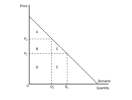 Refer to the graph shown. When the price is P1, consumer surplus
is
A.
A
B.
A+B
C.
A+B+C
D.
A+B+C+D
E.
A+B+C+D+E
Price Demand 01 Quantity
Refer to the graph shown. When the price is P1, consumer surplus
is
A.
A
B.
A+B
C.
A+B+C
D.
A+B+C+D
E.
A+B+C+D+E
Price Demand 01 Quantity
Price A B P2 F P1 G D Q2 Q, Q3 Quantity What is the area...
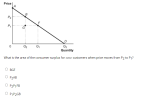 Price A B P2 F P1 G D Q2 Q, Q3 Quantity What is the area of the consumer surplus for new customers when price moves from P2 to P1? BGF OP2AB P2P1FB O P1P2GB
QUESTION 3 Figure Price Supply P K I P" P B M N Demand Quantity Refer...
 QUESTION 3 Figure Price Supply P K I P" P B M N Demand Quantity Refer to Figure. If the government imposes a tax size of P- P" in the above market then the area L+M+Y represents a. consumer surplus after the tax. producer surplus after the tax. Cconsumer surplus before the tax. producer surplus before the tax. QUESTION 4 4 point Figure Supply Dennd Quantity Q1 02 Q3 Q Qs Refer to Figure. If the government impose a tax...
Figure 9-11 Price Domestic Supply World Price Domestic Demand Quantity Refer to Figure 9.11. Consumer surplus in...
 Figure 9-11 Price Domestic Supply World Price Domestic Demand Quantity Refer to Figure 9.11. Consumer surplus in this market before trade is O a. A Ob. B+C O c. A+B+D. O d.c. Supply Demand Refer to Figure 7-21. Which area represents consumer surplus when the price is P1? O a. A O b.B ос. С To a.D
Q=100,000-10,000P solve for the consumer surplus at the equilibrium price and quantity Demand: Let the Market...
 Q=100,000-10,000P solve for the consumer surplus at the
equilibrium price and quantity
Demand: Let the Market Demand curve for soybeans be given by the following equation: Q=100,000 -10,000P where the quantity of soybeans in kilograms P = the price of soybeans in dollars per kilogram. Supply: Let the Market Supply curve for soybeans be given by the equation: Q=-5,000+ 5,000P 3) Consumer Surplus: The Consumer Surplus (CS) is the triangular area under the demand curve and above the equilibrium price....
Q=100,000-10,000P solve for the consumer surplus at the
equilibrium price and quantity
Demand: Let the Market Demand curve for soybeans be given by the following equation: Q=100,000 -10,000P where the quantity of soybeans in kilograms P = the price of soybeans in dollars per kilogram. Supply: Let the Market Supply curve for soybeans be given by the equation: Q=-5,000+ 5,000P 3) Consumer Surplus: The Consumer Surplus (CS) is the triangular area under the demand curve and above the equilibrium price....
According to the graph shown, if the price decreases from $22 to $16, consumer surplus would...
 According to the graph shown, if the price decreases from $22 to $16, consumer surplus would increase by Price $28 26 24 22 20 . 8 16 14 10 6 1 2 10 20 30 40 50 90 70 80 90 100 110 120 130 140 150 Quantity a. 120 b.360 c. 480 d. 600
Based on the graph shown here, how much is consumer surplus at the socially optimal price...
 Based on the graph shown here, how much is consumer surplus at the socially optimal price and quantity? That is, how much is consumer surplus, assuming a tax has been put in place to internalize the negative externality? Price ($) MSC $25 Supply (MPC) $15 $12 $8 Demand (MB) $2 50 100 Quantity O $25 $15 50 units $250 Ο Ο $175
Figure 7-2 1 Prive A N B c P2 D F Demand Decreto Q2 02 Refer...
 Figure 7-2 1 Prive A N B c P2 D F Demand Decreto Q2 02 Refer to Figure 7-2. When the price is P2, consumer surplus is OA B. A+B. A+B+C.
 Refer to the graph shown. An effective price floor at Pr causes consumer surplus to: Price Supply Pf Pe Pc Demand Q2 Q1 Q3 Quantity O change from areas C D F to areas B+C D O change from areas A -B-E to areas A B-C fall from areas C D+F to areaD fall from areas A B E to area A.
 Refer to the graph shown. When the price is P1, consumer surplus
is
A.
A
B.
A+B
C.
A+B+C
D.
A+B+C+D
E.
A+B+C+D+E
Price Demand 01 Quantity
Refer to the graph shown. When the price is P1, consumer surplus
is
A.
A
B.
A+B
C.
A+B+C
D.
A+B+C+D
E.
A+B+C+D+E
Price Demand 01 Quantity
 Price A B P2 F P1 G D Q2 Q, Q3 Quantity What is the area of the consumer surplus for new customers when price moves from P2 to P1? BGF OP2AB P2P1FB O P1P2GB
 QUESTION 3 Figure Price Supply P K I P" P B M N Demand Quantity Refer to Figure. If the government imposes a tax size of P- P" in the above market then the area L+M+Y represents a. consumer surplus after the tax. producer surplus after the tax. Cconsumer surplus before the tax. producer surplus before the tax. QUESTION 4 4 point Figure Supply Dennd Quantity Q1 02 Q3 Q Qs Refer to Figure. If the government impose a tax...
 Figure 9-11 Price Domestic Supply World Price Domestic Demand Quantity Refer to Figure 9.11. Consumer surplus in this market before trade is O a. A Ob. B+C O c. A+B+D. O d.c. Supply Demand Refer to Figure 7-21. Which area represents consumer surplus when the price is P1? O a. A O b.B ос. С To a.D
 Q=100,000-10,000P solve for the consumer surplus at the
equilibrium price and quantity
Demand: Let the Market Demand curve for soybeans be given by the following equation: Q=100,000 -10,000P where the quantity of soybeans in kilograms P = the price of soybeans in dollars per kilogram. Supply: Let the Market Supply curve for soybeans be given by the equation: Q=-5,000+ 5,000P 3) Consumer Surplus: The Consumer Surplus (CS) is the triangular area under the demand curve and above the equilibrium price....
Q=100,000-10,000P solve for the consumer surplus at the
equilibrium price and quantity
Demand: Let the Market Demand curve for soybeans be given by the following equation: Q=100,000 -10,000P where the quantity of soybeans in kilograms P = the price of soybeans in dollars per kilogram. Supply: Let the Market Supply curve for soybeans be given by the equation: Q=-5,000+ 5,000P 3) Consumer Surplus: The Consumer Surplus (CS) is the triangular area under the demand curve and above the equilibrium price....
 According to the graph shown, if the price decreases from $22 to $16, consumer surplus would increase by Price $28 26 24 22 20 . 8 16 14 10 6 1 2 10 20 30 40 50 90 70 80 90 100 110 120 130 140 150 Quantity a. 120 b.360 c. 480 d. 600
 Based on the graph shown here, how much is consumer surplus at the socially optimal price and quantity? That is, how much is consumer surplus, assuming a tax has been put in place to internalize the negative externality? Price ($) MSC $25 Supply (MPC) $15 $12 $8 Demand (MB) $2 50 100 Quantity O $25 $15 50 units $250 Ο Ο $175
 Figure 7-2 1 Prive A N B c P2 D F Demand Decreto Q2 02 Refer to Figure 7-2. When the price is P2, consumer surplus is OA B. A+B. A+B+C.
Most questions answered within 3 hours.
-
Where is the error in this code sequence?
String s1 = "Hello";
String s2 = "ello";...
asked 10 months ago -
Financial data for Joel de Paris, Inc., for last year
follow:
Joel de Paris, Inc.
Balance...
asked 10 months ago -
Consider this reaction:
Al2(SO4)3 (aq)+ BaCl3
(aq) Al2Cl6 (aq)- +
3BaSO4(s) . What is the...
asked 10 months ago -
Suppose that Savneet is considering increasing her
recent random sample from 20 car rentals to 40...
asked 10 months ago -
Trucks arrive at an unloading terminal at an average rate of 120
per hour.
Trucks arrive...
asked 10 months ago -
Why are methanol and ethanol completely soluble in water while
octanol is not very little soluble....
asked 10 months ago -
A facilities manager at a university reads in a research report
that the mean amount of...
asked 10 months ago -
When the CuSO4 is rehydrated by adding water to the anhydrous
compound, is this an endothermic...
asked 10 months ago -
A ray of sunlight is passing from diamond into crown glass; the
angle of incidence is...
asked 10 months ago -
A block of mass 0.249 kg is placed on top of a light, vertical
spring of...
asked 10 months ago -
how do the kidneys compensate in the presences of acidosis
a) trigger hyperventilate
b) reserve acid...
asked 10 months ago -
Question 501 pts
The rental rate of capital to the firm increases. Which of the
following...
asked 10 months ago