
Homework Answers
ANSWER.
Activity /participation consideration for each disability diagnosis.
* Blindness - Visual teaching strategies may make learning new motor skills
or participation challenging.
* Cerebral palsy - Hemiplegia or weakness of one side of the body may require
modification for ball games.
* Deafness - Use of sign language(ASL) may make it hard to communicate with
professionals and peers.
* Autism spectrum disorder - Restricted or focused interests may make participation
in teacher chosen activities difficult.
* Spina bifida - Missing vertebra or unprotected spinal cord may make certain physical
activities unsafe.
* Down syndrome - Intellectual disability may require shorter or step instruction for new skills.
Add Answer to:
Using the ICF model, match the activity/participation consideration that may be needed given common characteristics or...
Considering the ICF model, match the body function/structure consideration that is common among or associated with...
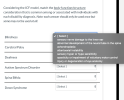 Considering the ICF model, match the body function/structure consideration that is common among or associated with individuals with each disability diagnosis. Note: each answer should only be used once but some may not be used at all. [Select] Blindness sensory nerve damage to the inner ear abnormal development of the neural tube in the spine achondroplasia atlantoaxial instability Cerebral Palsy sensory hyper or hypo sensitivity spasticity or impairment of voluntary motor control injury or degeneration of eye anatomy Deafness [Select]...
 Considering the ICF model, match the body function/structure consideration that is common among or associated with individuals with each disability diagnosis. Note: each answer should only be used once but some may not be used at all. [Select] Blindness sensory nerve damage to the inner ear abnormal development of the neural tube in the spine achondroplasia atlantoaxial instability Cerebral Palsy sensory hyper or hypo sensitivity spasticity or impairment of voluntary motor control injury or degeneration of eye anatomy Deafness [Select]...
Most questions answered within 3 hours.
-
Where is the error in this code sequence?
String s1 = "Hello";
String s2 = "ello";...
asked 10 months ago -
Financial data for Joel de Paris, Inc., for last year
follow:
Joel de Paris, Inc.
Balance...
asked 10 months ago -
Consider this reaction:
Al2(SO4)3 (aq)+ BaCl3
(aq) Al2Cl6 (aq)- +
3BaSO4(s) . What is the...
asked 10 months ago -
Suppose that Savneet is considering increasing her
recent random sample from 20 car rentals to 40...
asked 10 months ago -
Trucks arrive at an unloading terminal at an average rate of 120
per hour.
Trucks arrive...
asked 10 months ago -
Why are methanol and ethanol completely soluble in water while
octanol is not very little soluble....
asked 10 months ago -
A facilities manager at a university reads in a research report
that the mean amount of...
asked 10 months ago -
When the CuSO4 is rehydrated by adding water to the anhydrous
compound, is this an endothermic...
asked 10 months ago -
A ray of sunlight is passing from diamond into crown glass; the
angle of incidence is...
asked 10 months ago -
A block of mass 0.249 kg is placed on top of a light, vertical
spring of...
asked 10 months ago -
how do the kidneys compensate in the presences of acidosis
a) trigger hyperventilate
b) reserve acid...
asked 10 months ago -
Question 501 pts
The rental rate of capital to the firm increases. Which of the
following...
asked 10 months ago